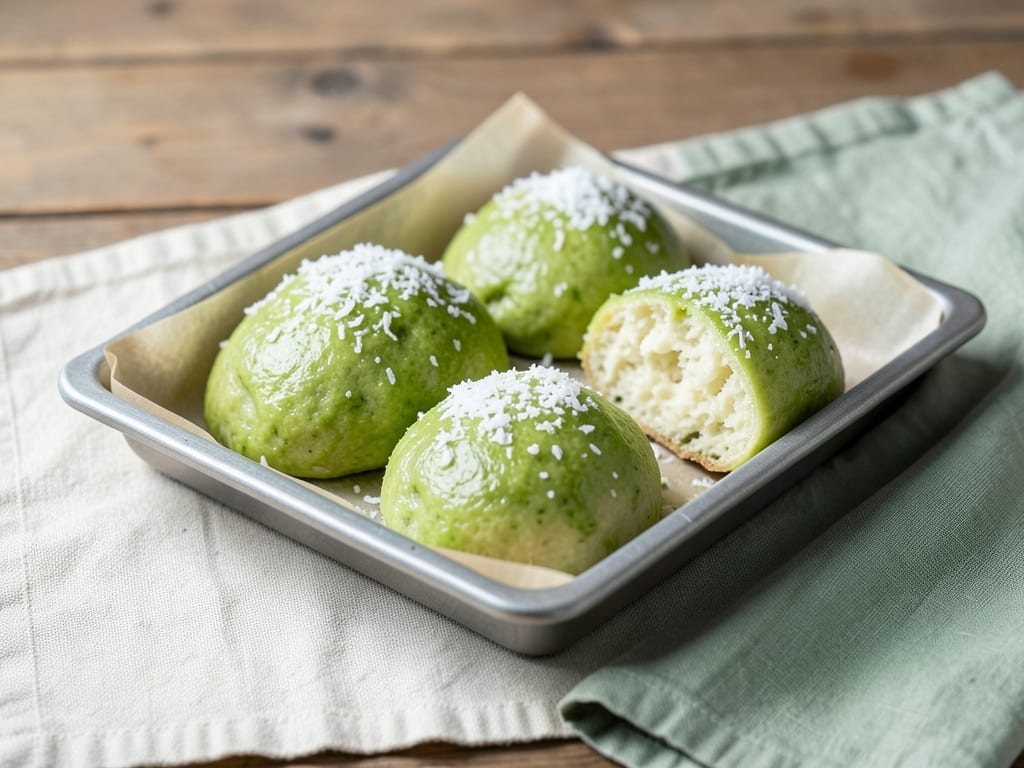
Thai Coconut Pandan Buns
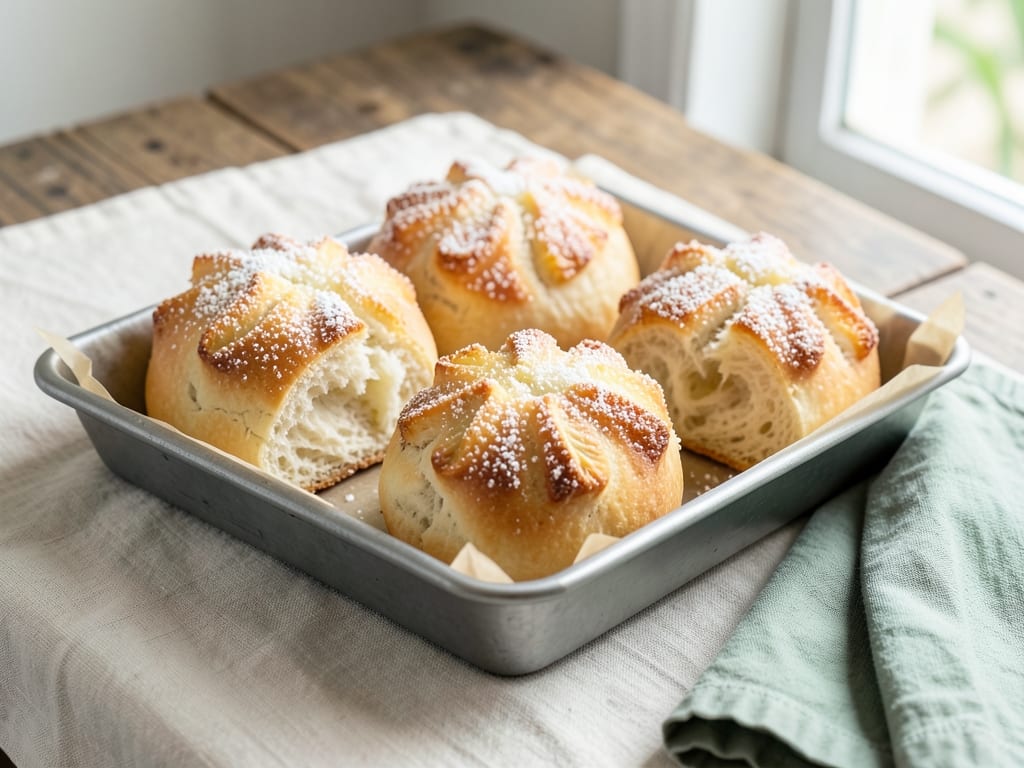
Light, fragrant sweet buns infused with the tropical green of pandan and enriched with coconut milk. Topped with shredded coconut and baked until golden, these pillowy buns are perfect for breakfast, tea time, or dessert.
- Prep
- 40 min
- Cook
- 25 min
- Wait
- 2 hr 30 min
- Total
- 3 hr 35 min
- Makes
- 12 buns
Steps
Before you start
- Bring eggs to room temperature (1 hour ahead)
- Have all ingredients measured and ready (mise en place)
- Preheat oven to 375°F (190°C) once the second rise begins
Combine dry ingredients
- In a large bowl, combine 500g all-purpose flour, 7g instant yeast, 50g granulated sugar, and 6g kosher salt.
- Whisk together thoroughly until the yeast is evenly distributed throughout (2–3 minutes).
- No streaks of yeast should be visible.
+ Show details− Hide details
Ready when: Mixture is uniform and combined, no streaks of yeast visible
Tip: Whisking the yeast throughout the flour helps it distribute evenly and improves rising.
Prepare wet ingredients
- In a small bowl, whisk together 40g melted unsalted butter, 2 large eggs (at room temperature), 240ml coconut milk, 20g pandan paste, and 5ml vanilla extract (if using).
- Whisk for 1–2 minutes until smooth and well combined.
- The pandan will give the mixture a light green color; there should be no visible lumps of paste.
+ Show details− Hide details
Ready when: Liquid is uniform in color and smooth, no lumps of pandan visible
Tip: Room-temperature eggs and melted butter mix together smoothly and integrate better into the dough.
Combine wet and dry
- Make a well in the center of the dry ingredients.
- Pour the green wet mixture into the well.
- Using a wooden spoon, stir from the center outward, gradually incorporating the flour, until a shaggy dough forms (2–3 minutes).
- All flour should be moistened; the dough will look rough and lumpy but no dry streaks should remain.
+ Show details− Hide details
Ready when: All flour is incorporated, no dry streaks visible
Tip: Don't overmix at this stage; you will knead the dough next, which develops gluten.
Knead until smooth and elastic
- Turn the dough onto a lightly floured work surface.
- Knead for 8–10 minutes: push the dough away from you with the heel of your hand, fold it back toward you, turn it a quarter turn, and repeat.
- The dough is ready when it's smooth, elastic, and springs back slowly when poked—it should feel moist and slightly soft but not sticky.
- If it's very sticky, dust with a small amount of flour (1 tbsp at a time) as you knead.
+ Show details− Hide details
Ready when: Dough is smooth, elastic, and holds its shape; springs back halfway when poked with a finger
Tip: If the dough is very sticky, knead in additional flour 1 tbsp at a time. Keep it slightly soft for the best crumb texture.
First rise
- Transfer the kneaded dough to a lightly oiled bowl, turning it to coat all sides.
- Cover the bowl with a damp cloth or plastic wrap.
- Let it rise at room temperature for 1 to 1.5 hours, or until the dough has roughly doubled in volume.
- You can test readiness by gently poking the dough with a floured finger—the indent should slowly spring back about halfway.
+ Show details− Hide details
Ready when: Dough has roughly doubled in size; poke indent springs back about halfway
Tip: Rising time varies with room temperature; warmer kitchens proof faster. Don't exceed 2 hours or the dough may overproof.
Shape into buns
- Punch down the dough gently to release gas (don't completely deflate—you want to keep some air).
- Divide the dough into 12 equal pieces (approximately 80g each using a kitchen scale).
- Roll each piece into a tight ball by cupping it between your hands and rolling gently in a circular motion until the surface is taut and smooth.
- Arrange the balls in a greased 9×13-inch (23×33 cm) baking pan in three rows of four, spacing them about 2 inches (5 cm) apart so they have room to expand.
+ Show details− Hide details
Ready when: 12 evenly sized balls arranged in pan with even spacing
Tip: Shape the buns tightly to trap air and create a tender crumb; loose shaping leads to dense buns.
Second riseOven 375°F / 190°C
- Cover the pan with a damp cloth.
- Let the buns rise at room temperature for 45–60 minutes until they are puffy and nearly touching each other.
- During the last 15 minutes of the rise, preheat the oven to 375°F (190°C).
+ Show details− Hide details
Ready when: Buns are puffy and nearly touching; they spring back slowly when gently poked
Tip: If your kitchen is cool, the second rise may take longer; proof in a warm spot (like near a warm oven) if needed.
Brush and top buns
- Just before baking, brush the top of each bun generously with the beaten egg wash (beat 1 remaining large egg with 1 tablespoon water).
- Sprinkle each bun with approximately ½ teaspoon sweetened shredded coconut, dividing evenly among the 12 buns.
- Optional: add a light pinch of brown sugar to a few buns for extra sweetness.
+ Show details− Hide details
Ready when: All buns are glazed and topped with coconut
Tip: Apply egg wash gently and evenly to avoid overworking the risen dough.
Bake until goldenOven 375°F / 190°C
- Bake at 375°F (190°C) for 20–25 minutes, until the tops are golden brown and a skewer inserted into the center of a bun comes out clean with no wet dough clinging to it.
- The edges may brown slightly faster than the centers; if browning too quickly, loosely tent the pan with aluminum foil for the last 5 minutes.
+ Show details− Hide details
Ready when: Tops are golden brown; skewer inserted into center comes out clean with no wet dough
Tip: All ovens vary; check at 20 minutes, then every 2 minutes until done.
Cool and serve
- Using a spatula, transfer the buns to a wire cooling rack immediately after removing from the oven.
- They can be served warm or at room temperature.
- The buns are best enjoyed fresh, within 1–2 hours of baking, while still slightly warm.
- Serve as-is or with a spread of butter or jam.
+ Show details− Hide details
Ready when: Buns are warm to touch and set enough to handle without breaking
Tip: If the buns stick to the pan, warm the pan slightly on a low burner to release them easily.
Good to know
Tips
- Pandan paste can be found in Southeast Asian markets or online; check the ingredient list to ensure it's pure pandan with no added fillers or excess sugar.
- Don't let the first rise go too long (beyond 2 hours); overproofing creates a thick crust and dense crumb.
- For even bun sizes, use a kitchen scale to divide the dough into 12 equal pieces (approximately 80g each) for consistent baking.
- The buns are fully baked when they sound hollow if you tap the bottom gently.
Make ahead
Dough can be mixed and proofed up to 1 day ahead. After the first rise, punch down, cover, and refrigerate overnight. The next day, bring to room temperature (1–2 hours), then shape, proof, and bake as directed. Alternatively, shape the buns, cover, and freeze them unbaked in the pan. Bake directly from frozen, adding 8–10 minutes to the baking time.
Storage & reheating
Room temperature: 2–3 days in an airtight container. Refrigerator: Up to 5 days in an airtight container; refresh in a 300°F (150°C) oven for 5 minutes before serving. Freezer: Up to 3 months; wrap cooled buns individually in plastic wrap or place in a freezer bag. Thaw at room temperature for 1–2 hours, then warm in a 300°F (150°C) oven for 5 minutes.
Substitutions
- pandan paste → Fresh pandan leaves (30–35 leaves). Rinse and tear leaves, blend with ¼ cup water, strain through a fine sieve. Use 1 cup of the resulting liquid in place of pandan paste and reduce coconut milk from 240ml to 180ml.
- pandan paste → Pandan powder. Use 1–2 tsp pandan powder mixed with ¼ cup warm water before adding to dough. Note: powder will not provide the bright green color of paste or fresh leaves.
- full-fat canned coconut milk → Whole milk plus coconut extract. Replace coconut milk with 240ml whole milk and add ¼ tsp coconut extract. The buns will taste slightly less coconutty but still delicious.
- instant yeast → Active dry yeast. Use 10g active dry yeast instead of instant; it may require an additional 15–20 minutes of rising time. Whisk it with the flour to distribute evenly.