Hong Kong Pineapple Buns
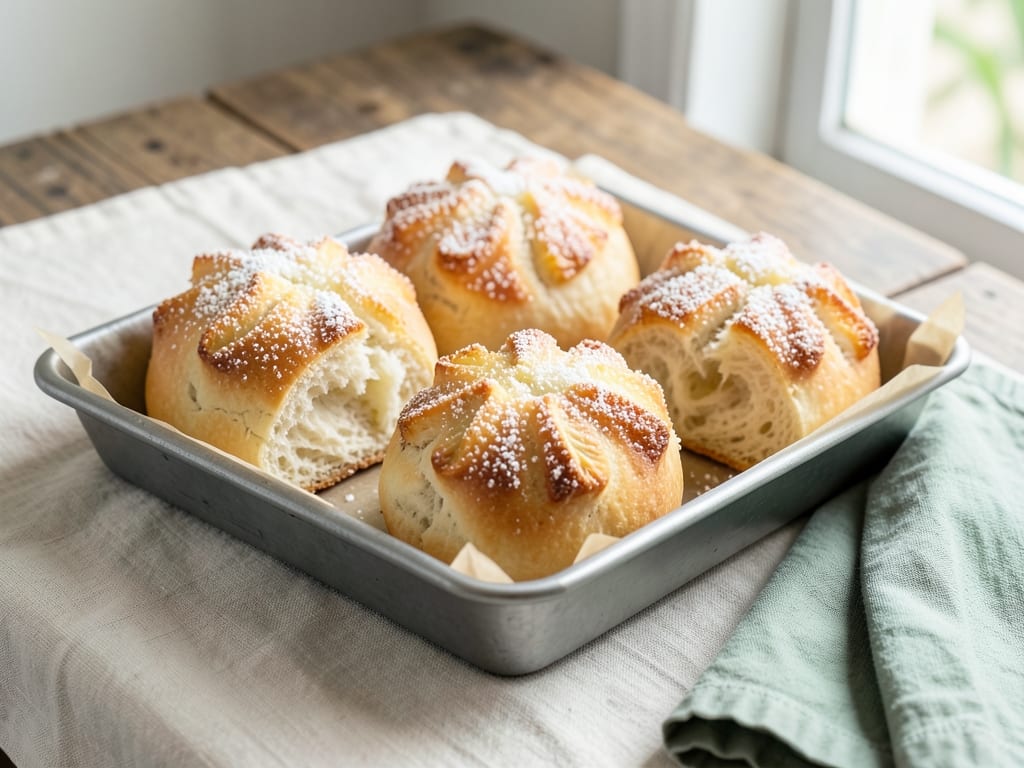
Hong Kong pineapple buns (菠蘿包) are soft, fluffy yeast buns crowned with a crispy, buttery sugar-flour topping. The 'pineapple' refers to the cracked pattern adorning the top, not the flavor—which is purely sweet and buttery. These are a beloved dim sum staple; the contrast between the tender, enriched crumb and the shattering crisp topping is irresistible warm from the oven.
- Prep
- 30 min
- Cook
- 20 min
- Wait
- 2 hr 15 min
- Total
- 3 hr 5 min
- Makes
- 12 buns
Steps
Before you start
- Soften the butter for the dough 1 hour ahead to room temperature (65–70°F / 18–21°C); keep the topping butter cold.
- Warm the milk to 110°F (43°C) and bring the egg to room temperature about 30 minutes before starting.
- Read the entire recipe to understand the two rising periods; total time is about 3 hours.
- Preheat the oven 15 minutes before the second rise is complete.
Mix the dough
- In a stand mixer bowl, combine the flour, yeast, sugar, and salt.
- Add the warm milk and whole egg.
- Mix on medium speed for 3–4 minutes until shaggy and fully hydrated.
- Gradually add the softened butter a few pieces at a time, mixing for 3–4 minutes until fully incorporated.
- The dough should be smooth, soft, and slightly tacky (not sticky), pulling away from the bowl sides.
- It will be glossy with no floury streaks.
+ Show details− Hide details
Ready when: Dough is smooth, elastic, and glossy; no floury streaks visible.
Tip: Add butter gradually in pieces; if not fully incorporated before adding the next piece, the dough will look separated and greasy instead of silky.
First rise (bulk fermentation)
- Transfer the dough to a lightly oiled bowl.
- Cover loosely with plastic wrap.
- Let rise at room temperature (68–72°F / 20–22°C) for 60–90 minutes until roughly doubled in volume.
- The dough should be puffy and soft; a gentle poke will leave a slow-closing indentation.
+ Show details− Hide details
Ready when: Dough is roughly double its original size; gentle poke leaves an indentation that closes slowly.
Tip: In a cool kitchen (under 70°F / 21°C), the rise may take up to 2 hours. In a warm kitchen (above 75°F / 24°C), watch closely to prevent over-proofing.
Prepare the pineapple topping
- While the dough rises, prepare the topping: In a small bowl, combine the flour, sugar, and salt for the topping.
- Add the cold cubed butter, egg yolk, and vanilla extract.
- Using a fork or your fingertips, work the mixture for 4–5 minutes, starting by breaking up the butter (until it resembles coarse breadcrumbs) and continuing until it comes together into a soft, crumbly paste that holds together when pressed.
- If too dry, add milk a few drops at a time.
+ Show details− Hide details
Ready when: Mixture is crumbly but cohesive; it holds together when squeezed but breaks apart easily.
Tip: Keep the butter very cold and work quickly. Overworking or warming the mixture makes it dense and oily instead of crispy and crumbly.
Shape the dough balls
- Turn out the risen dough onto a lightly floured surface.
- Divide into 12 equal pieces (about 52–55g each using a scale).
- Roll each piece into a tight ball by pulling the surface toward the bottom and pinching the seam underneath.
- Arrange seam-side down on a parchment-lined baking sheet, spacing them 2–2.5 inches apart.
+ Show details− Hide details
Ready when: Balls are round and tight with a seam underneath.
Tip: Don't overwork the dough; gentle handling maintains the air and creates tender buns. Handle them as little as possible.
Apply the pineapple topping
- Divide the topping evenly among the 12 buns, placing about 1 tablespoon (15 ml) on each center.
- Gently spread and press to cover most of the surface with a thin, even layer (don't compress the dough underneath).
- Using the back of a knife, fork, or a toothpick, score the topping in a crosshatch or hashtag pattern (about 1/4 inch / 0.5 cm apart), mimicking a pineapple's exterior.
- The topping will look crumbly—this is correct.
+ Show details− Hide details
Ready when: Topping is evenly distributed and scored in a pattern; no large gaps show the dough beneath.
Tip: Don't press hard or you'll compress the dough. Light pressure is key. Cracking as the bun rises is natural and desirable for the pineapple appearance.
Proof the topped buns
- Cover the baking sheet loosely with plastic wrap.
- Let rise at room temperature for 30–45 minutes until the buns are noticeably puffy and about 1.5 times their original size.
- The topping will begin to crack—this is expected and creates the signature pineapple look.
- A gentle press with your finger leaves a slow-closing indentation.
+ Show details− Hide details
Ready when: Buns are visibly puffed and light; gentle press with a finger leaves a slow-closing indentation.
Tip: Don't over-proof; if they rise too long, the topping cracks excessively and the crumb can become airy or collapse.
Bake until goldenOven 400°F / 205°C
- Preheat the oven to 400°F (200°C) about 15 minutes before baking.
- Remove the plastic wrap.
- Place the baking sheet on the center rack and bake for 18–20 minutes until the pineapple topping is deep golden brown and crispy, and the bun bottoms are light golden.
- The buns will smell sweet and fragrant.
- The topping will have darkened and cracked further with a shattered, craggy appearance.
+ Show details− Hide details
Ready when: Topping is deep golden brown and crispy; light tap on the bottom of a bun sounds hollow.
Tip: If the topping browns too quickly before the buns puff fully, lightly tent the sheet with foil for the first 10 minutes, then remove to finish browning.
Cool before serving
- Remove the baking sheet from the oven.
- Let the buns cool on the sheet for 10 minutes as the crumb sets and the topping firms.
- Transfer to a wire cooling rack and cool for an additional 20–30 minutes.
- They can be eaten warm or at room temperature.
- The topping's crispness is best enjoyed within the first few hours.
+ Show details− Hide details
Ready when: Buns are warm to the touch but not hot; the topping is crispy.
Tip: Reheating: wrap in foil and warm at 300°F (150°C) for 10–15 minutes, or microwave a single bun for 20–30 seconds (topping will soften slightly).
Good to know
Tips
- Use a stand mixer with a dough hook for best results. Hand-mixing requires vigorous kneading for 8–10 minutes and strong forearms; it's doable but more laborious.
- Room temperature is crucial for rise times. In a cool kitchen (under 70°F / 21°C), extend all rises by 25–50%. In a warm kitchen (above 78°F / 26°C), reduce by 15–25% to prevent over-proofing.
- The 'pineapple' name refers to the cracked pattern on top, not the flavor. For a classic appearance, score the topping before the second rise so the pattern becomes more pronounced as the bun expands beneath.
- Keep the topping butter cold and work quickly. Cold butter creates a crispy, crumbly topping. Warm butter produces a dense, cake-like texture. Chill your tools if needed in a very warm kitchen.
Make ahead
The pineapple topping can be made 1 day ahead and refrigerated in an airtight container; let it come to room temperature before using. Shaped, unrisen buns can be frozen on a baking sheet, transferred to a freezer bag, and kept for up to 3 weeks—thaw at room temperature and proceed with the second rise and baking.
Storage & reheating
Room temperature: up to 2 days in an airtight container (best the first day). Refrigerator: up to 4 days, tightly covered (topping may soften slightly). Freezer: up to 3 weeks, individually wrapped in plastic wrap, then placed in a freezer bag. Reheat wrapped in foil at 300°F (150°C) for 10–15 minutes, or microwave for 20–30 seconds per bun.
Substitutions
- Whole milk → Water or coconut milk. Water creates a very plain-flavored bun. Coconut milk adds subtle sweetness and richness. Both work well and let the buttery topping shine.
- Instant yeast (or bread yeast) → Active dry yeast (1.25 tsp / 4g) or fresh yeast (0.6 oz / 17g). If using dry yeast, mix into the warm milk and let sit 5 minutes to activate. Fresh yeast requires 30–50% longer rising times.
- Unsalted butter → Vegetable oil (1.5 tbsp / 23 ml). Oil produces a slightly softer, less rich crumb. The buns will have a more tender, less buttery texture.
- Vanilla extract → Omit entirely, or use almond extract (1/4 tsp / 1 ml). Traditional pineapple buns skip vanilla. Almond extract adds a subtle hint that complements the buttery topping elegantly.