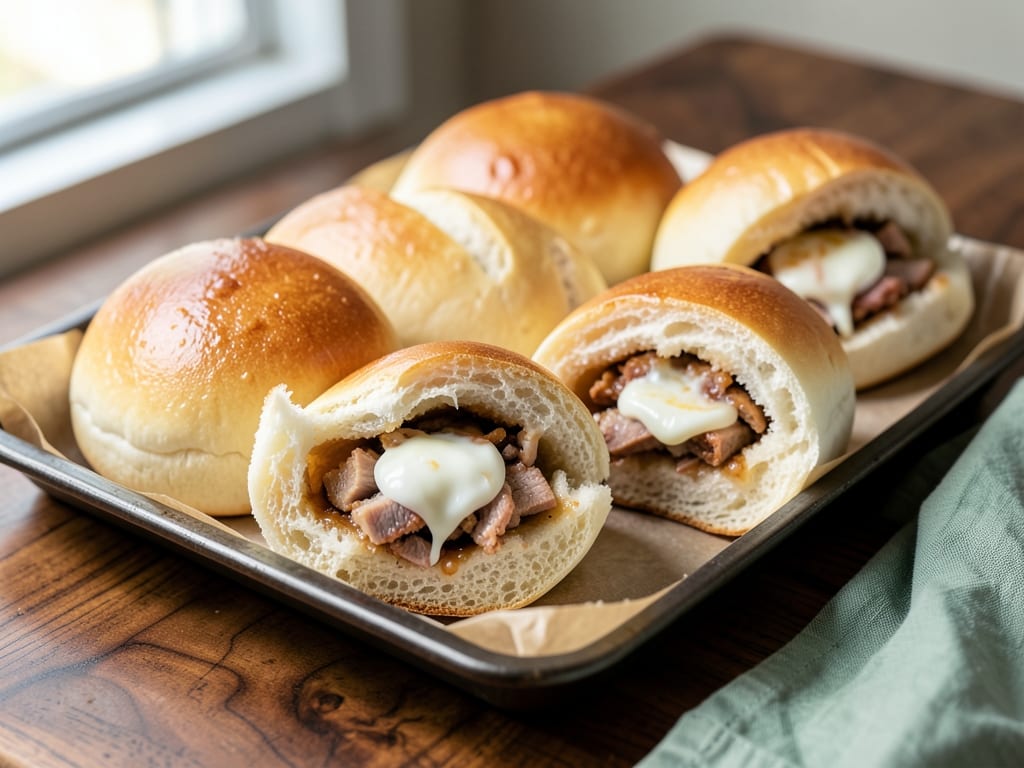
Baked Char Siu Bao
Fluffy, pillowy baked buns filled with sweet and savory char siu pork. These Chinese-style buns feature a tender yeasted dough encasing a honey-glazed filling of slow-cooked pork shoulder spiced with five-spice powder, hoisin, and aromatic garlic and ginger. Unlike steamed bao, these are baked until deep golden brown for a light, airy interior and lightly crispy exterior. Perfect for breakfast, lunch, or as a dim sum-style snack.
- Prep
- 1 hr
- Cook
- 25 min
- Wait
- 2 hr 10 min
- Total
- 3 hr 35 min
- Makes
- 8-10 baked buns
Steps
Before you start
- Bring milk to 110°F (43°C) warm and have the egg at room temperature for proper dough development
- Preheat oven to 375°F (190°C) before shaping buns in step 5
- Line baking sheets with parchment paper ahead of time
- Prepare a work surface for shaping and have a damp towel ready to cover buns between shaping
Mix and knead dough
- In a large mixing bowl, combine the flour, sugar, salt, and instant yeast.
- Create a well in the center and add the warm milk, room-temperature egg, and 1 tablespoon sesame oil.
- Mix with a wooden spoon or your hands until a shaggy dough forms.
- Sprinkle the softened butter over the dough and knead by hand on a lightly floured surface or in a stand mixer with dough hook for 8-10 minutes by hand (6-8 minutes in a mixer) until the dough is smooth, elastic, and slightly sticky.
- It should spring back slowly when poked.
+ Show details− Hide details
Ready when: Dough is smooth, elastic, slightly sticky, springs back slowly when poked
Tip: Ensure the milk is warm (about 110°F/43°C) to activate the yeast, but not hot or you'll kill it. The dough should be soft and slightly sticky—if it's too dry, add 1 tablespoon water; if too wet, add 1 tablespoon flour.
First rise until doubled
- Shape the dough into a ball.
- Place it in a lightly greased large bowl, turning the dough to coat it lightly on all sides.
- Cover the bowl with a damp kitchen towel or plastic wrap.
- Let the dough rise at room temperature (68-72°F / 20-22°C) for 60 minutes until doubled in size.
- Test doneness by gently poking the dough with a floured finger—if the indentation stays slightly indented without springing back completely, it's ready.
+ Show details− Hide details
Ready when: Dough has doubled in size, poke test shows indentation stays slightly indented
Tip: If your kitchen is warm (above 75°F), the dough may rise faster—check at 45 minutes. If cool, it may take longer.
Cook pork until tenderOven 160°F / 70°C
- While the dough rises, prepare the filling.
- Cut the pork shoulder into 2-inch chunks.
- Place the pork chunks in a medium-large saucepan and add 4 cups of water (should come to about 1 inch above the pork).
- Add the minced garlic and minced fresh ginger to the water.
- Bring to a boil over medium-high heat, skimming off any foam that rises to the surface (about 5 minutes).
- Once foam stops forming, reduce heat to medium-low and simmer, partially covered, for 30-40 minutes until the pork is very tender and shreds easily with two forks.
- The internal temperature should reach at least 160°F (71°C).
+ Show details− Hide details
Ready when: Pork is very tender and shreds easily with two forks, internal temperature reaches 160°F (71°C)
Tip: Don't skip skimming the foam—it removes impurities and makes the broth clearer. The pork must be very tender for proper shredding; if still firm after 40 minutes, continue cooking.
Shred pork and make sauce
- Drain the cooked pork in a colander, reserving 1/4 cup of the cooking liquid.
- Once cool enough to handle (about 5 minutes), shred the pork with two forks into fine strands about 1/8-inch thick.
- Heat 1 teaspoon sesame oil in a medium saucepan over medium heat.
- Add the shredded pork and stir briefly.
- Add the soy sauce, hoisin sauce, oyster sauce, honey, and five-spice powder.
- Pour in the reserved 1/4 cup cooking liquid.
- Stir well and simmer over medium-low heat for 5-7 minutes, stirring occasionally, until the sauce thickens and becomes glossy and coats the pork evenly.
- The filling should look relatively dry, not wet or soupy.
- Taste and adjust seasoning if desired.
- Transfer to a plate and cool completely to room temperature (about 20-30 minutes) before using.
+ Show details− Hide details
Ready when: Sauce is glossy and coats the pork, filling looks relatively dry; cooled to room temperature
Tip: Do not skip cooling—warm filling will soften the dough and make shaping difficult. The filling can be made up to 2 days ahead and refrigerated.
Shape and fill bunsOven 375°F / 190°C
- Preheat your oven to 375°F (190°C).
- Turn the risen dough out onto a lightly floured work surface and gently deflate it with your hands—press gently without punching.
- Divide the dough into 8-10 equal pieces (each about 50-55g).
- Using your hands, shape each piece into a loose ball, covering the others with a damp towel.
- With the palm of your hand or a rolling pin, gently flatten one dough ball into a thin disk about 3-4 inches in diameter.
- Place 2 tablespoons (about 30g) of cooled filling in the center.
- Fold the edges of the dough up and around the filling, gathering them at the top, then twist gently to seal.
- Place the bun seam-side down on a parchment-lined baking sheet, spacing them about 2 inches apart.
- Repeat with remaining dough and filling.
+ Show details− Hide details
Ready when: Buns are evenly shaped, sealed, and spaced 2 inches apart
Tip: Divide the dough into even pieces using a kitchen scale if possible—this ensures even baking. The filling must be completely cool or it will warm and soften the dough.
Second proof until puffy
- Cover the shaped buns loosely with a damp kitchen towel or plastic wrap, ensuring it doesn't stick to the dough.
- Let the buns proof at room temperature for 30-40 minutes until noticeably puffy and jiggly when the baking sheet is gently shaken.
- They should increase in size by about 50% and feel light when lifted.
+ Show details− Hide details
Ready when: Buns are puffy, jiggly when sheet is shaken, increased in size by about 50%
Tip: Over-proofing is common—watch for light, airy buns that still hold their shape. If buns become too soft and puffy, they may burst during baking. Slightly under-proofed is better than over-proofed.
Apply egg wash and bakeOven 375°F / 190°C
- Mix the egg yolk with 1 tablespoon water in a small bowl, stirring until well combined.
- Once the buns have finished proofing and your oven is preheated to 375°F (190°C), gently brush the top of each bun with the egg wash using a soft pastry brush, applying just enough to coat evenly.
- Place the baking sheets in the oven and bake at 375°F (190°C) for 20-25 minutes until the tops are deep golden brown.
- You should smell the aroma of baking bread and honey after about 15 minutes.
- The buns are done when the tops are a rich golden brown, not pale.
+ Show details− Hide details
Ready when: Tops are deep golden brown, aromatic, not pale
Tip: If your oven bakes unevenly, rotate the baking sheets halfway through for more uniform browning. Avoid opening the oven door during the first 15 minutes.
Cool and serve
- Remove the baked buns from the oven and let them cool on the baking sheets for 5-10 minutes, allowing the structure to set while still warm.
- Transfer the buns to a wire rack to cool further.
- Serve warm or at room temperature.
- The buns are best enjoyed within a few hours of baking but will stay fresh for 1-2 days in an airtight container at room temperature.
+ Show details− Hide details
Ready when: Buns are set but still warm, can be handled without falling apart
Tip: Warm buns are softest and most enjoyable. You can reheat cooled buns wrapped in foil at 300°F (150°C) for 10-15 minutes.
Good to know
Tips
- Do not skip cooling the filling completely before filling the buns—warm filling will soften the dough and make it hard to shape and seal.
- Use a kitchen scale if you have one to divide the dough into equal pieces; this ensures all buns proof and bake at the same rate and develop uniform color.
- The poke test is reliable for checking dough doneness: gently poke the dough with a floured finger; if the indentation stays indented (doesn't spring back), it's ready.
- Over-proofing is the most common mistake—watch for light, puffy buns that still hold their shape. Slightly under-proofed buns are better than ones that burst or deflate in the oven.
Make ahead
The filling can be made 2-3 days ahead and stored in an airtight container in the refrigerator. Shaped (unbaked) buns can be frozen up to 2 weeks: place them on a baking sheet to freeze for 2 hours, then transfer to a freezer bag. Thaw at room temperature (2-3 hours), then proof and bake as directed. Baked buns can be frozen up to 1 month wrapped individually in plastic wrap and then foil; reheat from frozen at 300°F (150°C) wrapped in foil for 20-25 minutes.
Storage & reheating
Room temperature: Store in an airtight container for 1-2 days. Serve at room temperature or reheat wrapped in foil at 300°F (150°C) for 10-15 minutes. Refrigerator: Store in an airtight container for 3-4 days; reheat as above. Freezer: Wrap individually in plastic wrap then foil, or store in an airtight container, for up to 1 month. Reheat from frozen at 300°F (150°C) wrapped in foil for 20-25 minutes.
Substitutions
- pork shoulder → Ground pork (1 lb / 450g). Cook in the saucepan with garlic and ginger over medium-high heat until browned (8-10 minutes), stirring frequently. Drain excess fat if needed. Proceed directly to making sauce, reducing the added water to 2 tablespoons instead of 1/4 cup. Flavor will be similar; texture will be finer.
- hoisin sauce → Soy sauce (1.5 tablespoons) + ketchup (1 tablespoon) + molasses (1/4 teaspoon). Combine these three ingredients to approximate hoisin's sweet-savory flavor. If molasses is unavailable, use 1/2 teaspoon brown sugar instead.
- sesame oil → Neutral oil such as vegetable, canola, or peanut oil. Use the same amounts. The sesame oil's nutty aroma will be missing, but the buns will still be delicious.
- Chinese five-spice powder → Ground cinnamon (1/4 teaspoon) + ground cloves (1/4 teaspoon) + ground fennel (1/4 teaspoon). Or use 3/4 teaspoon ground allspice as a quick substitute. The flavor profile will be slightly different but still aromatic and warming.
More rolls & buns
See all →
Find more like this
- Meal
- Brunch
- Cuisine
- Cantonese
- Main ingredient
- Pork Shoulder