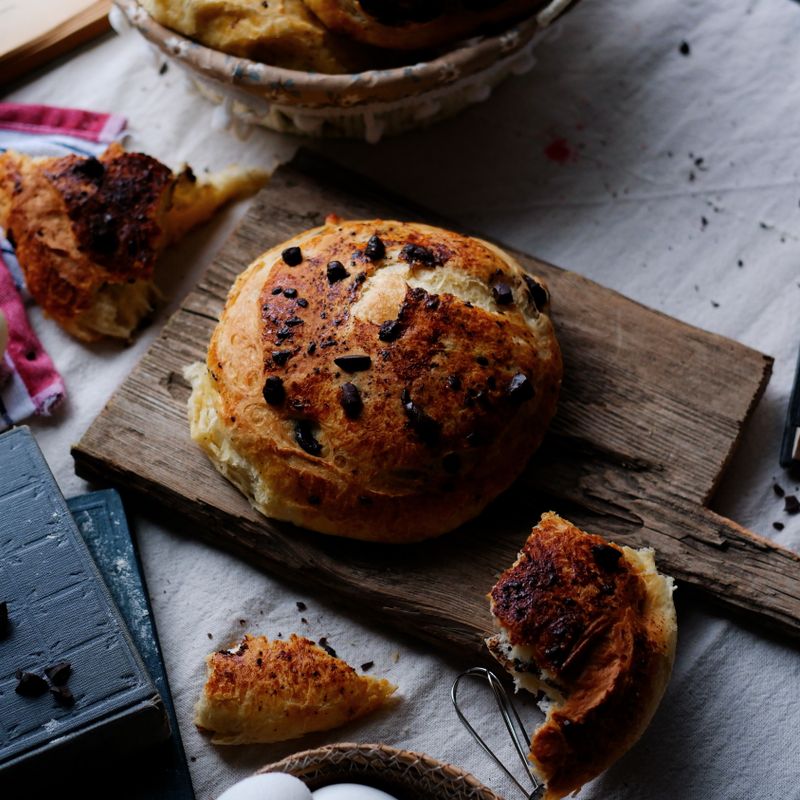
Spanish Bollo de Huevo: Savory Egg Bread with Anise
A classic Spanish Castilian savory bread enriched with eggs and lard, subtly flavored with anise seeds. The dough is tender and slightly sweet, baked until golden with a soft crust. Traditionally served for breakfast or as an accompaniment to savory meals. This bollo has a fine, even crumb and keeps well for several days.
- Prep
- 25 min
- Cook
- 35 min
- Wait
- 2 hr 30 min
- Total
- 3 hr 30 min
- Makes
- 1 loaf (8 slices)
Steps
Before you start
- Read through the entire recipe—bulk fermentation and final rise take about 2.5 hours total
- Have all ingredients at room temperature before mixing, especially eggs and lard
- Measure flour by weight if possible for the most consistent results
- Preheat your oven to 375°F (190°C) about 15 minutes before the final bake
Mix the dough base
- In a large mixing bowl, combine the bread flour, instant yeast, salt, and sugar.
- In a separate small bowl, whisk together the warm water (80–90°F / 27–32°C) and the lightly beaten eggs.
- Pour the wet mixture into the dry ingredients and stir with a wooden spoon or the dough hook of a stand mixer on low speed for about 2 minutes until the dry flour is fully incorporated and a shaggy dough forms.
- The dough will look somewhat wet and sticky.
+ Show details− Hide details
Ready when: All dry flour is hydrated and a rough, sticky dough forms
Tip: Do not overmix at this stage; let the autolyse rest happen next.
Autolyse rest
- Cover the bowl with a damp kitchen towel or plastic wrap.
- Let the dough rest undisturbed for 15 minutes at room temperature.
- This allows the flour to fully hydrate and makes the gluten development easier in the next step.
+ Show details− Hide details
Tip: This short rest significantly improves dough extensibility and final texture.
Incorporate lard and anise
- Resume mixing on low to medium speed (or by hand with a sturdy wooden spoon).
- Add the softened lard in 3 small additions, mixing for about 30 seconds between each addition until it is fully incorporated.
- The dough will be sticky.
- Once the lard is fully mixed in, add the lightly crushed anise seeds and mix for another minute until evenly distributed.
- The dough should be smooth, slightly wet, and glossy.
+ Show details− Hide details
Ready when: Lard and anise are fully distributed; dough is smooth and glossy
Tip: Add lard gradually and only when dough is warm enough to accept it; if the lard is too cold, it won't incorporate smoothly.
Bulk fermentation
- Transfer the dough to a clean, lightly oiled bowl.
- Cover with a damp towel or plastic wrap.
- Let it rise at room temperature (68–75°F / 20–24°C) for about 90 minutes, until the dough has increased in volume by roughly 50–70% and springs back slowly when poked.
- The dough will look bubbly and feel soft but still hold some structure.
+ Show details− Hide details
Ready when: Dough increased by 50–70%; springs back slowly when poked
Tip: Temperature matters: too cold and fermentation will take much longer; too warm and the dough may overproof.
Shape and proof
- Lightly flour a work surface.
- Gently turn out the dough onto the surface and pre-shape it into a round with minimal handling, using a bench scraper to fold the sides toward the center.
- Let it rest for 10 minutes.
- Then, shape it into a boule (tight round) by pulling the dough toward you, rotating a quarter turn, and repeating 4–6 times.
- Alternatively, for a loaf, gently stretch the dough into a rough rectangle, fold the top third down and seal, fold the bottom third up and seal, roll it away from you into a log, and seal the seam.
- Place the shaped dough seam-side up in a proofing basket (banneton) or seam-side down in a lightly oiled 9×5-inch loaf pan.
+ Show details− Hide details
Ready when: Dough is evenly shaped with seams sealed
Tip: Handle the dough gently to retain the gas bubbles developed during bulk fermentation; rough handling will deflate it.
Final proofOven 375°F / 190°C
- Cover the shaped dough loosely with a damp towel or plastic wrap.
- Let it rise at room temperature for 45–60 minutes until the dough has increased in volume by about 50% and gently springs back slowly when you poke it with a floured finger.
- The dough should feel airy but still have some resistance.
- Preheat your oven to 375°F (190°C) about 15 minutes before the end of this proof.
+ Show details− Hide details
Ready when: Dough increased by ~50% and springs back slowly when poked
Tip: Do not let the dough overproof; if it rises too much, it may collapse in the oven and the crumb will be coarse.
Apply egg wash and score
- Gently brush the surface of the dough with a thin layer of beaten egg wash (or a mixture of 1 beaten egg with 1 tablespoon water).
- If desired, you can make a shallow score across the top with a sharp knife or lame, about ¼ inch deep, to help guide expansion.
- Some bakers skip the score and simply brush with egg wash for a smooth, domed top.
+ Show details− Hide details
Ready when: Egg wash is evenly applied
Tip: Apply egg wash right before baking for the best color and shine; brushing too early may cause it to dry unevenly.
BakeOven 375°F / 190°C
- Place the loaf in the preheated 375°F (190°C) oven for 30–35 minutes.
- The bollo should turn a deep golden brown on top and sound hollow when tapped on the bottom.
- The internal temperature should reach 205–210°F (96–99°C) when measured with an instant-read thermometer inserted into the center.
- If the top is browning too quickly, tent loosely with foil for the last 10 minutes.
+ Show details− Hide details
Ready when: Deep golden brown top; hollow sound when tapped; internal temp 205–210°F (96–99°C)
Tip: Every oven is different; start checking at 30 minutes. The bollo should have good oven spring and a nicely domed top.
Cool
- Transfer the loaf to a wire cooling rack.
- Let it cool for at least 20 minutes before slicing.
- The bollo will continue to set as it cools, and cutting too early will result in a gummy crumb.
- For the best flavor and texture, wait until it is completely cool, about 1 hour.
+ Show details− Hide details
Ready when: Bread is cool to the touch and internal structure has set
Tip: Do not slice while still warm; the interior is still setting and will tear rather than slice cleanly.
Good to know
Tips
- Lard is traditional in Spanish bollo de huevo and gives it a distinctive tender crumb and rich, slightly sweet flavor that butter cannot replicate. Look for pure, unrendered lard from a butcher or specialty store.
- The anise seeds should be lightly crushed to release their aromatic oils and distribute their flavor more evenly throughout the dough. Use the side of a knife or a mortar and pestle.
- Room temperature is crucial for consistent fermentation times. If your kitchen is cool (below 68°F / 20°C), the dough will ferment more slowly; if it is warm (above 75°F / 24°C), it may overproof. Adjust timing accordingly.
- This bollo is best enjoyed fresh or lightly warmed. It is traditionally served for breakfast with chocolate, café con leche, or as an accompaniment to savory meals. In Spain, it is often split and filled with jamón or eaten plain with a smear of butter or lard.
Make ahead
You can prepare the dough up to the end of the bulk fermentation (step 4), then refrigerate it overnight in a covered bowl. The next day, shape, proof, and bake as directed—the cold dough may take 60–90 minutes for the final proof depending on how cold it is. Alternatively, you can freeze shaped, unbaked dough in a freezer bag for up to 1 month; thaw overnight in the refrigerator before the final proof.
Storage & reheating
Room temperature: wrapped in a clean kitchen towel or paper bag for up to 3 days. Refrigerator: in an airtight container for up to 5 days; refresh by wrapping in foil and warming in a 350°F (175°C) oven for 10 minutes. Freezer: wrapped tightly in plastic wrap and foil for up to 2 months; thaw at room temperature for 2–3 hours or overnight in the refrigerator, then refresh in a 350°F oven if desired.
Substitutions
- pure lard (or rendered pork fat), at room temperature → unsalted butter, softened. Use the same weight. Butter will give a slightly lighter, less tender crumb than traditional lard, but the flavor will be pleasant. Avoid using oil, as it won't provide the same richness.
- anise seeds → fennel seeds or a mixture of fennel and caraway seeds. Use the same weight. Fennel has a similar licorice flavor but is slightly more muted; caraway adds an earthier note if you prefer less anise character.
- bread flour → all-purpose flour. Use the same weight. The bollo will be slightly less chewy and have a softer crumb, but will still bake successfully.
- instant yeast → active dry yeast. Use the same weight; hydrate it in the warm water for 5 minutes before adding to the dry ingredients, or simply add it directly and mix slightly longer.
More yeast breads
See all →
Find more like this
- Meal
- Breakfast
- Cuisine
- Spanish
- Main ingredient
- Eggs
- Diet
- Dairy-Free
- Method
- Oven