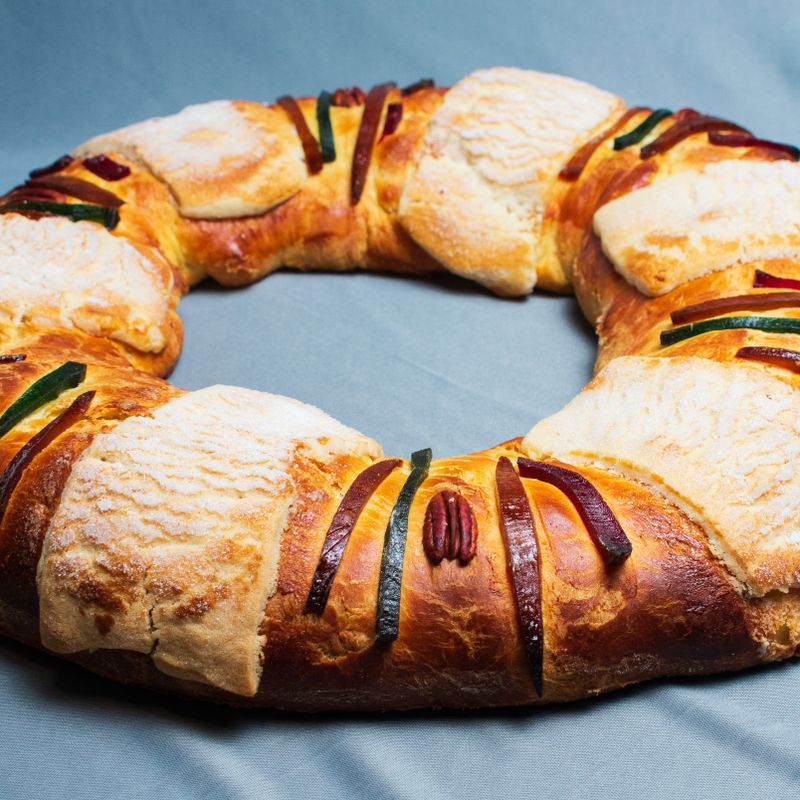
Spanish Rosca de Reyes with Hidden Charm
A traditional Spanish ring cake celebrate the Epiphany (January 6). This enriched dough is studded with candied fruit and whole almonds, perfumed with orange zest and warm spices, then glazed and crowned with more candied fruit. A small surprise—the "charm" (traditionally a tiny porcelain figurine or token)—is hidden inside before baking, a treasured find for whoever gets that slice.
- Prep
- 30 min
- Cook
- 40 min
- Wait
- 2 hr 30 min
- Total
- 3 hr 40 min
- Makes
- 1 ring cake (8 slices)
Steps
Before you start
- Bring eggs and butter to room temperature for 1 hour before starting
- If using a porcelain charm, wrap it tightly in food-grade plastic wrap to prevent breaking and ensure it is oven-safe
- Preheat oven to 375°F (190°C) 15 minutes before the second rise is complete
- Read through the full method—the dough needs two rises and the ring shape requires careful handling
Mix dough base
- In the bowl of a stand mixer, combine 3 cups (375 g) bread flour, 2 tsp (6 g) instant yeast, 1.5 tsp (9 g) salt, ½ cup (100 g) sugar, finely grated orange zest, ¼ tsp cinnamon, and 1/8 tsp nutmeg.
- In a separate small bowl, whisk together ¾ cup (180 ml) warm milk (110°F / 43°C) and 2 room-temperature eggs.
- Pour the wet ingredients into the dry ingredients and attach the dough hook.
- Mix on medium speed for 3 minutes until a shaggy dough forms.
+ Show details− Hide details
Ready when: Dough is shaggy and comes together
Tip: Warm milk speeds fermentation; water that is too hot will kill yeast, too cool will slow rising.
Add butter and knead
- With the mixer running on medium speed, add 4 tbsp (57 g) softened butter one tablespoon at a time, waiting a few seconds between additions.
- Continue kneading for 8–10 minutes until the dough is smooth, elastic, and slightly tacky.
- It should pull away from the bowl sides but stick a little to the bottom.
+ Show details− Hide details
Ready when: Dough is smooth, elastic, and springs back when poked
Tip: Add butter slowly so it fully incorporates; rushing causes a greasy dough.
Add fruit and almonds
- Stop the mixer and stir in ½ cup (85 g) chopped candied orange peel, ¼ cup (45 g) chopped candied citron, and ½ cup (60 g) whole blanched almonds using a wooden spoon or the mixer on low speed for 1–2 minutes.
- The fruit and nuts should be evenly distributed throughout.
+ Show details− Hide details
Ready when: Fruit and almonds are evenly distributed
Tip: Mix on low speed to avoid crushing the nuts and fruit, which should remain whole or in visible pieces.
First rise
- Transfer the dough to a lightly oiled large bowl, cover with a damp kitchen towel or plastic wrap, and let rise at room temperature (68–75°F / 20–24°C) for 60 minutes.
- The dough should increase by about half its original volume (not quite doubled).
- Push two fingers into the dough; if the indentation slowly springs back halfway, it is ready.
+ Show details− Hide details
Ready when: Dough has risen by about 50 percent and springs back slowly when poked
Tip: Avoid a warm draft (heating vents, sunny windowsills) which can cause uneven rising; a cool kitchen means the rise will take closer to 75 minutes.
Shape into ring
- Turn the dough out onto a lightly floured work surface.
- Gently pat it into a rough oval, then roll it into a rope about 20 inches (50 cm) long and 2 inches (5 cm) in diameter.
- Be gentle to avoid deflating trapped air.
- Join the two ends together, pinching firmly to seal, forming a ring.
- Transfer the ring to a parchment paper-lined baking sheet, spacing it so it has room to expand.
+ Show details− Hide details
Ready when: Ring is formed and seam is pinched closed
Tip: Handle the dough gently during shaping; aggressive kneading will deflate the carefully fermented bubbles.
Insert charm (optional) and second riseOven 375°F / 190°C
- If using a charm, carefully lift the ring and insert the wrapped charm into the side of the dough, pinching the dough closed around it so it is well hidden.
- Cover the ring loosely with plastic wrap or a towel and let it rise for 45–60 minutes at room temperature.
- It should increase in size noticeably and feel airy.
- Meanwhile, preheat the oven to 375°F (190°C) about 15 minutes before the second rise is complete.
+ Show details− Hide details
Ready when: Ring is noticeably larger and feels light and airy when gently pressed
Tip: The charm should be well wrapped and inserted so it doesn't contact raw dough; ensure it is food-safe and oven-proof.
Apply egg wash
- In a small bowl, whisk 1 large egg with 1 tbsp water.
- Brush the egg wash evenly over the entire ring using a pastry brush, making sure to coat the top and sides without pooling in crevices.
+ Show details− Hide details
Ready when: Ring is evenly coated with a light glaze
Tip: Use a light hand with the egg wash; too much will create pools that may prevent even browning.
BakeOven 375°F / 190°C
- Place the baking sheet in the preheated 375°F (190°C) oven.
- Bake for 38–42 minutes until the ring is deep golden brown, particularly on the top and sides.
- The bottom should also be a rich golden color.
- A skewer inserted into the thickest part should come out clean and hot.
- If the top is browning too quickly after 20 minutes, loosely tent with foil.
+ Show details− Hide details
Ready when: Ring is deep golden brown on top and bottom, skewer comes out clean and hot
Tip: Do not open the oven in the first 25 minutes; the sudden temperature drop can collapse the dough. If the top browns too quickly, tent with foil.
Cool slightly
- Remove the baking sheet from the oven and let the ring cool on the sheet for 8–10 minutes so it firms up enough to handle.
- Transfer the ring to a wire rack and let it cool to warm (not hot) before glazing, about 15–20 minutes.
+ Show details− Hide details
Ready when: Ring is still warm to the touch but no longer steaming
Tip: Glazing a too-hot cake will cause the glaze to run off; glazing when too cool will make it thick and dull.
Make glaze
- While the ring cools, combine ¾ cup (150 g) granulated sugar and 3 tbsp (45 ml) whole milk in a small saucepan over medium heat.
- Stir until the sugar dissolves completely and the mixture becomes smooth and glossy, about 2–3 minutes.
- Remove from heat and let it cool to just warm (about 110°F / 43°C) before using—the glaze should flow easily but not be scorching hot.
+ Show details− Hide details
Ready when: Sugar is completely dissolved and mixture is smooth
Tip: Do not boil the glaze; it will become grainy. Warm glaze flows best but cool enough not to soak into the warm cake.
Glaze and garnish
- Pour the warm glaze slowly over the top of the cooled ring, letting it flow down the sides naturally.
- Work quickly so the glaze sets evenly.
- While the glaze is still wet, press ¼ cup (45 g) candied orange peel strips and ¼ cup (30 g) blanched whole almonds onto the top of the ring in a decorative pattern, spacing them evenly around the cake.
- Let the glaze set for 30 minutes at room temperature.
+ Show details− Hide details
Ready when: Glaze has set to a firm, opaque coating
Tip: If the glaze hardens too quickly, gently rewarm it for 10–15 seconds over low heat before pouring; press garnishes onto the glaze before it fully hardens or they will slide off.
Good to know
Tips
- Wrap the charm securely in food-grade plastic wrap and confirm it is oven-safe (ceramic or porcelain) before inserting; never use plastic objects or anything that could leach chemicals when heated.
- For a deeper, more complex flavor, toast the blanched almonds in a dry skillet over medium heat for 3–4 minutes, stirring often, until fragrant. Cool before adding to the dough.
- The rosca is traditionally served on January 6 (Epiphany) with hot chocolate or coffee. Whoever receives the slice with the charm inside is said to have good luck for the year ahead—or, in some regions, is responsible for throwing the next party.
- If you do not have a ring mold, shape the dough into a ring freeform on the baking sheet, then use a small (2–3 inch / 5–8 cm) ovenproof bowl or ball of crumpled foil in the center to maintain the ring shape during rise and baking; remove before glazing.
Make ahead
The dough can be prepared up to step 4 (after the first rise), then covered and refrigerated overnight. The next morning, remove from the fridge, let it come to room temperature (about 30 minutes), then proceed with shaping and the second rise. The baked rosca (without glaze) will keep at room temperature for up to 2 days before glazing if you prefer to glaze it fresh closer to serving. Glazing is best done on the day of serving for the freshest appearance.
Storage & reheating
Room temperature: Store under a cake dome or loosely wrapped in foil for up to 3 days. The cake dries slightly but remains sweet. Refrigerator: Keep in an airtight container for up to 5 days; refresh by wrapping in foil and warming at 300°F (150°C) for 10 minutes. Freezer: Wrap the cooled, glazed rosca tightly in plastic wrap and then foil; freeze for up to 2 months. Thaw at room temperature for 2 hours, then refresh gently in a 300°F oven for 10 minutes if desired.
Substitutions
- candied orange peel → Candied citron, candied lemon peel, or a mix of dried apricots and dried cranberries, finely chopped. Candied citron has a slightly more bitter, aromatic flavor but works beautifully in this cake. Dried fruit should be roughly the same size (¼-inch pieces) for even distribution.
- blanched whole almonds → Blanched whole hazelnuts, blanched whole macadamia nuts, or roasted whole pistachios (unsalted). Any whole nut will work; avoid crushed or sliced nuts as they may break during mixing and affect texture. Pistachios add a striking green speckle.
- bread flour → All-purpose flour (use the same weight, 375 g, or 3 cups plus 2 tbsp). All-purpose flour has slightly less protein, so the dough may be a touch softer and the crumb slightly more tender. The rise time may be 10 minutes shorter.
- orange zest → Finely grated zest of 1 lemon, or 1 tsp orange extract mixed with 1 tsp water. Lemon zest adds bright acidity; extract provides flavor but lacks the floral aromatics of fresh zest. If using extract, reduce slightly as it is potent.