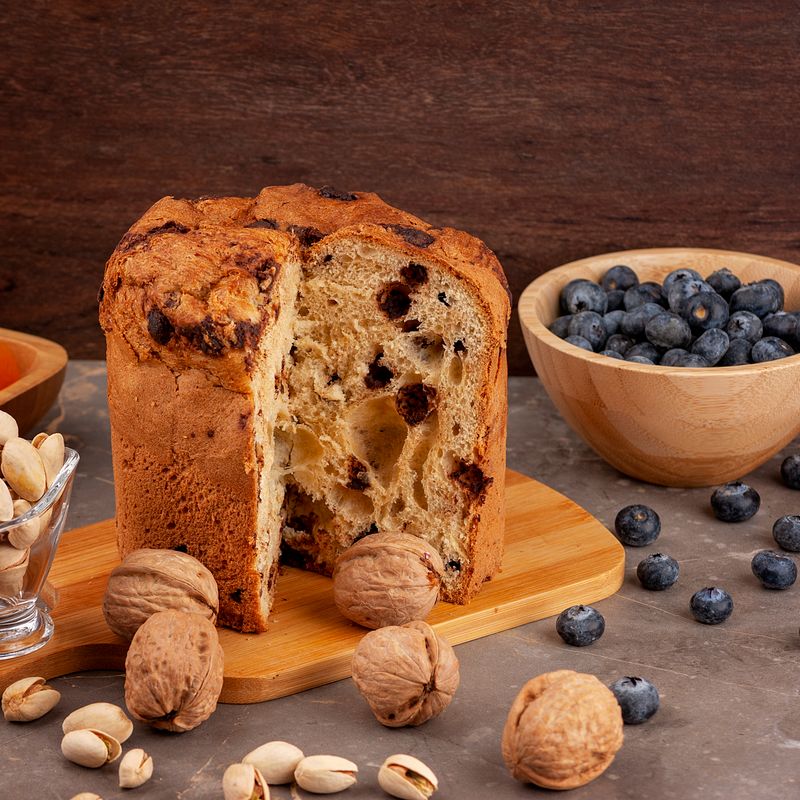
Italian Panettone Sweet Bread with Dried Fruit
A classic Italian panettone—a tall, dome-topped sweet bread studded with candied citrus peel, plump raisins, and infused with vanilla and a whisper of liqueur. The dough undergoes multiple rises to develop a delicate, feathery crumb and is enriched with eggs and butter. Traditionally baked in tall paper molds, panettone's aroma and golden color make it a showstopper for the holiday table. Plan ahead: this takes two full days, including overnight fermentation and final proofing.
- Prep
- 45 min
- Cook
- 50 min
- Wait
- 21 hr
- Total
- 22 hr 35 min
- Makes
- 1 panettone (12–14 slices)
Steps
Before you start
- Have all ingredients at room temperature (70–75°F / 21–24°C); cold butter and eggs will split the dough
- Prepare candied citrus peel and raisins: soak raisins in 2 tablespoons warm water with 1 tablespoon brandy or rum for 30 minutes; drain well before use
- Use a panettone mold (3¾-inch / 9.5 cm diameter, 4¾-inch / 12 cm height) or improvise with a tall straight-sided vessel lined with parchment paper; have parchment ready to line the mold before the dough rises
- Read the full recipe—the multiple rises and folds are essential for the open crumb structure
Mix the preferment (poolish)
- In a small bowl, whisk together 70 g (½ cup + 1 tablespoon) bread flour, 2 teaspoons instant yeast, and 1 tablespoon granulated sugar.
- Add 80 ml (⅓ cup) lukewarm water (75–80°F / 24–27°C) and stir until combined.
- The mixture will be thick and rough.
- Cover loosely with plastic wrap and let sit at room temperature (68–72°F / 20–22°C) for 12–16 hours.
- It will become bubbly, frothy, and rise significantly.
+ Show details− Hide details
Ready when: Preferment is bubbly, risen, and smells yeasty and slightly fruity
Tip: The long fermentation builds flavor and creates a more tender crumb. Don't skip or shorten this step.
Combine dough base
- In a large mixing bowl or stand mixer bowl, add the bubbling preferment.
- Add the remaining 270 g (1¾ cups + 1 tablespoon) bread flour, 4 egg yolks (from the 4 separated eggs), 1 additional egg yolk, 35 g (2¾ tablespoons) granulated sugar, 6 g (1 teaspoon) fine sea salt, 2.5 ml (½ teaspoon) vanilla extract, and 22 ml (1½ tablespoons) brandy.
- Do not add the egg whites or butter yet.
- Using the dough hook on medium speed (or mixing by hand), combine for 5–6 minutes until shaggy and beginning to come together.
- The dough will look sticky.
+ Show details− Hide details
Ready when: Dough is cohesive but rough and sticky, beginning to pull away from bowl sides
Tip: Ensure all ingredients are at room temperature to prevent the dough from becoming too warm or cold, which inhibits gluten development.
Build the dough (first phase)
- Add the softened butter to the dough in 3–4 small pieces, one piece at a time.
- Keep the mixer on medium speed, allowing each piece to fully incorporate (1–2 minutes) before adding the next.
- The dough will look greasy and loose at first but will tighten as you knead.
- After all butter is in, continue mixing for 8–10 minutes on medium speed until the dough is silky, elastic, and pulls away cleanly from the bowl sides but still sticks very slightly to the bottom.
- The dough temperature should reach 76–80°F (24–27°C).
+ Show details− Hide details
Ready when: Dough is silky, elastic, and barely sticks to the bowl bottom; windowpane test: a small piece stretched very thin is translucent and doesn't tear
Tip: Add butter too quickly and the dough may become greasy and fail to develop gluten. Patience here yields a tender, open crumb.
Fold in egg whites and leavening
- With the mixer on low speed, add the 4 reserved egg whites one at a time, waiting 20–30 seconds between each addition.
- The dough will look loose and slick after each white is added but will tighten after a few seconds of mixing.
- After all whites are incorporated, mix on medium speed for 2–3 minutes more.
- The dough should look shiny, smooth, and very slightly glossy but not oily.
- It will be soft and sticky—this is correct.
+ Show details− Hide details
Ready when: Dough is silky and glossy, springs back slowly when poked, and holds a very soft indent
Tip: Egg whites add moisture and richness; adding them after butter ensures they don't inhibit gluten development.
First rise (bulk fermentation)
- Transfer the soft dough to a lightly oiled 5–6 quart bowl.
- Cover with plastic wrap and let rise at room temperature (70–72°F / 21–22°C) for 1½ to 2 hours, until the dough has increased by about 50% in volume and jiggles slightly when the bowl is moved.
- The dough will remain soft and sticky and may not look dramatically different—this is normal for a rich dough.
+ Show details− Hide details
Ready when: Dough has risen 50%, feels airy when pressed, and jiggles in the bowl
Tip: Rich doughs like panettone rise more slowly than lean doughs; patience and accurate temperature control are key.
Fold in dried fruit and candied peel
- Gently fold the dried, well-drained raisins and candied citrus peel into the dough using a bench scraper or the dough hook on the lowest speed.
- Work the fruit in gently over 3–4 minutes, folding the dough over itself, until the fruit is distributed evenly.
- Try not to deflate the dough.
- Some fruit pieces may break, but that's fine.
- The dough will remain very soft and sticky.
- If the dough becomes too warm during folding, let it rest for 5 minutes before continuing.
+ Show details− Hide details
Ready when: Fruit is evenly distributed throughout the dough; no clumps of raisins or peel remain visible
Tip: Folding gently preserves the air bubbles developed during fermentation. Overmixing will make the panettone dense.
Second rise (proofing in mold)
- Line a panettone mold (3¾ × 4¾ inches / 9.5 × 12 cm, or similar tall vessel) with parchment paper, allowing 1–2 inches to extend above the rim.
- Gently transfer the dough to the mold—it should fill about one-third to halfway up the sides.
- Cover loosely with plastic wrap or a damp kitchen towel and let rise at room temperature (70–72°F / 21–22°C) for 3–4 hours, until the dough has risen to about 1 inch below the top of the mold and feels airy and pillowy when gently pressed.
- The dough should spring back slowly but not completely.
+ Show details− Hide details
Ready when: Dough has risen to 1 inch below the mold rim, feels light and airy, and springs back slowly when poked
Tip: Do not overproof—the dough should not rise above the mold rim before baking or it will collapse in the oven. Check at 3 hours and cover with foil if rising too quickly.
Shape and final proof (overnight cold)
- Once the dough has risen in the mold, cover it with plastic wrap and refrigerate at 38–40°F (3–4°C) for 12–16 hours.
- The cold retardation allows the crumb structure to stabilize and the flavors to deepen.
- The dough will not rise further in the cold but may rise slightly when removed.
+ Show details− Hide details
Ready when: Dough is chilled and firm to the touch but not rock hard
Tip: The overnight cold rest is optional but highly recommended—it improves flavor and gives you flexibility in timing. You can bake the next morning.
Remove from cold and final riseOven 375°F / 190°C
- Remove the panettone from the refrigerator 1–2 hours before baking.
- Let it come to room temperature (around 70°F / 21°C) on the counter.
- The dough may rise slightly during this time.
- Preheat the oven to 375°F (190°C) for at least 15 minutes before baking.
+ Show details− Hide details
Ready when: Dough is at room temperature and may have risen slightly
Tip: Bringing the dough to room temperature prevents the outside from baking too fast and the inside from remaining underbaked.
Brush and top
- Gently brush the top of the dough with 21 g (1½ tablespoons) melted butter.
- If using pearl sugar, sprinkle 20 g (1½ tablespoons) evenly over the buttered top.
- Score the top with a shallow cross (¼ inch deep) using a sharp knife if desired, to encourage even rising.
+ Show details− Hide details
Ready when: Top is evenly buttered and topped with pearl sugar (if using)
Tip: Pearl sugar is optional but traditional; it adds crunch and beauty. Do not press it into the dough or it will sink.
Bake the panettoneOven 375°F / 190°C
- Place the mold on a baking sheet and carefully slide into the preheated oven at 375°F (190°C).
- Bake for 40–50 minutes, until the top is deep golden brown and a wooden skewer inserted into the center comes out with just a few moist crumbs (not wet dough).
- The internal temperature should reach 205–210°F (96–99°C).
- If the top is browning too quickly, tent loosely with aluminum foil after 25–30 minutes.
- The panettone will puff up and rise slightly above the mold rim.
+ Show details− Hide details
Ready when: Top is deep golden brown; skewer inserted into center comes out with a few moist crumbs; internal temperature is 205–210°F (96–99°C)
Tip: A panettone can appear underbaked when it's actually done—look for golden color and feel for a firm dome at the top. Underbaking is better than overbaking; the crumb will firm as it cools.
Cool and rest
- Remove the panettone from the oven and let it cool in the mold for 10 minutes.
- Invert the panettone onto a wire rack and peel away the parchment paper.
- Let it cool completely at room temperature for at least 4 hours, preferably overnight, before slicing.
- As it cools, the interior will firm up and the flavors will stabilize.
+ Show details− Hide details
Ready when: Panettone is completely cool to the touch and feels firm on the outside with a slight give on the sides; no steam rises when inverted
Tip: Do not slice warm panettone—it will crumble. Patience here is rewarded with clean slices and perfect texture.
Slice and serve
- Using a serrated or thin sharp knife, slice the cooled panettone vertically into 12–14 slices, wiping the knife clean between cuts with a damp cloth.
- Serve at room temperature with a glass of sweet wine (Moscato d'Asti), hot chocolate, or espresso.
- Panettone is traditionally enjoyed in the morning or as a dessert.
+ Show details− Hide details
Ready when: Slices are clean and the crumb is open, moist, and golden with visible fruit pieces
Tip: A serrated knife works better than a straight blade. If the panettone crumbles, try a cold, thin-bladed knife or wait for the panettone to warm slightly.
Good to know
Tips
- Panettone is a two-day project due to the overnight preferment and final cold proof. Plan accordingly and don't rush the rises—they build flavor and crumb structure.
- Temperature control is critical: keep the kitchen at 68–75°F (20–24°C) during rises. A cool room slows fermentation (use a proofing box or warm spot like a turned-off oven with the light on); a warm room speeds it up. Adjust rise times accordingly.
- The dough will feel very soft and sticky at all stages—this is normal and expected. Panettone dough is far richer and softer than typical bread dough. Do not add extra flour; trust the process.
- A panettone mold is a tall, narrow cylinder designed to encourage vertical rise and develop the characteristic dome. Paper panettone molds are inexpensive and traditional. If you don't have one, improvise with a tall, straight-sided heat-proof vessel (like a coffee can or large straight-sided jar) lined with parchment, but ensure it's at least 4 inches tall.
Make ahead
Panettone is best made 2–3 days ahead to allow flavors to meld and the crumb to mature slightly. Store wrapped at room temperature. It can also be made 1–2 weeks ahead and refrigerated, or frozen for up to 3 months. Thaw overnight at room temperature before serving.
Storage & reheating
Room temperature (68–72°F / 20–22°C): Wrap cooled panettone tightly in plastic wrap or parchment, then place in an airtight container. Keeps for 5–7 days. Flavor actually improves over the first 2–3 days. Refrigerator (38–40°F / 3–4°C): Wrap tightly and store for up to 2 weeks; bring to room temperature before serving. Freezer: Wrap tightly in plastic wrap and then foil; freeze for up to 3 months. Thaw overnight at room temperature on the counter. Reheat: Slice and warm gently in a 300°F (150°C) oven for 5–8 minutes to revive moisture, or enjoy at room temperature with warm beverages.
Substitutions
- candied citrus peel (orange and citron), diced → Candied orange peel alone, or a mix of candied lemon peel and orange peel. Use the same total weight (180 g). Pure candied citron peel is traditional but harder to find; orange peel is more accessible and equally delicious.
- golden or dark raisins → Golden raisins, Corinth raisins (currants), or a mix of raisins and dried cranberries. Use the same total weight (130 g). Darker raisins will slightly darken the crumb; currants add a subtle tartness. Soak and drain as directed.
- brandy or dark rum → Dark rum, cognac, or omit entirely and use 22 ml water or additional vanilla extract. The brandy adds warmth and complexity; the alcohol bakes off. Use a quality spirit if including. The panettone is lovely without alcohol—omit if preferred.
- unsalted butter, at room temperature → High-fat butter (at least 82% butterfat) or European-style butter. Extra-creamy butter enriches the dough and improves flavor and color. Standard 80% butter works fine; avoid margarine or butter blends.
More yeast breads
See all →
Find more like this
- Meal
- Dessert
- Cuisine
- Italian
- Diet
- Vegetarian
- Method
- Oven
- Quick & Easy
- Make Ahead
- Occasion
- Christmas