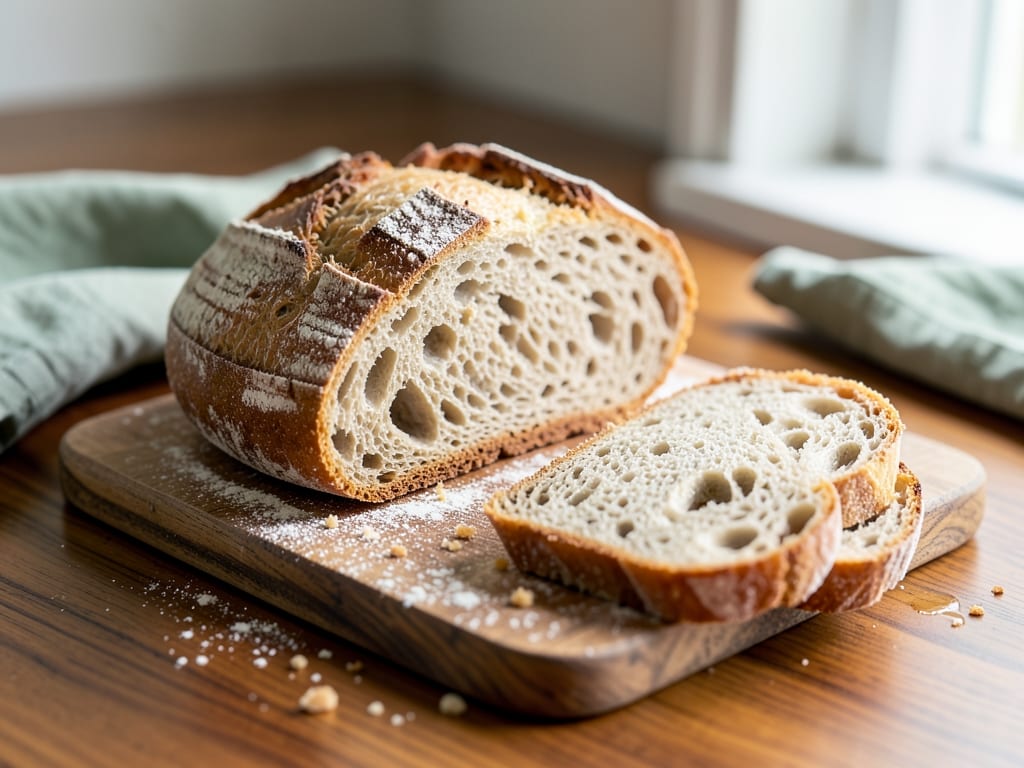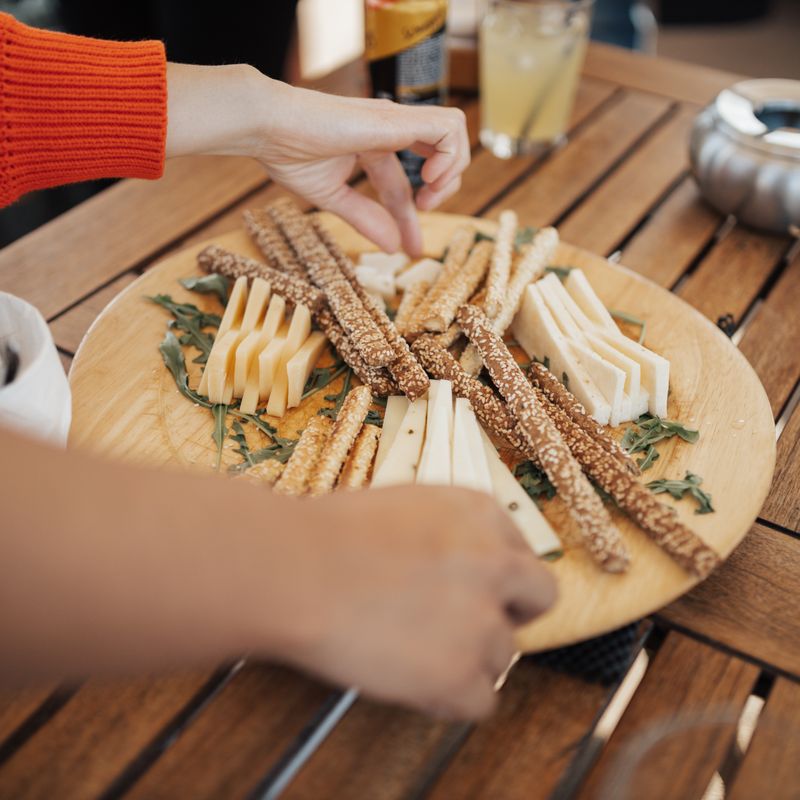
Vegan Sourdough Olive and Fennel Seed Breadsticks
Crispy, elongated breadsticks made from tangy sourdough dough studded with briny olives and warm fennel seeds. These Italian-inspired sticks are perfect for snacking, serving with dips, or alongside soup. The sourdough fermentation develops complex flavor, while the fennel adds subtle anise notes and the olives provide bursts of salty richness. Completely vegan and made with simple pantry staples.
- Prep
- 25 min
- Cook
- 25 min
- Wait
- 3 hr
- Total
- 3 hr 50 min
- Makes
- 12 breadsticks (about 8 inches / 20 cm each)
Steps
Before you start
- Ensure your sourdough starter is fed and at peak activity (bubbly and doubling in 4–8 hours) before starting
- Pit and coarsely chop the olives ahead of time
- Preheat your oven to 425°F (220°C) about 15 minutes before the final proof ends
- Line two large baking sheets with parchment paper
Mix the dough
- In a large bowl, combine the active sourdough starter, lukewarm water, bread flour, and fine sea salt.
- Use a wooden spoon or your hand to mix until all flour is hydrated and no dry bits remain, about 2–3 minutes.
- The dough will be shaggy and slightly sticky.
- Let it rest for 20 minutes (this is called autolyse).
+ Show details− Hide details
Ready when: All flour hydrated; dough is cohesive but rough
Tip: Don't knead yet—the 20-minute rest makes the next step easier
Incorporate olives and fennel
- After the rest, drizzle the 15 ml olive oil over the dough.
- Wet your hands and perform 4–5 sets of stretch-and-folds: grab one side of the dough, stretch it up and fold it over the center, rotate the bowl 90°, and repeat.
- After 2 sets, scatter the chopped olives and toasted fennel seeds over the dough and continue with 2–3 more stretch-and-folds to distribute them evenly.
- The dough will become smoother and more elastic.
+ Show details− Hide details
Ready when: Dough is smooth, elastic, and olives/fennel are distributed throughout
Tip: Wet hands prevent sticking during stretch-and-folds; work gently to avoid tearing the dough
Bulk fermentation
- Cover the bowl with a damp kitchen towel or plastic wrap.
- Let the dough ferment at room temperature (68–72°F / 20–22°C) for 3 hours.
- Perform one more set of stretch-and-folds at the 1.5-hour mark.
- The dough is ready when it's risen about 50–75% in volume, jiggles slightly when you shake the bowl, and passes the poke test: poke it gently with a floured finger—the indent should slowly spring back about halfway.
+ Show details− Hide details
Ready when: Dough has risen 50–75%, jiggles, and poke indent slowly springs back halfway
Tip: Warmer rooms shorten fermentation time; cooler rooms extend it. Adjust to fit your schedule
Shape the breadsticks
- Turn the dough onto a lightly floured work surface.
- Gently stretch it into a rough rectangle about 12×8 inches (30×20 cm).
- Using a bench scraper or sharp knife, cut the dough into 12 strips of roughly equal width (about 1 inch / 2.5 cm wide).
- Working with one strip at a time, gently roll it on the countertop under your palms, starting from the center and working outward, to extend it to about 8 inches (20 cm) long.
- The breadstick should be thin, even, and slightly tapered at the ends.
+ Show details− Hide details
Ready when: 12 breadsticks, each 8 inches long and evenly shaped
Tip: Don't overwork the dough or the gluten will tighten; roll gently with light pressure
Arrange on baking sheets
- Place the shaped breadsticks on two prepared baking sheets lined with parchment paper, spacing them about 1 inch (2.5 cm) apart.
- They'll expand slightly during the final proof.
- Cover loosely with a damp kitchen towel.
+ Show details− Hide details
Ready when: Breadsticks are arranged with even spacing
Tip: Leave room between sticks so they don't stick together during proofing
Final proofOven 425°F / 220°C
- Let the breadsticks proof at room temperature for 45 minutes to 1 hour.
- They should look slightly puffy and feel light when you pick one up.
- Unlike a full loaf, breadsticks don't need to double in size—just 30–40% rise is enough.
- Toward the end of this time, preheat your oven to 425°F (220°C).
+ Show details− Hide details
Ready when: Breadsticks are slightly puffy and spring back slowly when pressed
Tip: Don't overproof or they'll collapse in the oven; a light poke should leave a slow-closing indent
Brush and season
- Gently brush each breadstick with the 10 ml olive oil.
- If using fleur de sel, sprinkle a tiny pinch over each stick.
- Be restrained—the olives and salt in the dough already provide plenty of seasoning.
+ Show details− Hide details
Ready when: Breadsticks are lightly coated and optionally seasoned
Tip: Reserve a little olive oil if you like—you can drizzle breadsticks after baking for extra richness
Bake until goldenOven 425°F / 220°C
- Place both baking sheets in the preheated 425°F (220°C) oven.
- Bake for 22–26 minutes, rotating the sheets halfway through (at about 12 minutes), until the breadsticks are deep golden brown and crispy on the outside.
- They should sound hollow when tapped on the bottom and feel light in your hand.
+ Show details− Hide details
Ready when: Deep golden brown, hollow when tapped, light and crispy
Tip: Rotate sheets at the midpoint to ensure even browning; oven hot spots vary, so watch for color
Cool and serve
- Transfer the breadsticks to a wire rack to cool for at least 10 minutes before serving.
- They'll continue to crisp up as they cool.
- Serve at room temperature with dips such as hummus, romesco sauce, or herbed olive oil.
+ Show details− Hide details
Ready when: Breadsticks are crispy throughout and cool enough to handle
Tip: Don't skip the cooling—breadsticks that are still warm will be chewy; cooling firms them up
Good to know
Tips
- Toast the fennel seeds in a dry skillet over medium heat for 1–2 minutes until fragrant, then cool completely. Toasting brings out their warm, slightly sweet anise flavor and prevents them from becoming hard and bitter in the oven.
- Use a kitchen scale for accurate measurements—by weight, sourdough becomes much more reliable. If measuring by volume, spoon flour into a measuring cup and level off; don't scoop directly into the bag.
- The poke test is your best guide for fermentation doneness. Poke the dough gently with a floured finger about ½ inch deep; if the indent springs back fully, it needs more time; if it doesn't spring back, it's overproofed.
- If your breadsticks brown too quickly but aren't fully baked through, cover them loosely with foil and lower the oven to 400°F (200°C) for the remaining time.
Make ahead
Bulk fermentation can be slowed by refrigerating the dough for 12–24 hours after the initial stretch-and-folds (at the 2–3 hour mark). Shape cold or thawed to room temperature, then proceed with a shorter final proof (20–30 minutes) before baking. Alternatively, shape breadsticks and freeze them on the baking sheets for up to 2 weeks, then bake from frozen, adding 5–8 minutes to the bake time.
Storage & reheating
Store cooled breadsticks in an airtight container at room temperature for up to 3 days. To restore crispness, warm them in a 350°F (175°C) oven for 5–7 minutes. They freeze well for up to 1 month in a freezer bag; thaw at room temperature for 1–2 hours or reheat from frozen in a 350°F (175°C) oven for 8–10 minutes.
Substitutions
- Castelvetrano or Kalamata olives, pitted → sun-dried tomatoes or roasted red peppers, coarsely chopped. Use the same weight; these add tanginess and sweetness instead of brininess. Sun-dried tomatoes should be oil-packed for best results.
- fennel seeds → caraway seeds, cumin seeds, or Italian seasoning (1 tsp dried oregano + ½ tsp dried thyme). Fennel is warm and anise-like; these alternatives add different herbal or earthy notes while maintaining the breadstick's savory character.
- bread flour → all-purpose flour (use 360 g to account for lower gluten and slight difference in hydration). All-purpose flour works but produces a slightly less chewy crumb; the breadsticks will be more tender and delicate.
- active sourdough starter, fed and at peak → 1 tsp instant yeast mixed with 50 ml water + 100 g flour fed and rested 1 hour to approximate sourdough flavor (this is not a true substitute, but a shortcut if you lack a starter). This won't have the complex sourdough flavor, but the breadsticks will still be good; reduce initial fermentation to 2 hours total and skip the extra stretch-and-folds.