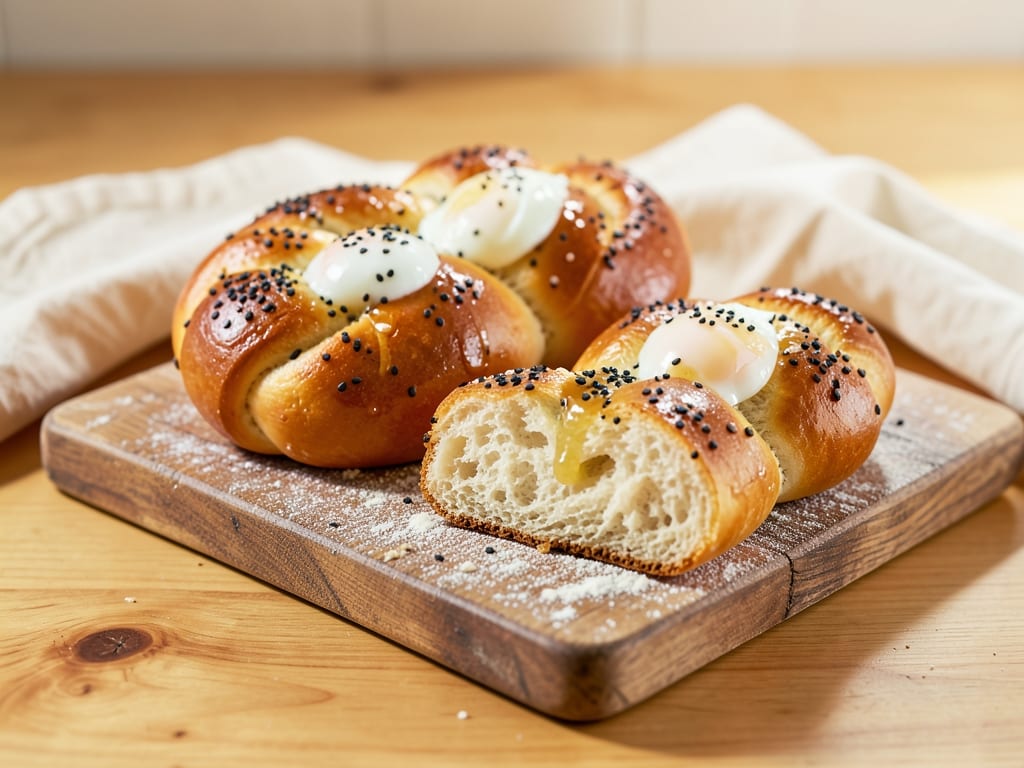
Israeli Challah with Honey
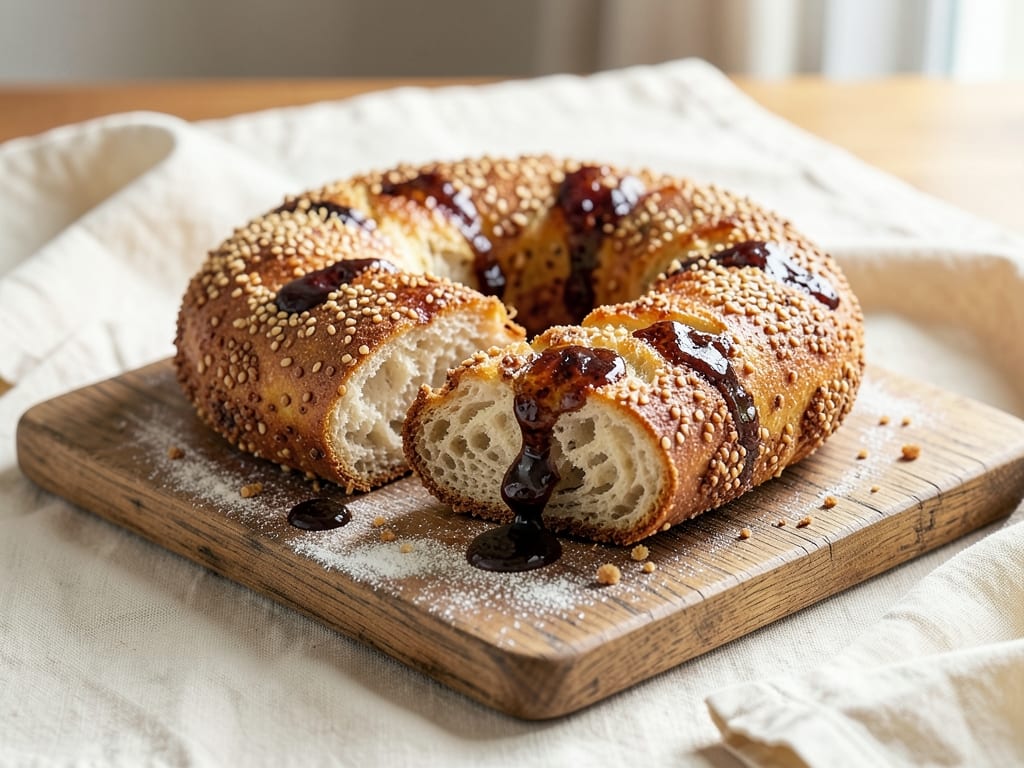
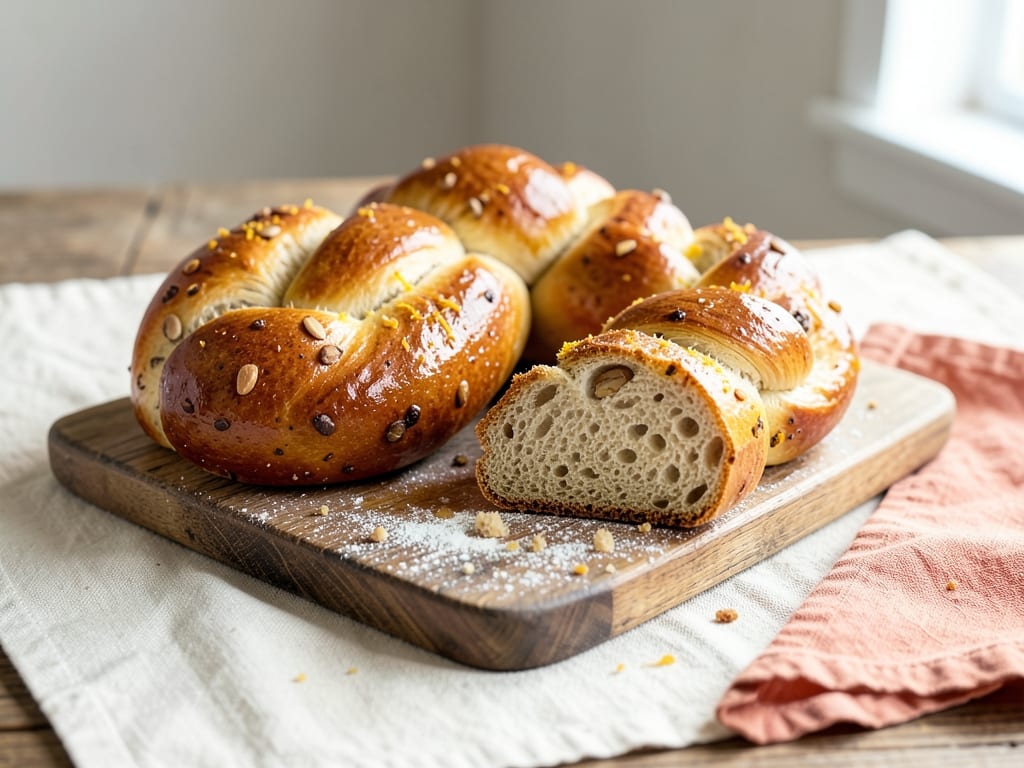
Two soft, golden, honey-sweetened braided loaves with a tender, pull-apart crumb and a glossy sesame-dusted crust. Made with oil instead of butter, so it's dairy-free and perfect for any festive table.
- Prep
- 45 min
- Cook
- 32 min
- Wait
- 3 hr 5 min
- Total
- 4 hr 22 min
- Makes
- 2 loaves (8 slices each)
Steps
Before you start
- Plan on about 4½ hours start to finish; most of it is hands-off rising time.
- Measure flour by weight if you can. Too much flour makes dense challah, and this dough should feel soft and slightly tacky.
- Use a thermometer to check your water: 105–110°F (40–43°C) is warm to the touch but not hot. Water above 120°F (49°C) can kill the yeast.
- Line two large baking sheets with parchment paper, or bake the loaves one sheet at a time on the middle rack.
Bloom the yeast
- In the bowl of a stand mixer, whisk the warm water (105–110°F / 40–43°C), honey and yeast together until the honey dissolves.
- Let it stand for 5 minutes.
+ Show details− Hide details
Ready when: The surface looks foamy and smells yeasty
Tip: If there's no foam after 10 minutes, the yeast or water was off. Start again with fresh yeast.
Mix the dough
- Add the oil and 2 beaten eggs to the yeast mixture and whisk briefly.
- Add the flour and salt.
- Attach the dough hook and mix on low speed for 2 minutes, scraping down the bowl once, until no dry flour remains and a shaggy dough forms.
+ Show details− Hide details
Ready when: No dry flour patches remain; the dough looks rough and sticky
Tip: Keep the salt away from the yeast until the flour is added, since direct contact can slow yeast.
Knead until smooth
- Knead on medium-low speed for 8–10 minutes (or by hand on a lightly floured surface for 12–15 minutes).
- If the dough sticks heavily to the bowl, add up to 1–2 tablespoons extra flour, one tablespoon at a time.
+ Show details− Hide details
Ready when: Dough is smooth, elastic and slightly tacky, and it passes the windowpane test: a small piece stretches thin enough to see light through without tearing
Tip: Resist adding too much flour. A slightly tacky dough bakes into a softer loaf.
First rise
- Shape the dough into a ball and place it in a large, lightly oiled bowl, turning once to coat.
- Cover with a towel or plastic wrap and let rise in a warm spot (75–80°F / 24–27°C) for 90 minutes.
+ Show details− Hide details
Ready when: Dough has doubled, and a fingertip pressed in 1 inch (2.5 cm) leaves a dent that springs back slowly
Tip: In a cool kitchen, rising may take up to 2 hours. Judge by the dough, not the clock.
Divide into strands
- Turn the dough onto a lightly floured surface and gently press out the large bubbles.
- Weigh it and divide in half (about 670 g each).
- Divide each half into 3 equal pieces (about 223 g each).
- Roll each piece into a rope about 16 inches (40 cm) long, tapering slightly at the ends.
- Cover the ropes with a towel as you work.
+ Show details− Hide details
Ready when: Ropes are even in thickness and spring back slightly when stretched
Tip: If a rope keeps shrinking back, cover it and rest it for 5 minutes, then roll again.
Braid the loaves
- Line up 3 ropes side by side and pinch them together firmly at the top.
- Braid by crossing the right rope over the middle, then the left rope over the new middle, repeating to the end.
- Pinch the ends together and tuck both ends under.
- Transfer to a parchment-lined baking sheet.
- Repeat with the remaining 3 ropes, leaving 3 inches (7.5 cm) between loaves.
+ Show details− Hide details
Ready when: Braids are even and snug, with the ends tucked under
Tip: Braid loosely. Tight braids stop the loaf from expanding and can split in the oven.
Egg wash and second riseOven 350°F / 175°C
- In a small bowl, beat the wash egg with the water and 1 teaspoon honey until smooth.
- Brush a thin coat over each loaf, saving the leftover wash.
- Cover loosely with a towel and let rise for 45 minutes.
- Preheat the oven to 350°F (175°C) for the last 20 minutes of rising.
+ Show details− Hide details
Ready when: Loaves look puffy and about 1½ times larger; a gentle fingertip press leaves a dent that fills back slowly
Tip: Don't let the first coat of wash pool between the braids, or it can scramble and look streaky.
Glaze again and bakeOven 350°F / 175°C
- Brush the loaves a second time with the remaining egg wash, then sprinkle with sesame seeds if using.
- Bake at 350°F (175°C) on the middle rack for 30–35 minutes, rotating the pans halfway through.
- If the tops brown too fast, tent loosely with foil after 20 minutes.
+ Show details− Hide details
Ready when: Crust is deep golden brown, the loaf sounds hollow when tapped on the bottom, and the center reads 190°F (88°C) on an instant-read thermometer
Tip: Bake one sheet at a time on the middle rack for the most even browning.
Cool completely
- Slide the loaves onto a wire rack and cool for at least 45 minutes before slicing, so the crumb finishes setting.
+ Show details− Hide details
Ready when: Loaves feel barely warm to the touch on the bottom
Tip: Cutting into warm bread squashes the soft crumb. Tear it by hand if you can't wait.
Good to know
Tips
- Weigh the dough pieces so the strands are equal; this gives an evenly shaped, symmetrical braid.
- A double egg wash (before and after the second rise) gives the signature deep, glossy shine.
- The dough should be soft and slightly tacky. Too much flour is the most common cause of dry challah.
- For a dramatic presentation, make one larger loaf with a six-strand braid and bake it for 40–45 minutes.
Make ahead
"After kneading, the dough can rise once in the fridge, covered, for 8–12 hours. Let it sit at room temperature for 45 minutes, then divide, shape and continue with the second rise (it may need an extra 15–20 minutes). Baked loaves can also be frozen (see storage) up to 1 month ahead."
Storage & reheating
"Room temperature: wrap tightly or store in an airtight bag for up to 3 days. Fridge: up to 5 days, though it dries out faster. Freezer: wrap cooled loaves in plastic and foil and freeze for up to 3 months; thaw at room temperature for 3–4 hours. To reheat, warm in a 325°F (160°C) oven for 8–10 minutes, loosely covered with foil."
Substitutions
- bread flour → all-purpose flour. Use the same weight (750 g). The loaf will be slightly softer and less chewy. Add 1–2 tbsp less water if the dough feels too wet.
- honey → granulated sugar or date syrup. Use 120 g (⅔ cup) sugar, or the same amount of date syrup. Sugar gives a lighter flavor and a slightly paler crust.
- instant yeast → active dry yeast. Use the same amount, but let it bloom in the warm water and honey for 10 minutes until foamy before continuing.
- sesame seeds → poppy seeds. Use the same amount for a traditional alternative, or leave the seeds off entirely.
More yeast breads
See all →

Find more like this
- Meal
- Dinner
- Cuisine
- Middle Eastern
- Main ingredient
- Eggs
- Method
- Oven