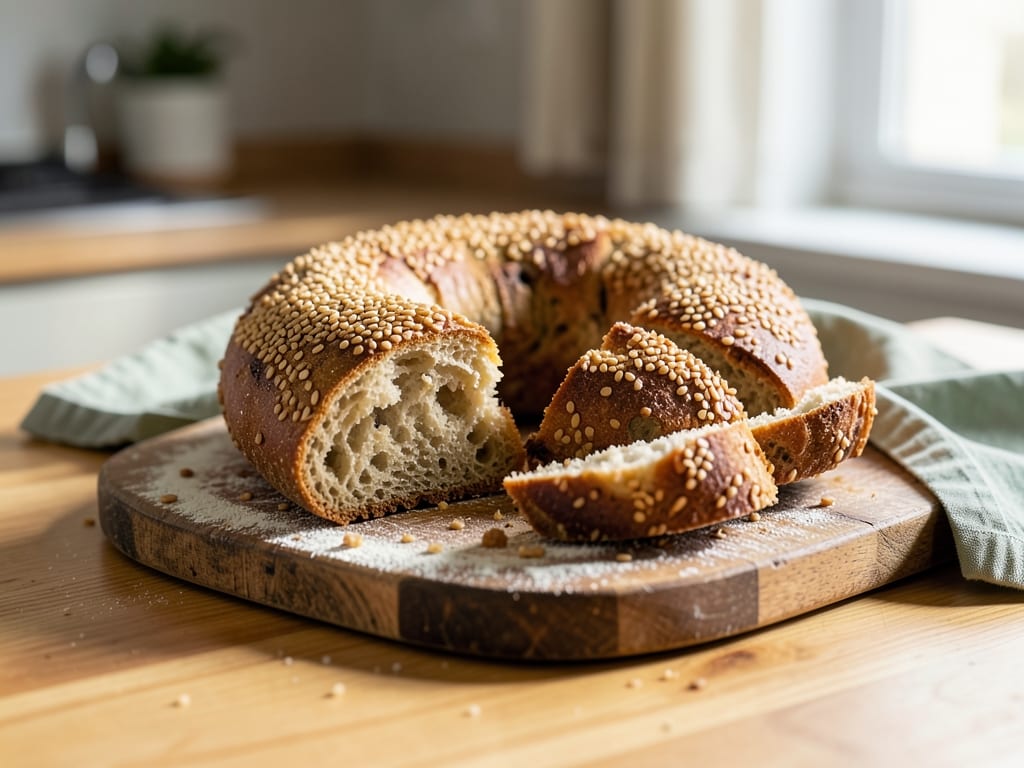
Sourdough Ka'ak Bread Rings
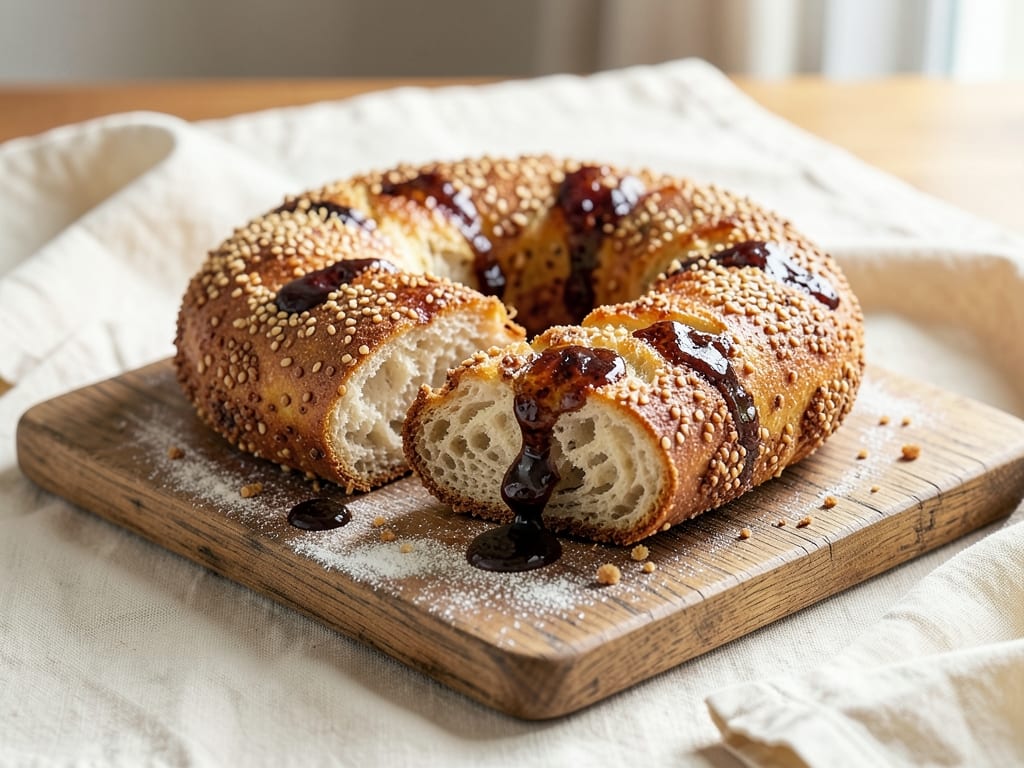
Chewy-crisp Middle Eastern bread rings made with a lively sourdough starter, fragrant mahleb, and a thick coat of toasted sesame seeds. Slightly sweet, nutty, and perfect with tea, labneh, or za'atar and olive oil.
- Prep
- 1 hr 5 min
- Cook
- 23 min
- Wait
- 6 hr 25 min
- Total
- 7 hr 53 min
- Makes
- 12 rings (about 3½ inches / 9 cm across)
Steps
Before you start
- Feed your starter 4–8 hours ahead so it is bubbly, domed, and has at least doubled; use it at its peak (100% hydration, equal weights flour and water).
- Plan on about 8 hours start to finish, most of it hands-off: roughly 5 hours bulk fermentation at 75°F (24°C), 15 minutes rest, and about 50 minutes final proof. A cooler kitchen needs longer.
- Weigh ingredients with a kitchen scale if you can; this is a fairly stiff dough and cup measures vary.
- Ground mahleb (from cherry pits) is sold at Middle Eastern groceries and online. Buy it fresh and ground, as it loses its almond-cherry aroma quickly.
Mix the dough
- In a large bowl, whisk the lukewarm milk, olive oil, sugar, and starter until the starter breaks up and the mixture looks milky with no large clumps.
- Add the bread flour, salt, mahleb, and anise (if using).
- Stir with a sturdy spoon, then your hand, until no dry flour remains and you have a shaggy, stiff dough.
+ Show details− Hide details
Ready when: No dry flour left in the bowl; dough is shaggy and stiff.
Tip: Add the salt and spices on top of the flour, not directly onto the starter, so they mix in evenly.
Knead until smooth
- Turn the dough onto a lightly floured counter and knead for 8–10 minutes, pushing with the heel of your hand, folding, and turning.
- The dough will start stiff and become smooth and elastic.
- Shape into a ball and place in a lightly oiled bowl (use a drop of extra oil from the measured amount if needed).
- Cover.
+ Show details− Hide details
Ready when: Dough is smooth, slightly tacky but not sticky, and springs back slowly when poked.
Tip: This is a firm dough by design. Resist adding much more flour, which would make the rings dry.
Bulk ferment
- Cover the bowl and leave at about 75°F (24°C).
- After 1 hour, wet your hand and do one set of stretch-and-folds: lift an edge, stretch it up, and fold over the center, turning the bowl four times.
- Re-cover and leave for about 4 more hours.
+ Show details− Hide details
Ready when: Dough is about 50–75% larger, puffy, jiggles when the bowl is moved, and has a few bubbles visible.
Tip: Fermentation time depends on room temperature and starter strength. In a cool kitchen it can take 1–2 hours longer; judge by the dough, not the clock.
Prepare the coating
- About 15 minutes before the end of bulk fermentation, toast the sesame seeds in a dry skillet over medium-low heat, stirring constantly, for 3–4 minutes.
- Tip into a shallow bowl to cool.
- In a second shallow bowl, stir the honey into the water until dissolved.
- Line two baking sheets with parchment.
+ Show details− Hide details
Ready when: Sesame seeds smell nutty and are pale golden, not brown.
Tip: Sesame burns fast. Pour it out of the hot pan immediately so it doesn't keep cooking.
Divide and rest
- Turn the dough onto an unfloured counter and divide into 12 equal pieces, about 78 g (2¾ oz) each; use a scale for even rings.
- Roll each piece into a loose ball, cover with a towel, and rest 15 minutes so the gluten relaxes and the dough rolls out easily.
+ Show details− Hide details
Ready when: Balls feel soft and relaxed when pressed.
Shape the rings
- On an unfloured counter, roll each ball under your palms into a smooth rope about 10 inches (25 cm) long and ½ inch (1.5 cm) thick.
- Bring the ends together to form a ring and overlap them by about 1 inch (2.5 cm).
- Press and pinch firmly to seal, then roll the seam gently against the counter to blend it.
+ Show details− Hide details
Ready when: Seam is fully sealed with no visible join or gap.
Tip: If the rope keeps shrinking back, cover it and let it rest 5 minutes. A very slightly damp counter gives grip for rolling.
Dip and coat
- Dip the top of each ring into the honey water, letting excess drip off, then press the wet side firmly into the toasted sesame seeds until thickly coated.
- Place seed-side up on the lined baking sheets, spacing 6 rings per sheet about 2 inches (5 cm) apart.
+ Show details− Hide details
Ready when: Top of every ring is fully covered in sesame seeds.
Tip: Dip quickly rather than soaking; too much liquid makes the seeds slide off and the bread soggy.
Final proof and preheatOven 400°F / 205°C
- Cover the rings loosely with a towel and proof at room temperature for about 50 minutes.
- About 20 minutes into the proof, preheat the oven to 400°F (200°C) with racks in the upper and lower thirds.
+ Show details− Hide details
Ready when: Rings look puffy and a gently pressed finger leaves a dent that springs back slowly.
Tip: Don't over-proof; the rings should look plump but still hold a clear center hole.
BakeOven 400°F / 205°C
- Bake at 400°F (200°C) for 20–22 minutes, swapping the sheets between racks and rotating them front to back halfway through, until the rings are deep golden brown and the sesame is toasty.
+ Show details− Hide details
Ready when: Deep golden brown on top and bottom, and the bottoms sound hollow when tapped.
Tip: If the sesame is browning faster than the bread, tent loosely with foil for the last 5 minutes.
Cool completely
- Slide the rings on the parchment onto wire racks and cool for at least 20 minutes.
- They crisp and set as they cool, giving a crunchy crust and chewy interior.
+ Show details− Hide details
Ready when: Rings are barely warm and feel firm.
Tip: Cooling on a rack keeps the bottoms from steaming and going soft.
Good to know
Tips
- Weigh the dough pieces for rings of uniform size so they bake at the same pace.
- Press the sesame seeds on firmly; they will release some in baking, but a thick coat gives the signature nutty crunch.
- Use a vigorous starter. A sluggish starter will leave dense rings and may need 7–8 hours of bulk fermentation.
- For a crisper, biscuit-like ka'ak, bake 5 extra minutes at 350°F (175°C) after the main bake.
Make ahead
"After shaping and coating (step 7), cover the rings and refrigerate on the baking sheets for 8–12 hours. Let them sit at room temperature for about 45–60 minutes until puffy, then bake as directed. Or bake fully a day ahead and re-crisp before serving."
Storage & reheating
"Room temperature in an airtight container or bag for up to 3 days. Freeze cooled rings in a zip-top freezer bag for up to 3 months. Reheat room-temperature or thawed rings on a baking sheet at 350°F (175°C) for 5–8 minutes to refresh the crust."
Substitutions
- ground mahleb → extra ground anise or a pinch of ground cardamom plus ¼ teaspoon almond extract. The flavor will differ from classic ka'ak but still taste warm and aromatic.
- whole milk → water or unsweetened oat milk. Water gives a slightly crisper, less tender crumb; use the same amount.
- honey → maple syrup or light corn syrup. Used only to help the sesame stick; use the same amount.
- bread flour → all-purpose flour. Slightly softer, less chewy rings; reduce the milk by 1 tablespoon (15 ml) if the dough feels sticky.
More yeast breads
See all →

Find more like this
- Meal
- Breakfast
- Cuisine
- Middle Eastern
- Diet
- VegetarianHalal
- Method
- Oven