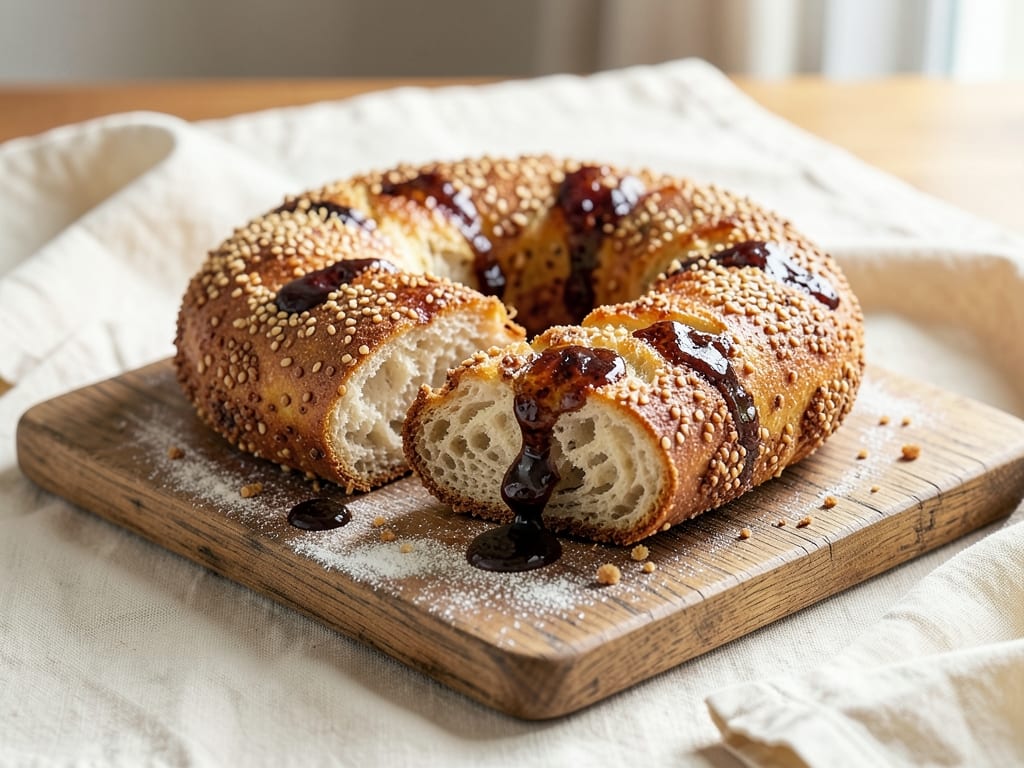
Sourdough Simit (Turkish Sesame Rings)
Chewy, deeply sesame-crusted Turkish bread rings made with a sourdough starter and dipped in grape molasses for a glossy, golden-brown crust. A gentle tang meets nutty toasted sesame in every bite.
- Prep
- 1 hr
- Cook
- 20 min
- Wait
- 5 hr 20 min
- Total
- 6 hr 40 min
- Makes
- 8 simit rings (about 5 inches / 12 cm wide)
Steps
Before you start
- Feed your starter 4–8 hours ahead so it is bubbly, doubled and floats in water (100% hydration: equal weights flour and water).
- Plan on about 6½ hours start to finish; most of it is hands-off fermenting. The dough is fairly stiff, which makes the rings easy to roll and twist.
- Grape molasses (pekmez) is sold in Middle Eastern shops and online. It is thinner and tangier than cane molasses.
- Set a room temperature of about 75–78°F (24–26°C) for fermenting; in a cooler kitchen, allow extra time.
Mix and rest dough
- In a large bowl, stir together the lukewarm water and sourdough starter until the starter mostly dissolves.
- Add the bread flour and salt.
- Mix with a wet hand or spatula until no dry flour remains and the dough looks shaggy.
- Cover and let rest.
+ Show details− Hide details
Ready when: No dry flour remains and the dough is rough but cohesive
Tip: This is a stiffer dough (about 62% hydration) than typical sourdough. Don't add extra water; it makes shaping easier.
Stretch and fold
- Wet your hand.
- Grab one edge of the dough, stretch it up gently and fold it over the center.
- Turn the bowl a quarter turn and repeat 8 times in total, until the dough tightens.
- Cover.
- Repeat this set of folds 2 more times, 30 minutes apart (3 sets in all).
+ Show details− Hide details
Ready when: Dough feels smoother, springier and resists stretching after the last fold
Bulk ferment
- Leave the covered dough at 75–78°F (24–26°C) until it has grown by about 50% and looks puffy with a few bubbles at the edges and a slightly domed top.
- Expect about 2 more hours.
+ Show details− Hide details
Ready when: Dough is up about 50%, jiggles when the bowl is shaken, and has bubbles at the edges
Tip: Go by the dough, not the clock. In a cool kitchen it may need 1–2 extra hours.
Divide and rest
- Turn the dough onto a lightly floured surface.
- Cut it into 8 equal pieces, about 112 g each (weigh them).
- Gently round each piece into a ball by cupping it against the counter and dragging in a small circle.
- Cover with a damp towel and rest 20 minutes so the dough relaxes for rolling.
- Line two baking sheets with parchment.
+ Show details− Hide details
Ready when: Balls are smooth and slightly relaxed, spreading a little when touched
Toast sesame, mix dip
- Toast the sesame seeds in a dry skillet over medium-low heat, stirring constantly, for 3–4 minutes, until pale golden and fragrant.
- Tip into a wide shallow dish and cool.
- In a second wide shallow bowl, whisk the grape molasses with the warm water until smooth and fluid, like thin syrup.
+ Show details− Hide details
Ready when: Seeds are pale golden and smell nutty; dip is evenly blended with no molasses streaks
Tip: Pull the seeds off the heat the moment they color; they keep browning in the hot pan and will darken more in the oven.
Roll and twist rings
- Without flour, roll one ball under your palms on a clean, lightly damp counter into an even rope about 20 inches (50 cm) long.
- Fold it in half and twist the two strands around each other 5–6 times.
- Bring the ends together to form a ring about 5 inches (12 cm) across and pinch the ends firmly to seal.
- Repeat with the remaining balls, keeping the others covered.
+ Show details− Hide details
Ready when: Ropes are even in thickness and the twisted ring holds its shape with a sealed join
Tip: If the rope springs back, cover it for 5 minutes and try again. A damp, not floury, counter gives grip.
Dip and coat
- Dip each ring into the molasses mixture, turning to coat both sides and letting the excess drip off for a few seconds.
- Lay it in the sesame seeds, flip, and press so seeds cover every surface thickly.
- Place on the lined sheets, about 2 inches (5 cm) apart, 4 per sheet.
+ Show details− Hide details
Ready when: Rings are completely and thickly covered in sesame seeds
Tip: Dip rings one at a time, and use one dry hand for the sesame dish and one wet hand for the molasses to avoid clumps.
Final proofOven 450°F / 230°C
- Cover the rings loosely with towels and proof at room temperature for 45 minutes.
- About 20 minutes in, place racks in the upper and lower thirds of the oven and preheat to 450°F (230°C).
+ Show details− Hide details
Ready when: Rings look visibly puffy, and a gently pressed finger leaves a dent that springs back slowly
Tip: Don't overproof; the twist pattern blurs and the rings go flat.
BakeOven 450°F / 230°C
- Bake both sheets at 450°F (230°C) for 18–20 minutes, swapping and rotating the sheets halfway, until the simit are deep golden-brown with toasted sesame.
- Be sure they are browned at the base too.
+ Show details− Hide details
Ready when: Deep golden-brown crust and a hollow sound when tapped on the bottom
Tip: If the sesame darkens too fast, tent loosely with foil for the final 5 minutes.
Cool and serve
- Slide the simit onto a wire rack and cool at least 15 minutes.
- Serve warm or at room temperature, plain or with white cheese, tomatoes, and tea.
+ Show details− Hide details
Ready when: Rings are warm, not hot, and the crust is crisp
Good to know
Tips
- Weigh ingredients with a scale for the best consistency.
- Toasting the sesame seeds beforehand gives a deep nutty flavor and prevents pale, raw-tasting seeds.
- Keep the molasses dip thin enough to drip freely; a thick dip makes seeds clump and burn.
- Bake until truly deep golden; pale simit taste doughy and lack the signature crisp crust.
Make ahead
"After shaping, coating and placing on trays, cover and refrigerate the rings up to 12 hours. Let stand at room temperature 30–45 minutes until puffy, then bake as directed."
Storage & reheating
"Room temperature in a paper bag or loosely covered up to 2 days. Freeze in a zip-top bag up to 3 months. Reheat at 350°F (175°C) for 5–8 minutes (10–12 minutes from frozen) to re-crisp the crust."
Substitutions
- grape molasses (pekmez) → date syrup or pomegranate molasses. Date syrup gives a sweeter, darker crust; pomegranate molasses is tangier, so use slightly less.
- bread flour → all-purpose flour. The crumb will be slightly softer and the dough may need 10–15 g less water.
- hulled white sesame seeds → unhulled sesame seeds. They have a more rustic, slightly bitter flavor; toast a little less.
- active sourdough starter (100% hydration) → whole wheat or rye starter. Works well at the same weight, with a slightly earthier flavor and a faster ferment.
More yeast breads
See all →


Find more like this
- Meal
- Breakfast
- Cuisine
- Turkish
- Method
- Oven
- Quick & Easy
- 5 Ingredients or LessFreezer Friendly