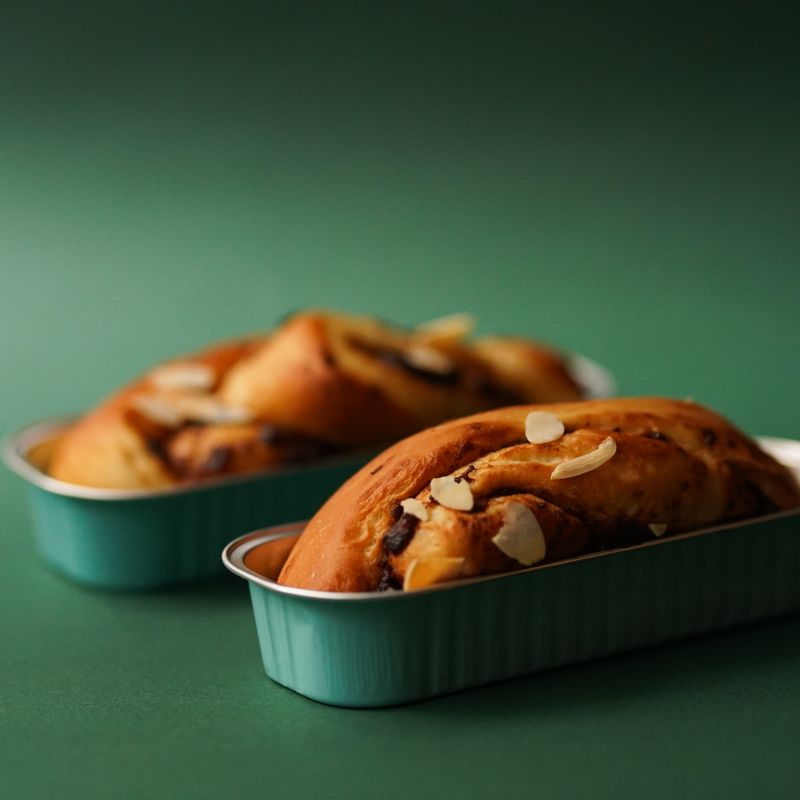
Buttery Brioche Loaf
A tender, golden, richly buttery French loaf with a feathery, shreddy crumb and a glossy crust. The dough is mixed in a stand mixer, chilled for easy handling and deeper flavor, then shaped into eight balls and baked in a standard loaf pan.
- Prep
- 1 hr
- Cook
- 38 min
- Wait
- 7 hr 45 min
- Total
- 9 hr 23 min
- Makes
- 1 loaf (10 slices)
Steps
Before you start
- Plan about 9½ hours start to finish: 1 hour first rise, at least 4 hours chilling, about 1¾ hours proofing, then baking and cooling. The chill can be stretched to 16 hours, so you can mix in the evening and shape the next morning.
- Use eggs and milk straight from the fridge; cold ingredients keep the butter from melting while the dough is kneaded.
- Cut the 170 g of dough butter into ½-inch (1 cm) cubes and let it sit about 20 minutes, until cool but pliable (around 60°F / 16°C): it should bend without cracking or smearing.
- You need a stand mixer with a dough hook; this sticky dough is very hard to knead by hand.
- Weigh ingredients with a kitchen scale if you can. Brioche is sensitive to flour and egg amounts.
Mix the dough
- In the bowl of a stand mixer, combine the bread flour, sugar, salt and yeast and stir briefly with a spoon.
- Add the beaten eggs and cold milk.
- Fit the dough hook and mix on low speed (speed 2 on most mixers) for 3 minutes, stopping once to scrape the bottom and sides, until no dry flour remains and a shaggy, sticky dough forms.
+ Show details− Hide details
Ready when: No dry flour remains; dough is shaggy and sticky.
Tip: Keep the salt and yeast on opposite sides of the flour when you add them if you are not stirring first; direct contact can slow the yeast.
Develop the gluten
- Increase the speed to medium-low (speed 4) and knead for 8 to 10 minutes.
- The dough will first look slack and slap against the bowl, then gradually pull together into a smooth, elastic mass that clears most of the sides of the bowl.
- Stop and scrape the hook and bowl twice.
+ Show details− Hide details
Ready when: Dough is smooth, elastic, and pulls cleanly from the sides of the bowl, though the bottom still sticks a little.
Tip: Developing gluten before adding the butter is what gives the loaf its tall, shreddy structure.
Knead in the butter
- With the mixer on medium-low, add the cool butter cubes a few at a time, waiting until each addition is mostly absorbed before adding more; this takes about 8 minutes.
- Scrape down the bowl as needed.
- The dough will look broken and greasy partway through; keep going.
- Once all the butter is in, knead 4 to 5 more minutes on medium speed.
+ Show details− Hide details
Ready when: Dough is glossy, smooth and very soft, and stretches into a thin translucent sheet (windowpane) without tearing. It should feel cool, not warm and oily.
Tip: If the dough feels warm or the butter smears and turns greasy, stop the mixer and chill the bowl for 15 minutes before continuing.
First rise
- Scrape the dough into a lightly buttered large bowl (use a dab of the pan butter), cover tightly with plastic wrap, and let it rise at room temperature (about 72°F / 22°C) for 1 hour.
- It will puff and increase by about half; it will not double.
+ Show details− Hide details
Ready when: Dough looks puffy and about 1½ times its original size.
Fold and chill
- Gently fold the edges of the dough into the center several times to deflate it, re-cover the bowl, and refrigerate for at least 4 hours or up to 16 hours.
- The cold firms the butter so the dough can be shaped without sticking.
+ Show details− Hide details
Ready when: Dough is firm, cold, and no longer sticky to the touch.
Tip: Do not skip the chill; warm brioche dough is too soft to shape cleanly.
Shape the loaf
- Butter a 9×5-inch (23×13 cm) loaf pan with the remaining softened pan butter.
- Turn the cold dough onto an unfloured surface (add only a dusting of flour if it sticks) and weigh it: it should be about 900 g.
- Cut into 8 equal pieces (about 112 g each).
- Roll each piece into a tight ball by cupping your palm over it and moving in small circles against the counter.
- Arrange the balls in two rows of four in the pan, seam sides down.
+ Show details− Hide details
Ready when: Balls are smooth and taut on top, sitting snugly in two rows.
Tip: Work quickly and with cool hands; if the dough softens, return it to the fridge for 10 minutes.
Proof the loaf
- Cover the pan loosely with greased plastic wrap and let it proof in a draft-free spot at about 75°F (24°C) for 1½ to 2 hours.
- The balls will merge and the dough will swell about 1 inch (2.5 cm) above the rim of the pan.
+ Show details− Hide details
Ready when: Dough domes about 1 inch above the rim and a floured fingertip pressed in leaves a dent that springs back slowly.
Tip: Cold dough proofs slowly; if the dough hasn't domed after 2 hours, give it 20 more minutes.
Preheat and glazeOven 350°F / 175°C
- About 20 minutes before the proof ends, place a rack in the lower third of the oven and preheat to 350°F (180°C).
- Beat the wash egg with the wash milk until completely smooth.
- Gently brush the top of the loaf with a thin, even coat, taking care not to let egg pool between the balls or drip down the sides of the pan.
+ Show details− Hide details
Ready when: Surface is evenly glossy with no pooled egg.
Tip: Brush gently; pressing hard will deflate the risen dough.
Bake until goldenOven 350°F / 175°C
- Bake at 350°F (180°C) on the lower rack for 20 minutes, until the top is a deep golden brown.
+ Show details− Hide details
Ready when: Top is deep golden brown.
Tip: Put a baking sheet on the rack below to catch any butter drips.
Tent and finish bakingOven 350°F / 175°C
- Loosely tent the loaf with aluminum foil to stop the top from over-browning.
- Continue baking at 350°F (180°C) for 16 to 18 more minutes.
- Check the center with an instant-read thermometer inserted through the top into the middle of the loaf.
+ Show details− Hide details
Ready when: Internal temperature reads 190°F (88°C) and the loaf sounds hollow when tapped on the bottom.
Tip: If the center is under 190°F (88°C), the crumb will be gummy; bake 3 to 5 minutes more and recheck.
Cool completely
- Let the loaf rest in the pan for 10 minutes, then run a thin knife around the edges and turn it out onto a wire rack.
- Cool right side up for at least 50 minutes more before slicing with a serrated knife.
+ Show details− Hide details
Ready when: Loaf is barely warm to the touch at the bottom.
Tip: Slicing warm brioche compresses the crumb; patience gives clean, feathery slices.
Good to know
Tips
- Keep the dough cool throughout: cold eggs and milk, cool butter, and a fridge rest if it ever feels greasy or warm.
- Judge the kneading by the windowpane test rather than the clock; stand mixers vary in power.
- Proof by look, not time. The dough should dome about 1 inch above the rim and feel airy and marshmallow-soft.
- Use the foil tent only after the top is deeply golden, and always confirm doneness with a thermometer at 190°F (88°C).
Make ahead
The dough can be chilled up to 16 hours after the first rise (step 5). You can also freeze the shaped, unproofed loaf in its pan, wrapped well, for up to 1 month; thaw overnight in the fridge, then proof 2 to 3 hours before baking.
Storage & reheating
Room temperature: wrap well and keep up to 3 days. Fridge: not recommended, as it dries the crumb faster. Freezer: slice, wrap tightly, and freeze up to 3 months. Reheat slices in a toaster, or wrap the whole thawed loaf in foil and warm at 300°F (150°C) for 10 to 12 minutes.
Substitutions
- bread flour → all-purpose flour. Gives a slightly softer, less tall loaf. Reduce the milk by 1 tablespoon (15 ml) if the dough feels too slack.
- instant yeast → active dry yeast, 2¼ tsp (7 g). Dissolve in the cold milk warmed to 100°F (38°C) for 5 minutes first, then proceed as written.
- whole milk → heavy cream or water. Cream makes a richer crumb; water gives a slightly crisper crust. Use the same amount, cold.
- unsalted butter → European-style unsalted butter (82–84% fat). Higher butterfat gives more flavor and a more tender crumb. Keep it cool and pliable.
More yeast breads
See all →

Find more like this
- Meal
- Breakfast
- Cuisine
- French
- Main ingredient
- Eggs
- Diet
- VegetarianHalal
- Method
- Oven
- Quick & Easy
- Make Ahead