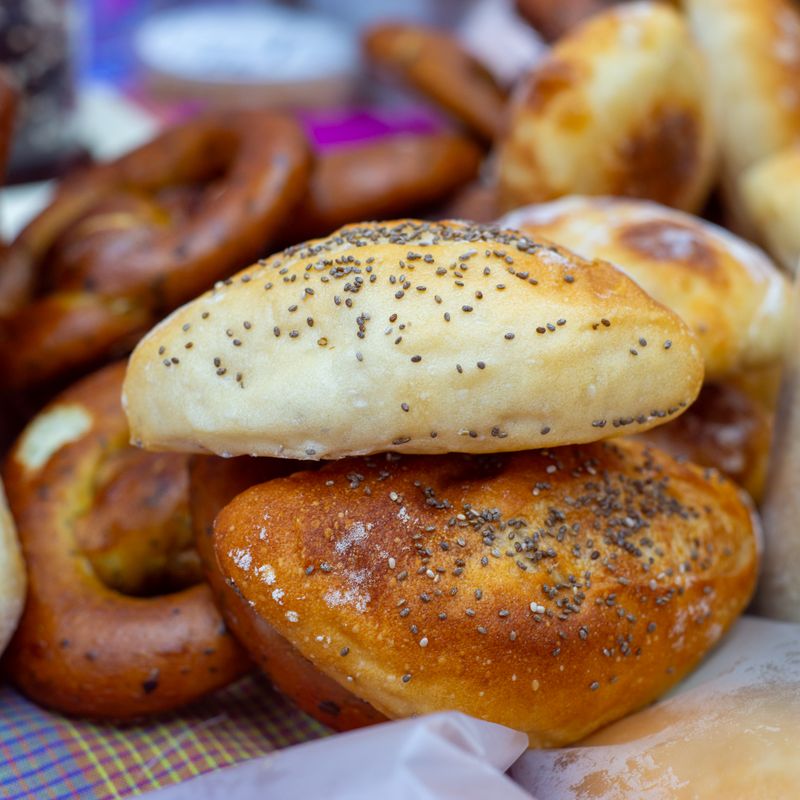
Homemade Chewy Bagels with Malt and Honey
Deli-style bagels with a shiny, blistered crust and a dense, chewy crumb. A stiff bread-flour dough sweetened with honey and barley malt syrup is shaped, chilled for flavor, boiled in malted water, and baked until deep golden.
- Prep
- 48 min
- Cook
- 32 min
- Wait
- 2 hr 40 min
- Total
- 4 hr
- Makes
- 8 bagels (about 4 inches / 10 cm wide)
Steps
Before you start
- Use bread flour, not all-purpose. Its higher protein gives bagels their chew.
- Measure the flour and water by weight if you can. The dough is meant to be stiff, and too much water makes soft, flat bagels.
- Barley malt syrup is thick and sticky. Run your spoon under hot water first so it slides off.
- Plan about 4 hours from start to finish. The shaped bagels can instead chill in the fridge overnight (up to 16 hours) for deeper flavor.
Mix the dough
- In the bowl of a stand mixer, stir the warm water (100°F/38°C), honey, and 1 tbsp malt syrup until dissolved.
- Add the bread flour, instant yeast, and fine sea salt.
- Mix with the dough hook on low speed for 2 to 3 minutes, until no dry flour remains and the dough forms a stiff, shaggy ball.
+ Show details− Hide details
Ready when: No dry flour is left and the dough is a stiff, shaggy ball.
Tip: Water hotter than 120°F (49°C) can kill the yeast. Check it with a thermometer.
Knead until smooth
- Knead on medium-low speed for 8 minutes, until the dough is very smooth, firm, and springs back when poked.
- If kneading by hand, knead on an unfloured counter for 12 to 15 minutes.
- The dough will be much stiffer than bread dough.
- Do not add extra water or flour.
+ Show details− Hide details
Ready when: The dough is smooth and springs back slowly when poked. A small piece stretches into a thin, translucent sheet without tearing right away.
Tip: If your mixer jumps around the counter, hold it steady or stop and rest the dough for 5 minutes.
First rise
- Lightly oil a large bowl with ½ tsp of the neutral oil.
- Shape the dough into a ball, turn it in the bowl to coat, and cover tightly with plastic wrap.
- Let it rise at room temperature (about 72°F/22°C) for 60 minutes.
+ Show details− Hide details
Ready when: The dough looks puffy and has grown about 1½ times in size. It will not fully double.
Divide and shape
- Line two baking sheets with parchment and brush it lightly with the remaining ½ tsp oil.
- Turn the dough onto an unfloured counter and cut it into 8 pieces of about 105 g each, weighing them.
- Roll each piece into a tight ball.
- Poke a thumb through the center, then stretch the hole to about 2 inches (5 cm) wide by rotating the ring around your fingers.
- Place 4 bagels on each sheet, spaced apart.
+ Show details− Hide details
Ready when: Each bagel is a smooth ring with a hole about 2 inches (5 cm) wide and no seams on top.
Tip: The hole shrinks as the bagels proof and boil, so make it wider than looks necessary. A dry counter gives the grip you need for rolling tight balls.
Rest the bagels
- Cover the shaped bagels loosely with a clean kitchen towel or lightly oiled plastic wrap.
- Let them rest at room temperature for 20 minutes.
- They will puff slightly.
+ Show details− Hide details
Ready when: The bagels look slightly puffy but are not doubled.
Chill the bagelsOven 450°F / 230°C
- Transfer the covered baking sheets to the refrigerator for at least 60 minutes.
- For better flavor and more blistered crusts, chill up to 16 hours.
- In the last 20 minutes of chilling, position an oven rack in the center and preheat the oven to 450°F (230°C).
- Fill a wide pot with the 8 cups water, 2 tbsp malt syrup, and the baking soda.
+ Show details− Hide details
Ready when: A bagel dropped in a bowl of cold water floats within about 10 seconds. If it sinks, proof 15 more minutes.
Tip: Baking soda foams up when added to hot water, so add it to the cold water before heating.
Boil the bagels
- Bring the pot to a gentle, steady boil over medium-high heat.
- Lower 2 to 3 bagels in at a time, without crowding.
- Boil for 1 minute, flip with a slotted spoon, and boil 1 minute more for a chewy crust.
- Lift out, let excess water drain for a few seconds, and return to the parchment, spaced 2 inches (5 cm) apart.
- Repeat with the rest.
+ Show details− Hide details
Ready when: The bagels float, look puffed and shiny, and have a slightly wrinkled surface when lifted.
Tip: Boiling longer than 2 minutes per bagel makes the crust tough and leathery.
Top the bagels
- While the bagels are still wet and shiny, sprinkle the tops generously with the everything bagel seasoning or sesame seeds, if using.
- Seeds will not stick to bagels that have dried, so top each batch right after boiling.
+ Show details− Hide details
Ready when: Tops are evenly coated with seasoning.
Tip: Skip this step for plain bagels.
Bake the bagelsOven 450°F / 230°C
- Bake in the preheated 450°F (230°C) oven for 20 to 24 minutes.
- Switch the baking sheets between racks and rotate them front to back halfway through, at about 11 minutes.
- If you only have one rack, bake one sheet at a time and keep the second sheet in the fridge until ready to boil.
+ Show details− Hide details
Ready when: The bagels are deep golden brown on top and bottom, and sound hollow when you tap the base.
Tip: Pale bagels are underbaked and will turn gummy as they cool, so bake them until they are deeply golden.
Cool before slicing
- Move the bagels to a wire rack and cool for at least 20 minutes.
- The crumb finishes setting as they cool, so slicing too early gives a gummy interior.
- Slice with a serrated knife and serve plain, toasted, or with cream cheese.
+ Show details− Hide details
Ready when: The bagels feel just warm or at room temperature, with a crisp crust.
Good to know
Tips
- Weigh the dough pieces so all 8 bagels are the same size and bake evenly.
- Use a wide pot with gently bubbling, not violently rolling, water so the bagels keep their shape.
- If bagels stick to the parchment after boiling, brush the paper with a little more oil before baking next time.
- For a shinier crust, brush the boiled bagels with a beaten egg white before topping.
Make ahead
"After shaping, cover the bagels and refrigerate for up to 16 hours (overnight). Boil and bake straight from the fridge, with no rest at room temperature. Add 1 to 2 minutes to the boil if the bagels feel very cold."
Storage & reheating
"Room temperature in an airtight bag or container: up to 2 days. Freezer: slice cooled bagels, wrap tightly, and freeze up to 3 months. Toast straight from frozen. To refresh whole bagels, warm them in a 350°F (175°C) oven for 5 to 8 minutes. Refrigerating makes them stale faster, so avoid it."
Substitutions
- barley malt syrup → Dark brown sugar or more honey (same amount). The bagels will lack the classic malty flavor and deep color, but will still be chewy. Use 1 tbsp brown sugar in the boiling water.
- instant yeast → Active dry yeast (2¼ tsp / 7 g). Dissolve it in the warm water with the honey and let it sit for 5 to 10 minutes until foamy before adding the flour.
- bread flour → High-gluten flour (same weight). Gives an even chewier bagel. All-purpose flour works but yields a softer, less chewy crumb.
- honey → Granulated sugar or maple syrup (same amount). Provides the same food for the yeast and a slight sweetness.
More yeast breads
See all →
Find more like this
- Meal
- Breakfast
- Cuisine
- American
- Quick & Easy
- Make Ahead