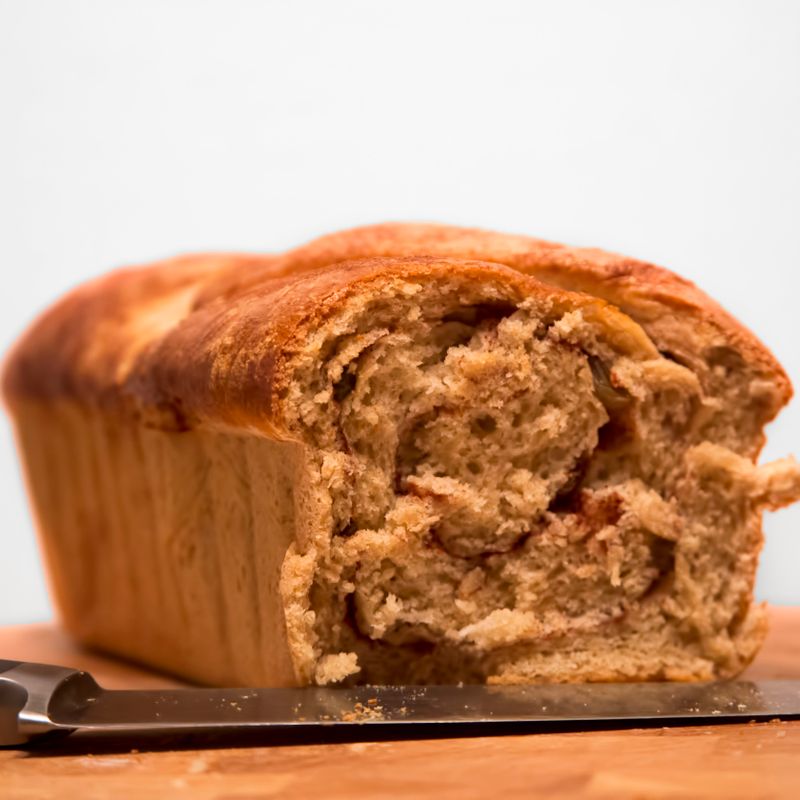
Homemade Cinnamon Swirl Bread
A soft, tender milk-and-butter loaf with a thick ribbon of brown sugar and cinnamon spiraling through every slice. Bread flour gives it a springy, bakery-style crumb that toasts beautifully.
- Prep
- 57 min
- Cook
- 45 min
- Wait
- 3 hr 50 min
- Total
- 5 hr 32 min
- Makes
- 1 loaf (12 slices)
Steps
Before you start
- Plan on about 5½ hours from start to sliceable loaf, most of it hands-off rising and cooling.
- Take the egg out 30 minutes ahead so it is not cold when it goes into the dough.
- Soften the filling butter (2 tablespoons/28 g) and 1 tablespoon (14 g) of the pan butter so both are spreadable but not melted. The other tablespoon of pan butter is melted after baking.
- Warm the milk to 105–110°F (40–43°C). Hotter than 120°F (49°C) can kill the yeast, so use a thermometer.
- Weigh the flour if you can (440 g). The pan is buttered in step 4, before the dough is rolled out.
Mix the dough
- In the bowl of a stand mixer, whisk the warm milk, instant yeast and granulated sugar.
- Let stand 5 minutes until foamy on top.
- Add the beaten egg and cooled melted dough butter and whisk to combine.
- Add the bread flour and fine salt.
- Stir with a spatula until a shaggy dough forms and no dry flour remains.
+ Show details− Hide details
Ready when: The yeast mixture is foamy and smells yeasty; the dough is shaggy with no dry flour.
Tip: If there is no foam after the 5 minutes, wait 5 more. If still flat, the yeast is dead or the milk was too hot; start again with fresh yeast.
Knead until smooth
- Attach the dough hook and knead on medium-low (speed 2) for 8 minutes.
- Or knead by hand on a lightly floured counter for 10–12 minutes.
- The dough should be soft and slightly tacky but pull away from the bowl sides.
- Add flour 1 tablespoon at a time only if it is truly sticking to your fingers.
+ Show details− Hide details
Ready when: The dough is smooth and elastic. A small piece stretches into a thin, translucent sheet without tearing (windowpane test).
Tip: Too much added flour makes a dry, dense loaf. Slightly tacky is correct.
First rise
- Shape the dough into a ball and place it in a lightly greased large bowl, turning once to coat.
- Cover with plastic wrap or a damp towel.
- Let rise in a draft-free spot at about 75–78°F (24–26°C) for 60–75 minutes.
+ Show details− Hide details
Ready when: The dough has doubled, and a fingertip poke leaves a dent that springs back slowly.
Tip: In a cool kitchen, set the bowl in the oven with only the light on.
Make filling, butter pan
- Stir the brown sugar and cinnamon together in a small bowl, mashing out lumps with a fork.
- Set the 2 tablespoons softened filling butter nearby.
- Use 1 tablespoon (14 g) of the softened pan butter to grease the 9×5-inch loaf pan thoroughly, including the corners.
- Set the remaining 1 tablespoon pan butter aside to melt after baking.
+ Show details− Hide details
Ready when: The filling is an even, sandy, uniformly brown mixture with no clumps, and the pan is glossy with butter in every corner.
Tip: Keep the pan butter for brushing separate so you don't use it up on the pan.
Roll out and fill
- Turn the risen dough onto a lightly floured counter and gently press out the large bubbles.
- Roll it into a rectangle 8 inches (20 cm) wide by 16 inches (40 cm) long, with an 8-inch short side facing you.
- Spread the softened filling butter evenly over the surface, leaving a ½-inch (1 cm) clean border along the two long sides and the far short edge; spread right up to the short edge nearest you.
- Sprinkle the cinnamon-sugar evenly over the butter within the same area and press it lightly with your palm.
+ Show details− Hide details
Ready when: The rectangle is an even 8×16 inches with a thin, uniform layer of filling that stops ½ inch from the two long sides and the far end.
Tip: If the dough springs back while rolling, cover it and rest 5 minutes, then continue.
Roll and place in pan
- Starting from the 8-inch short edge nearest you, roll the dough up into a tight log, keeping it snug as you go.
- Pinch the seam and both ends firmly to seal.
- Place the log seam-side down in the buttered pan, tucking the ends under if needed so it sits flat.
+ Show details− Hide details
Ready when: The log is about 8–9 inches long, snug, and the seam is sealed on the bottom.
Tip: A loose roll bakes with large gaps under the crust. Keep the roll tight and pinch the seam well so filling does not leak.
Second riseOven 350°F / 175°C
- Cover the pan loosely with greased plastic wrap.
- Let the loaf rise at room temperature for 45–60 minutes.
- About 20 minutes before the end, place a rack in the lower third of the oven and preheat to 350°F (175°C).
+ Show details− Hide details
Ready when: The dough crowns about ½–1 inch (1–2.5 cm) above the rim of the pan and a gentle poke springs back slowly.
Tip: Do not let it overproof. A dough that rises far above the rim can collapse in the oven.
Bake the loafOven 350°F / 175°C
- Bake at 350°F (175°C) on the lower rack for 40–45 minutes.
- If the top is deep brown after 25 minutes, tent loosely with aluminum foil.
- Check the temperature in the center of the loaf with an instant-read thermometer.
+ Show details− Hide details
Ready when: The crust is deep golden brown, the loaf sounds hollow when tapped, and the center reads 190°F (88°C).
Tip: Pulling it too early leaves the swirl gummy. Trust the thermometer.
Brush and cool in pan
- Melt the remaining 1 tablespoon pan butter and brush it over the hot loaf.
- Let it cool in the pan for 15 minutes, then run a thin knife around the edges and turn the loaf out onto a wire rack.
+ Show details− Hide details
Ready when: The loaf slides out easily, with any melted filling on the sides still soft but not stuck.
Tip: If melted sugar sticks the loaf, loosen it with a knife before turning out.
Cool and slice
- Cool the loaf on the rack, upright, for 1½ hours.
- Slice with a serrated bread knife into 12 slices about ¾ inch (2 cm) thick, using a gentle sawing motion.
+ Show details− Hide details
Ready when: The loaf is just barely warm or room temperature and the bottom feels dry, not steamy.
Tip: Cutting while hot compresses the crumb and smears the swirl.
Good to know
Tips
- Weigh the flour if you can. Too much flour is the most common cause of dry, dense bread.
- Use fine table or sea salt. If you only have Diamond Crystal kosher salt, use about 2 teaspoons; flaky salts weigh much less per teaspoon.
- Roll the log snugly and seal the seam to prevent gaps and a collapsed swirl.
- Keep the border clean and the filling even; piling it thickly causes tunnels. Cool fully before slicing.
Make ahead
After shaping (step 6), cover the pan tightly and refrigerate 8–12 hours. Next day, let it stand at room temperature 45–60 minutes until it crowns above the rim, then bake as directed, adding 3–5 minutes if needed. You can also bake the loaf a day ahead and store as below.
Storage & reheating
Room temperature: wrap tightly or keep in an airtight bag up to 3 days. Fridge: not recommended, since it dries the crumb faster. Freezer: wrap the cooled loaf (or slices) well and freeze up to 3 months; thaw at room temperature 3–4 hours. To reheat, toast slices or warm the wrapped loaf at 300°F (150°C) for 10–15 minutes.
Substitutions
- bread flour → all-purpose flour, same weight. The loaf will be a little softer and less chewy. Add 1–2 extra tablespoons of flour if the dough feels very sticky.
- instant yeast → active dry yeast, same amount. Let it foam in the warm milk and sugar for 10 minutes before adding other ingredients; the first rise may take 15 minutes longer.
- whole milk → 2% milk or unsweetened oat milk. 2% gives a slightly less rich crumb; oat milk works well, but the dough will be a bit less tender.
- light or dark brown sugar → granulated sugar plus 1 tsp molasses. Stir the molasses into the sugar until evenly damp for a similar flavor.
More yeast breads
See all →
Find more like this
- Meal
- Breakfast
- Cuisine
- American
- Diet
- VegetarianHalal
- Method
- Oven
- Quick & Easy
- Make Ahead