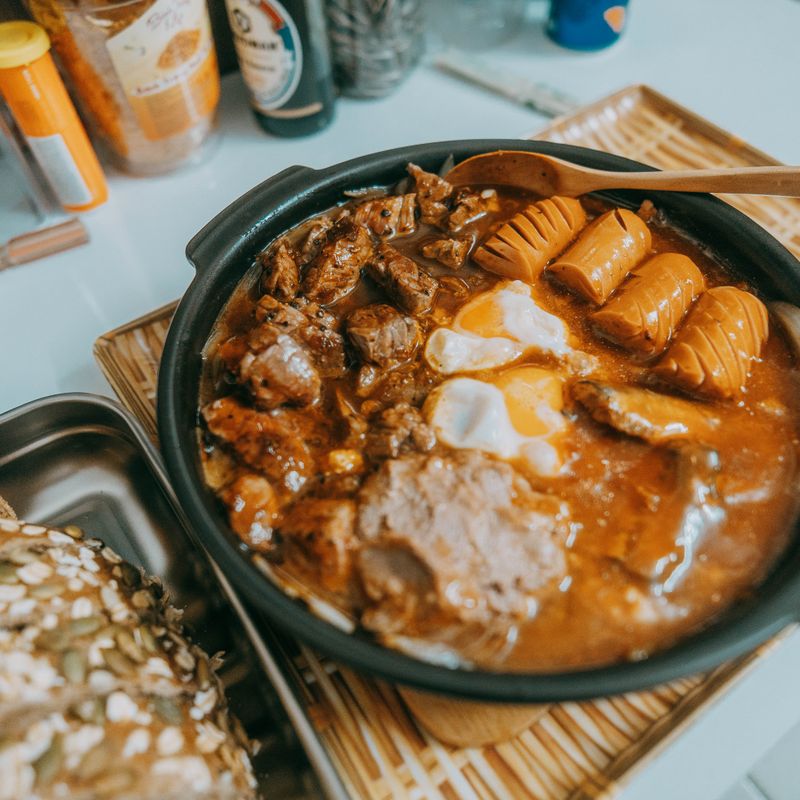
Breakfast Sausage Egg Casserole
Browned breakfast sausage, sharp cheddar and toasted bread cubes soak up a savory Dijon-spiked egg custard, then bake into a golden, puffed casserole that slices cleanly. It's an easy crowd-pleaser that can be assembled the night before and kept chilled until it goes into the oven.
- Prep
- 25 min
- Cook
- 1 hr 25 min
- Wait
- 1 hr
- Total
- 2 hr 50 min
- Makes
- 1 casserole (12 squares, from a 9×13-inch pan)
Steps
Before you start
- Cube the bread and shred the cheese ahead of time. Shred the cheese from a block, because pre-shredded cheese melts less smoothly.
- The assembled casserole must soak in the refrigerator, never on the counter. Plan for at least 30 minutes of chilled soaking before baking. An overnight soak (up to 12 hours) gives the best, most custardy texture.
- Cool the cooked sausage completely, to room temperature or colder, before it goes in the dish. Warm meat in raw egg custard is a food safety risk.
- Bake the chilled casserole straight from the fridge. Do not let it sit out to warm up. A cold dish simply needs more oven time, and it is done only when the center reads 160°F (71°C).
- Use a 9×13-inch (23×33 cm) baking dish at least 2 inches (5 cm) deep so the custard doesn't overflow.
Toast the breadOven 300°F / 150°C
- Heat the oven to 300°F (150°C).
- Spread the bread cubes in a single layer on a rimmed baking sheet.
- Bake for 15 minutes, stirring once halfway, until the cubes feel dry and crisp on the outside but are not browned.
+ Show details− Hide details
Ready when: Cubes feel dry and firm when pressed, with only a hint of color
Tip: Skip this step if your bread is already 2–3 days stale.
Brown sausage and onion
- Heat a 12-inch (30 cm) skillet over medium-high heat.
- Add the sausage and break it into ½-inch (1 cm) crumbles with a wooden spoon.
- Cook for 5 minutes until mostly browned, then add the diced onion.
- Cook 4–5 more minutes, stirring often, until the sausage has no pink left and the onion is soft and translucent.
+ Show details− Hide details
Ready when: Sausage is browned with no pink, and the onion is soft and translucent
Tip: Don't stir constantly in the first few minutes. Letting the sausage sit briefly gives it better browning.
Drain and fully cool
- Tilt the skillet and spoon off most of the rendered fat.
- Spread the sausage and onion on a plate in a thin layer and blot with a paper towel.
- Let the sausage and the toasted bread cool for 20 minutes, until neither feels warm to the touch.
- For extra safety, or if your kitchen is hot, slide the plate of sausage into the fridge for 10 minutes.
+ Show details− Hide details
Ready when: Sausage feels cool or room temperature, with no warmth when you touch it
Tip: Excess fat makes the casserole oily, so blot well. Warm meat in raw custard also invites bacterial growth.
Layer the dish
- Rub the softened butter over the bottom and sides of a 9×13-inch (23×33 cm) baking dish.
- Scatter the toasted bread cubes in an even layer.
- Top with the cooled sausage and onion, then 1½ cups (about 170 g) of the cheddar.
- Reserve the remaining ½ cup (about 55 g) cheese for the top, and keep it refrigerated until needed.
Whisk the custard
- In a large bowl, whisk the eggs for about 30 seconds until no streaks of white remain.
- Whisk in the cold milk, Dijon, salt, pepper and smoked paprika until smooth and evenly combined.
+ Show details− Hide details
Ready when: Mixture is uniformly pale yellow with the mustard fully dissolved
Tip: The sausage is already seasoned, so resist adding extra salt until you've tasted the finished casserole.
Pour and chill to soakOven 350°F / 175°C
- Slowly pour the custard evenly over the bread layer.
- Press the bread gently with a spatula so the cubes on top are moistened.
- Cover with plastic wrap or foil and refrigerate on a level shelf for at least 30 minutes and up to 12 hours.
- Do not leave the dish on the counter.
- If baking after a short soak, preheat the oven to 350°F (175°C) during the last 15 minutes.
- If baking the next day, preheat the oven fully before you take the dish out of the fridge.
+ Show details− Hide details
Ready when: Most of the liquid has been absorbed and the bread cubes look saturated
Tip: Raw egg custard should never sit at room temperature. Keep it chilled until it goes into the hot oven.
Bake coveredOven 350°F / 175°C
- With the oven at 350°F (175°C), take the dish straight from the fridge, uncover it, then cover tightly with foil, tenting it slightly so it doesn't touch the surface.
- Bake on the center rack for 30 minutes, until the edges are beginning to set and the center is still slightly jiggly.
+ Show details− Hide details
Ready when: Edges are set and puffed; the center still wobbles slightly
Tip: Lightly spray the underside of the foil to prevent sticking. Do not shorten this step for a cold dish; add time if anything.
Uncover and bake to 160°FOven 350°F / 175°C
- Remove the foil and sprinkle the reserved ½ cup cheddar over the top.
- Return the dish to the oven and bake 25–30 minutes, then check.
- The casserole is done only when an instant-read thermometer reads 160°F (71°C) in the center and in at least two other spots, and the top is golden and a knife in the center comes out clean.
- If any spot is below 160°F (71°C), keep baking and re-check every 5 minutes.
- A casserole that started in the fridge or soaked overnight often needs 35–45 minutes uncovered.
+ Show details− Hide details
Ready when: Golden top, no liquid pooling when pressed, and every spot checked reads at least 160°F (71°C)
Tip: If the top browns before the center reaches 160°F (71°C), loosely tent with foil and keep baking. Don't go by color or time alone.
Rest and serve
- Let the casserole rest on a rack for 10 minutes so it firms up for clean slices.
- Sprinkle with sliced scallions, cut into 12 squares and serve warm.
+ Show details− Hide details
Ready when: Casserole holds its shape when cut, with no runny egg
Tip: Cutting right out of the oven makes the squares slump.
Good to know
Tips
- Don't skip toasting the bread. Soft, fresh cubes break down and give a gummy, bread-pudding texture.
- Cool the sausage completely before layering so the meat doesn't warm the raw eggs. Keep the assembled dish in the fridge until it goes into the oven.
- Judge doneness by temperature, not time. Edges set first, so probe the center and a couple of other spots. All must read 160°F (71°C), and a chilled or overnight casserole may need extra time.
- Add 1 cup of sautéed bell pepper or baby spinach (squeezed dry) to the sausage layer for extra vegetables. Cool it fully before layering.
Make ahead
Assemble through step 6, cover tightly, and refrigerate up to 12 hours (overnight). Keep it chilled the whole time. Preheat the oven fully, then bake straight from the fridge without letting it warm up on the counter. Bake covered for 30 minutes, then uncovered until the center reads 160°F (71°C) in several spots, which may take 10 to 15 minutes longer than a short-soak casserole.
Storage & reheating
Room temperature: no more than 2 hours after baking. Refrigerator: airtight container up to 4 days. Freezer: wrap individual squares tightly and freeze up to 2 months; thaw overnight in the fridge. Reheat squares in the microwave 60–90 seconds, or in a 325°F (165°C) oven for 15 minutes covered with foil, until steaming hot and 165°F (74°C) in the center.
Substitutions
- bulk breakfast sausage → Diced ham or crumbled cooked bacon (about 2 cups). Skip browning for ham; just sauté the onion in 1 tablespoon butter or oil until soft. Bacon should be cooked and drained. Cool either one completely before layering.
- sturdy white bread or country-style bread → Day-old French bread, brioche, or English muffins. Use the same weight. Brioche gives a richer, softer texture.
- sharp cheddar cheese → Pepper Jack, Gruyère, or Colby Jack. Use the same amount, shredded from a block.
- whole milk → Half-and-half or 2% milk. Half-and-half makes it richer. 2% works fine, with a slightly less creamy texture.
More casseroles
See all →

Find more like this
- Meal
- Breakfast
- Cuisine
- American
- Diet
- HalalSugar-Free
- Method
- Oven
- Quick & Easy
- EasyMake Ahead