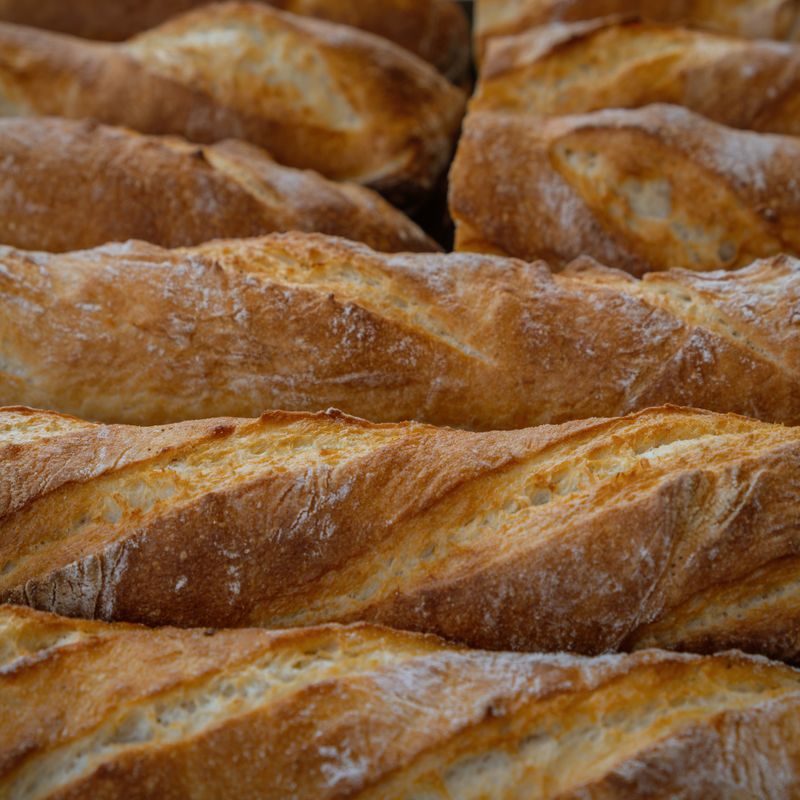
Classic French Baguettes
Crackling, deep-golden baguettes with an open, chewy crumb and a nutty wheat flavor, made with just four ingredients. A long, gentle fermentation with folds builds flavor and structure without a mixer or a starter.
- Prep
- 43 min
- Cook
- 25 min
- Wait
- 3 hr 50 min
- Total
- 4 hr 58 min
- Makes
- 3 baguettes, each about 15 inches (38 cm) long
Steps
Before you start
- Read the timing first: this is a same-day dough that needs about 5 hours from start to cooling, mostly hands-off.
- Weigh the ingredients with a digital scale if you can. Baguette dough is wet (70% hydration), and cup measures vary.
- Clear the lowest oven rack position for a pan of steam and place a second rack in the center. Make sure your oven fits a 16-inch-wide baking surface.
- Have a very sharp razor blade or lame, a clean linen towel (or couche), and a spray bottle ready before shaping.
Mix and rest
- In a large bowl, stir the yeast into the lukewarm water until dissolved.
- Add the 600 g bread flour and mix with a wet hand or spatula until no dry flour remains and the dough is a shaggy, sticky mass.
- Cover the bowl with a damp towel or plate and let it rest for 20 minutes.
- This rest hydrates the flour and starts gluten development without kneading.
+ Show details− Hide details
Ready when: No dry flour pockets remain; dough looks shaggy and slightly smoother after resting
Tip: Do not add the salt yet; it slows gluten development during the rest.
Work in salt
- Sprinkle the salt over the dough.
- With a wet hand, pinch and squeeze the dough repeatedly for about 2 minutes to work in the salt, then stretch and fold the dough over itself in the bowl for 3 more minutes, rotating the bowl each time (about 5 minutes in all).
- The dough will be sticky but should become smoother and start to resist stretching.
+ Show details− Hide details
Ready when: Dough looks cohesive, no salt grains are felt, and it pulls back slightly when stretched
Tip: Keep a small bowl of water nearby and wet your hand whenever the dough sticks. Do not add extra flour.
Bulk ferment with folds
- Cover the bowl and leave the dough at room temperature (72–75°F / 22–24°C) for 2 hours.
- At 30, 60 and 90 minutes, wet your hands, grab one edge of the dough, stretch it up gently and fold it over the center.
- Turn the bowl a quarter turn and repeat 3 more times (4 folds per round).
- Cover again after each round and leave it alone for the remaining time.
+ Show details− Hide details
Ready when: Dough has increased by about 75%, is domed and jiggly, and shows bubbles on the surface and sides
Tip: In a cool kitchen, allow up to 2½ hours. Judge by the dough's volume, not the clock.
Divide and pre-shape
- Lightly flour a work surface using some of the extra flour.
- Gently turn out the dough without deflating it more than necessary.
- Cut it into 3 equal pieces of about 345 g each.
- Pat each piece into a loose rectangle, then fold it into thirds like a letter, and turn it seam side down.
- Cover with a towel and let the pieces rest for 20 minutes.
+ Show details− Hide details
Ready when: Pieces look relaxed and slightly puffy, and spread a little when touched
Tip: Handle gently; the gas in the dough is what makes the open crumb.
Shape the baguettes
- Working with one piece at a time, pat it into a rectangle about 6 × 8 inches (15 × 20 cm), with a long side facing you.
- Fold the top third down to the center and press the seam with your fingertips.
- Fold the bottom third up over it and seal the seam firmly with the heel of your hand.
- Roll the cylinder seam side down and, using both hands and working from the center outward, roll and gently stretch it to 15 inches (38 cm) long, tapering the ends slightly.
- The seam should be tight and the surface taut.
+ Show details− Hide details
Ready when: Each loaf is an even 15-inch cylinder with a taut surface and a sealed seam underneath
Tip: If the dough springs back when stretching, rest it for 5 minutes under the towel and try again.
Proof and preheatOven 475°F / 245°C
- Dust the linen couche generously with flour and lay the loaves seam side up on it, pleating the cloth between them so they do not touch.
- Cover loosely with a towel and proof for 45 minutes.
- Meanwhile, 30 minutes before baking, place the baking stone on the center rack and a sturdy empty metal pan on the lowest rack, then preheat the oven to 475°F (245°C).
- Keep the boiling water for later.
+ Show details− Hide details
Ready when: Loaves look puffy and a gently pressed fingertip leaves a dent that springs back slowly
Tip: Underproofed loaves burst unevenly; overproofed loaves go flat. Press gently, and bake when the dent recovers slowly.
Transfer and score
- Gently roll each loaf seam side down onto a rimless baking sheet or parchment-lined board.
- Using a razor blade held at a shallow 30° angle, make 3 to 5 slashes down the length of each loaf, each about 4 inches (10 cm) long and overlapping by one-third.
- Use quick, confident strokes about ¼ inch (6 mm) deep.
+ Show details− Hide details
Ready when: Slashes open slightly right after cutting without dragging the dough
Tip: A dull blade drags and deflates the loaf. Keep the blade nearly flat for a classic ear.
Bake with steamOven 475°F / 245°C
- Slide the loaves, on the parchment, onto the hot stone.
- Immediately pour the 1 cup boiling water into the hot pan on the lowest rack and quickly close the oven door.
- Bake at 475°F (245°C) for 12 minutes.
- The steam keeps the crust soft so the loaves can expand fully.
+ Show details− Hide details
Ready when: Loaves have risen, the slashes have opened into ears, and the crust is pale gold
Tip: Wear oven mitts and stand back when pouring water; the steam is very hot. Do not open the door during this stage.
Vent and finishOven 450°F / 230°C
- Carefully remove the steam pan, using oven mitts.
- Reduce the oven to 450°F (230°C) if the loaves are browning quickly, then bake 12 to 13 minutes more, until the crust is deep golden brown.
- Tap the underside of a loaf: it should sound hollow, and an instant-read thermometer in the center should read 205–210°F (96–99°C).
+ Show details− Hide details
Ready when: Deep golden-brown crust, hollow sound when tapped on the bottom, 205–210°F (96–99°C) inside
Tip: Pale baguettes taste bland. Bake until they are a deep golden, not light tan.
Cool completely
- Transfer the baguettes to a wire rack and let them cool for at least 30 minutes.
- You will hear the crust crackle as it cools.
- Do not slice early; the crumb is still setting and will turn gummy.
+ Show details− Hide details
Ready when: Loaves feel light and are barely warm to the touch
Good to know
Tips
- Do not add flour to a sticky dough. The high hydration creates the open, airy crumb; wet hands are better than dry ones.
- No baking stone? Preheat an inverted heavy baking sheet instead. Bake the loaves on parchment so they slide on easily.
- If your oven is shorter than 16 inches, bake in two batches, keeping the second batch in the fridge while the first bakes.
- For a crisper crust, turn the oven off after baking, leave the door ajar, and let the loaves sit 5 minutes before cooling.
Make ahead
"For deeper flavor, after the 2-hour bulk ferment, cover the dough and refrigerate for 12 to 18 hours. Next day, let it sit at room temperature for 30 minutes, then divide, shape, proof 45 to 60 minutes and bake as directed."
Storage & reheating
"Best eaten the day it is baked. Keep at room temperature, cut side down on a board or in a paper bag, for up to 1 day; do not refrigerate. Freeze completely cooled loaves, wrapped tightly, for up to 2 months. Reheat from frozen or stale at 400°F (200°C) for 5 to 8 minutes directly on the oven rack to re-crisp the crust."
Substitutions
- bread flour → unbleached all-purpose flour. Use the same weight but reduce water to 400 ml; the crumb will be a little softer and less chewy.
- instant yeast → active dry yeast. Use ¾ teaspoon (2.5 g) and dissolve it in the lukewarm water for 5 minutes before mixing.
- fine sea salt → kosher salt. Use 1 tablespoon (about 15 g) of Diamond Crystal, or weigh 12 g of any salt for accuracy.
- bread flour → 25% whole wheat flour. Replace 150 g of the bread flour and add 15 ml more water for a nuttier loaf.
More yeast breads
See all →

Find more like this
- Meal
- Breakfast
- Cuisine
- French
- Method
- Oven
- Quick & Easy
- 5 Ingredients or LessBudget