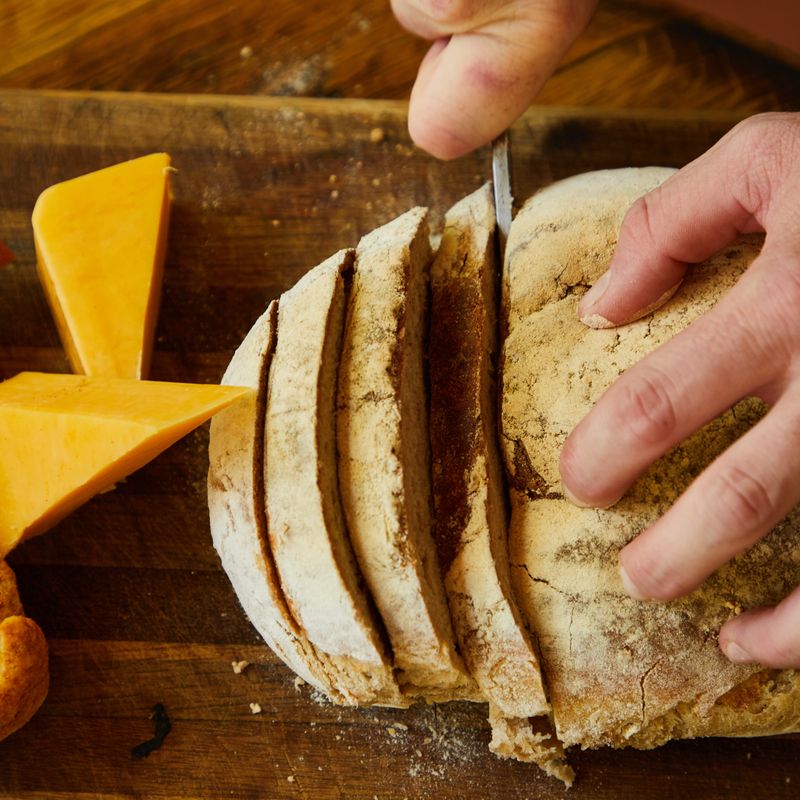
Sourdough Korean Gochujang and Cheese Tear Bread
A pull-apart tear bread made with bubbly sourdough starter, studded with layers of gochujang-seasoned butter and stretchy mozzarella cheese. The spicy Korean chili paste creates a bold, umami-rich flavor that balances the tangy sourdough and creamy cheese. Perfect for sharing straight from the oven while the cheese is still melted and the crust crackles.
- Prep
- 30 min
- Cook
- 25 min
- Wait
- 8 hr
- Total
- 8 hr 55 min
- Makes
- 1 loaf (12–14 pull-apart pieces)
Steps
Before you start
- Use active, bubbly sourdough starter at its peak (doubled and with a dome of bubbles on top)
- Set out butter to soften to room temperature 1 hour ahead
- Have mozzarella cut or torn into small pieces (about pea-sized)
- Read the entire recipe; bulk fermentation and shaping happen over 6–8 hours
Mix dough
- In a stand mixer bowl or large mixing bowl, combine the active sourdough starter, lukewarm water, bread flour, and salt.
- Using the dough hook on medium speed (or mixing by hand), combine for 2 minutes until no dry flour remains.
- The dough should be shaggy and slightly sticky.
- Let rest for 10 minutes to fully hydrate.
+ Show details− Hide details
Ready when: No visible dry flour
Tip: Do not overwork at this stage; you want a loose, extensible dough, not a tight one.
Bulk ferment dough
- Cover the bowl loosely with a damp kitchen towel or plastic wrap.
- Let rest at warm room temperature (70–75°F / 21–24°C) for 4–6 hours.
- Perform 4 sets of stretch and folds: every 45 minutes for the first 3 hours, wet your hand, grab one side of the dough, and stretch it up and fold it over the center, rotating the bowl a quarter turn and repeating until the dough feels strengthened and cohesive.
- By the end of bulk fermentation, the dough should be puffy, soft, and increase by 50–75% in volume.
+ Show details− Hide details
Ready when: Dough is 50–75% larger, airy with visible bubbles, and jiggles when you move the bowl
Tip: Stretch and folds build strength without kneading; if your house is cold, place the bowl in an oven with the light on, or wrap it in a towel.
Prepare filling
- While the dough ferments, make the gochujang-butter spread.
- In a small bowl, whisk together softened butter, gochujang, minced garlic, and toasted sesame oil until smooth and well combined.
- Set aside at room temperature.
+ Show details− Hide details
Ready when: Mixture is uniform and spreadable
Tip: Make this while doing stretch and folds so it is ready when you shape.
Shape dough
- Turn the fermented dough out onto a lightly floured work surface.
- Gently shape it into a rough rectangle about 10 inches wide by 12 inches long (25×30 cm), being careful not to deflate too much.
- Working quickly, spread about two-thirds of the gochujang-butter mixture evenly across the dough, leaving a 1-inch (2.5 cm) border on all sides.
- Scatter half the mozzarella and half the sliced scallions over the gochujang layer.
+ Show details− Hide details
Ready when: Rectangle is approximately 10×12 inches with a clean border
Tip: If the dough resists shaping, let it rest for 5 minutes under a damp towel to relax the gluten.
Roll and layer
- Starting from one of the long sides, roll the dough tightly toward you, creating a log.
- Pinch the seam closed.
- Turn the log so the seam faces down.
- Using a bench scraper or very sharp knife, cut the log into 12–14 equal pieces about 1.5 inches (4 cm) wide.
- The cut side of each piece should show the spiral.
+ Show details− Hide details
Ready when: 12–14 equal spiral-cut pieces
Tip: Use a very sharp knife and a gentle sawing motion to prevent squashing the dough.
Arrange in pan
- Lightly butter or oil an 8×4-inch loaf pan (or 7-inch round cake pan).
- Arrange the cut pieces upright in the pan, spiral side up and facing out, in two rows.
- Scatter the remaining mozzarella pieces and scallion slices around and between the pieces.
- Drizzle any remaining gochujang-butter mixture over the top.
- Cover loosely with a damp towel or plastic wrap.
+ Show details− Hide details
Ready when: Pieces are snugly arranged with filling visible
Tip: Arrange pieces cut-side up so the spiral is visible and the bread can pull apart easily.
Final rise
- Cover the pan loosely and let the bread rise at warm room temperature (70–75°F / 21–24°C) for 1.5–2 hours, or until the pieces have puffed and begun to touch the top of the pan or touch each other.
- Alternatively, place the pan in the refrigerator for 8–12 hours overnight; the rise will be slower, developing more flavor.
- Remove from the fridge 45 minutes before baking to warm up slightly.
+ Show details− Hide details
Ready when: Dough is puffy and pieces touch the rim; poke gently and it springs back slowly
Tip: A cold overnight rise is ideal for sourdough flavor; the dough can spend 8–12 hours in the fridge.
Preheat ovenOven 400°F / 205°C
- Preheat the oven to 400°F (200°C) and place a rack in the upper-middle position.
- If you chilled the dough overnight, remove it from the fridge and let it sit on the counter for about 45 minutes to warm up.
+ Show details− Hide details
Ready when: Oven is at temperature
Tip: Use the upper-middle rack so the top browns beautifully without the bottom burning.
Bake breadOven 400°F / 205°C
- Place the pan in the preheated 400°F (200°C) oven.
- Bake for 25–30 minutes, until the top is deeply golden brown and the cheese has melted visibly.
- The internal temperature at the center should be around 200–205°F (93–96°C).
- If the top browns too quickly (after 15 minutes), loosely tent with aluminum foil, but allow the cheese to remain slightly exposed.
+ Show details− Hide details
Ready when: Top is deep golden brown, cheese is melted and bubbling slightly, internal temp is 200–205°F (93–96°C)
Tip: Do not skip the tent if browning is too fast; the interior needs time to set while the top crisps.
Cool and serve
- Remove the pan from the oven and let the bread cool in the pan for 5 minutes.
- Turn it out onto a wire rack or serve directly from the pan.
- Let cool for another 5–10 minutes so the cheese sets slightly (it will still be warm and stretchy).
- Sprinkle with toasted sesame seeds if desired.
- Serve warm, pulling apart the pieces by hand.
+ Show details− Hide details
Ready when: Bread is cool enough to handle and cheese has firmed slightly but is still melting
Tip: Serve immediately while warm; as it cools, the cheese will firm up and the bread becomes less tender.
Good to know
Tips
- Keep your sourdough starter active and bubbly at its peak; a sluggish or underdoubled starter will result in a dense, flat loaf. Feed it 4–6 hours before using.
- Stretch and folds are gentler than kneading for sourdough and build structure without overworking the gluten. Wet your hand to prevent sticking.
- Mozzarella releases moisture as it melts; tear it into small pieces and drain wet mozzarella on a paper towel before using so the bread does not become soggy.
- A cold overnight rise in the fridge boosts sourdough flavor and gives you flexibility; the slow fermentation also makes the dough easier to shape cleanly.
Make ahead
Prepare the gochujang-butter filling up to 2 days ahead and store in the fridge. Shape and arrange in the pan up to 12 hours ahead, then chill; let warm to room temperature for 45 minutes before baking.
Storage & reheating
Room temp (up to 4 hours): Keep covered with a towel to retain moisture. Fridge (up to 3 days): Wrap tightly in plastic wrap; reheat gently in a 300°F (150°C) oven for 10–12 minutes until warm and cheese softens. Freezer (up to 3 months): Cool completely, wrap tightly, and label. Thaw overnight in the fridge, then reheat as above.
Substitutions
- fresh mozzarella → White cheddar, Gruyère, or fontina. Use any melting cheese with a similar texture. White cheddar adds sharpness; Gruyère adds nuttiness; fontina gives a richer, creamier result.
- gochujang (Korean red chili paste) → Sambal oelek (Indonesian chili paste) mixed with 1 tsp tomato paste and 1 tsp sugar. Sambal is spicier and less sweet than gochujang; add a touch of sweetness to balance. Use the same amount by weight.
- bread flour → All-purpose flour. All-purpose flour will produce a slightly softer, less chewy crumb. Reduce water by 10 ml since all-purpose absorbs less than bread flour.
- toasted sesame oil → Neutral oil (canola or grapeseed) mixed with a pinch of sesame extract, or omit. Sesame oil adds authentic Korean flavor but is optional. Omitting it is fine; the bread will still be delicious.
More yeast breads
See all →

Find more like this
- Meal
- Breakfast
- Cuisine
- Korean
- Main ingredient
- Mozzarella
- Method
- Oven