
Black Sesame and Tahini Breakfast Bagels
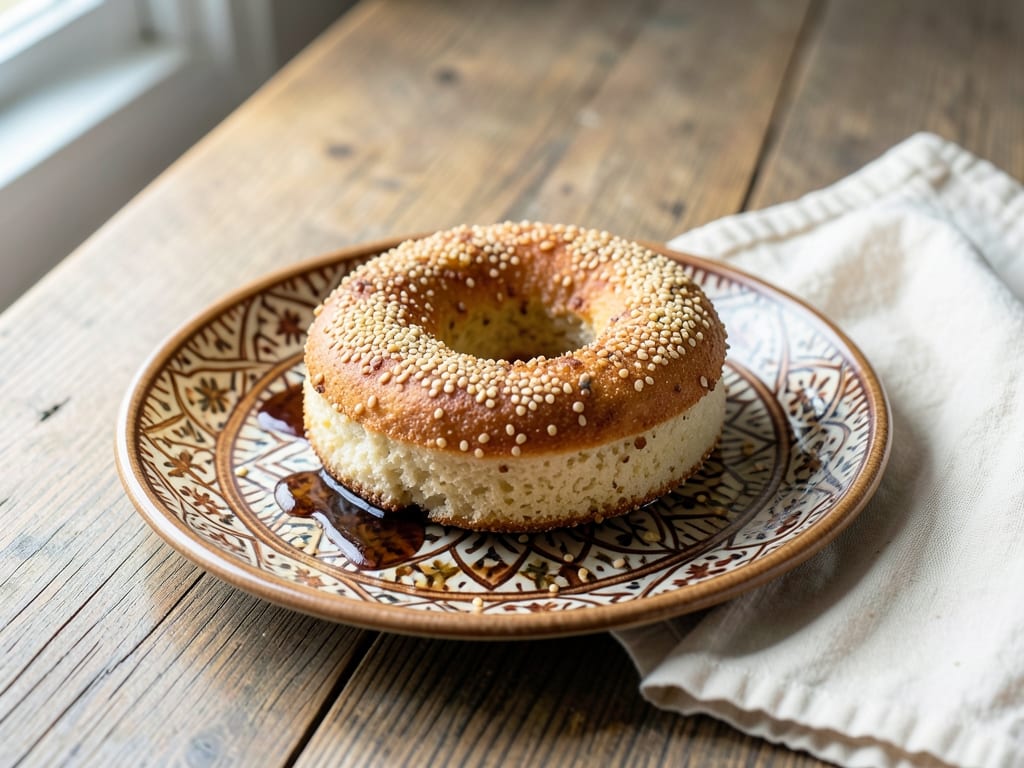
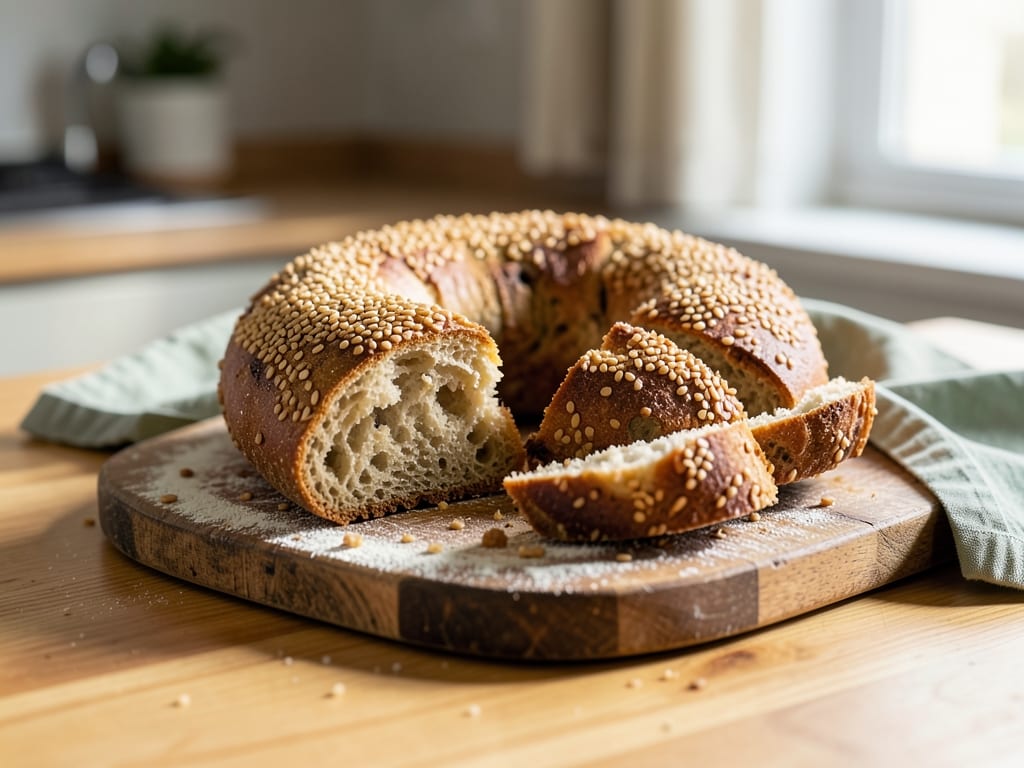
Chewy bagels infused with nutty tahini and studded with earthy black sesame seeds, with a subtle honey sweetness. These Middle Eastern–inspired bagels are boiled briefly before baking to achieve that signature dense, tender crumb, and are finished with a glistening black sesame crust for a striking presentation.
Steps
Before you start
- Read through the full recipe—bagels require two separate rises and a brief boil before baking
- Preheat your oven to 425°F (220°C) 15 minutes before the second bake
- Gather all ingredients and ensure your instant yeast is fresh (active)
Mix dough ingredients
- In the bowl of a stand mixer, combine 455 g bread flour, 5 g instant yeast, and 9 g salt.
- In a separate small bowl, whisk together 300 ml cold water, 45 g tahini, and 21 g honey until the tahini is fully incorporated (it's easier if you stir the tahini first, then add water and honey).
- Add the wet mixture to the dry ingredients and mix on low speed with the dough hook for 2 minutes, scraping down the bowl as needed.
- Increase to medium speed and knead for 8–10 minutes until a smooth, elastic dough forms.
- The dough should be slightly tacky but hold its shape.
+ Show details− Hide details
Ready when: Dough is smooth, elastic, and slightly tacky; pulls away from the bowl sides cleanly
Tip: Don't skip the brief rest before kneading; it helps the flour fully hydrate and results in easier handling.
First rise
- Transfer the dough to a lightly oiled large bowl, cover tightly with plastic wrap, and let rise at room temperature (68–72°F / 20–22°C) for 60 minutes, until puffy and increased in volume by roughly 50% (not fully doubled—bagel dough rises more gently than sandwich bread).
+ Show details− Hide details
Ready when: Dough is visibly puffed and slightly domed on top
Tip: Bagel dough rises more slowly than other breads because of its density; don't overproof or the bagels will be tough.
Divide and pre-shape
- Turn the dough out onto a lightly floured work surface and gently press to deflate.
- Using a bench scraper or knife, divide the dough into 6 equal pieces (each roughly 115 g).
- Gently pre-shape each piece into a round by rolling it slightly on the counter, then cover loosely with a damp kitchen towel.
+ Show details− Hide details
Ready when: Six roughly equal rounds; pieces hold their shape lightly
Tip: Weigh the pieces for consistency—evenly sized bagels bake uniformly.
Form bagel rings
- Take one pre-shaped dough round, poke your thumb through the center, and gently stretch the dough into a ring shape roughly 3 inches (7.5 cm) in diameter, keeping the hole centered and the walls even.
- The dough should be about ½ inch (1.25 cm) thick.
- Repeat with the remaining pieces.
- Place the shaped bagels on a parchment-lined baking sheet, leaving 2 inches (5 cm) between them.
+ Show details− Hide details
Ready when: Six bagel rings with visible holes and even thickness
Tip: Don't make the holes too large—they will shrink slightly as the bagels proof, but if the hole is too big, it may close during baking.
Second rise
- Cover the shaped bagels loosely with plastic wrap or a damp towel and let them proof at room temperature for 60–75 minutes, until they look puffy and slightly domed.
- They should yield gently to a light press but spring back immediately.
+ Show details− Hide details
Ready when: Bagels are visibly puffy and domed; a light poke leaves a shallow indentation that springs back slowly
Tip: Underproofing gives dense, chewy bagels; overproofing makes them doughy. Aim for a gentle proof.
Preheat oven and prepare boiling waterOven 425°F / 220°C
- Preheat your oven to 425°F (220°C).
- Fill a 4-quart pot with water and bring to a rolling boil over high heat.
- Stir in 12 g baking soda (the water will foam slightly).
+ Show details− Hide details
Ready when: Water is at a rolling boil; baking soda is fully dissolved
Tip: Baking soda raises the pH of the boiling water, which helps the bagel exterior brown and gelatinize properly.
Boil bagels
- Working with 2–3 bagels at a time, gently lower them into the boiling water using a slotted spoon.
- They will initially sink, then float to the surface after 30–45 seconds.
- Once floating, boil for exactly 1 minute per side (flip with the slotted spoon), then 1 minute total on the top.
- Remove with the slotted spoon and place on a clean kitchen towel to drain for 1–2 minutes.
+ Show details− Hide details
Ready when: Bagels are pale golden and firm to the touch; no longer doughy or sticky
Tip: Don't skip the boil—it sets the bagel's structure and creates the chewy crust. Boil in small batches to maintain water temperature.
Apply black sesame topping
- Place the boiled, drained bagels back on the parchment-lined baking sheet.
- While still slightly warm and damp, press or sprinkle 120 g black sesame seeds (about 20 g per bagel) onto the top half of each bagel.
- If desired, sprinkle a few white sesame seeds for contrast.
- The seeds should adhere to the damp surface.
+ Show details− Hide details
Ready when: Bagels are evenly coated with black sesame; topping is secure
Tip: Apply seeds while the bagels are still damp from boiling—they'll stick more reliably. Use a light touch so seeds don't fall off during baking.
Bake bagelsOven 425°F / 220°C
- Bake at 425°F (220°C) for 22–28 minutes, until the tops are golden brown and the sesame seeds are fragrant and slightly darkened.
- The bottoms should be firm and sound hollow when tapped.
- Rotate the baking sheet halfway through if your oven has hot spots.
+ Show details− Hide details
Ready when: Tops are golden brown; sesame seeds are fragrant and slightly darkened; bottom sounds hollow when tapped
Tip: Rotate the sheet at the 12-minute mark if baking unevenly. The bagels are done when the crust is firm and slightly crispy.
Cool and serve
- Transfer the bagels to a wire rack and let cool for at least 15 minutes before slicing or serving.
- They will firm up slightly as they cool.
- Serve warm or at room temperature, split and toasted if desired, with your choice of toppings.
+ Show details− Hide details
Ready when: Bagels are warm to the touch but no longer steaming; crust is set
Tip: Cooling is essential—cutting into a hot bagel will compress the crumb and make it gummy.
Good to know
Tips
- Tahini can separate during storage—stir it thoroughly before measuring to ensure even distribution throughout the dough.
- If your bagels spread too much during proofing, they may have overproofed. Next time, reduce the second rise by 10–15 minutes or use slightly cooler room temperature.
- Black sesame seeds have less oil than white sesame and will not brown as dramatically; this is normal. The dark color is from the seed itself, not from toasting.
- For extra richness, brush the cooled bagels lightly with melted tahini or honey before serving.
Make ahead
These bagels are best enjoyed the day they're baked. You can prepare and shape the bagels up to 12 hours ahead: after forming the bagel rings (Step 4), refrigerate them on a covered baking sheet overnight. The next morning, remove from the fridge and let them proof at room temperature for 30–40 minutes before boiling and baking. Cold proofing slows fermentation and develops deeper flavor.
Storage & reheating
Room temperature (up to 1 day): Store in a paper bag or on a rack; they will gradually lose moisture. Refrigerator (3–5 days): Wrap tightly and refrigerate; reheat in a 350°F (175°C) oven for 5–7 minutes before serving. Freezer (up to 3 months): Wrap individually in foil or freezer paper, then place in a freezer-safe bag. Thaw at room temperature (2–3 hours) or reheat from frozen in a 375°F (190°C) oven for 15–20 minutes.
Substitutions
- black sesame seeds → white sesame seeds, poppy seeds, or nigella seeds. Use the same weight. Black sesame has an earthy, slightly bitter flavor; white sesame is milder and nuttier. Either works beautifully.
- tahini (sesame paste) → almond butter or sunflower seed butter. Use the same weight. The flavor will shift from Middle Eastern to earthier or more floral, but the texture and chew remain similar.
- honey → brown sugar or maple syrup. Use the same weight. Brown sugar adds molasses depth; maple syrup contributes a subtle woodsy note.
- bread flour → all-purpose flour (use 3 tablespoons less total flour due to lower protein). All-purpose flour yields slightly softer, less chewy bagels. Reduce total flour to 3¼ cups (420 g) to compensate.
More yeast breads
See all →

Find more like this
- Meal
- Breakfast
- Cuisine
- Middle Eastern
- Method
- Oven