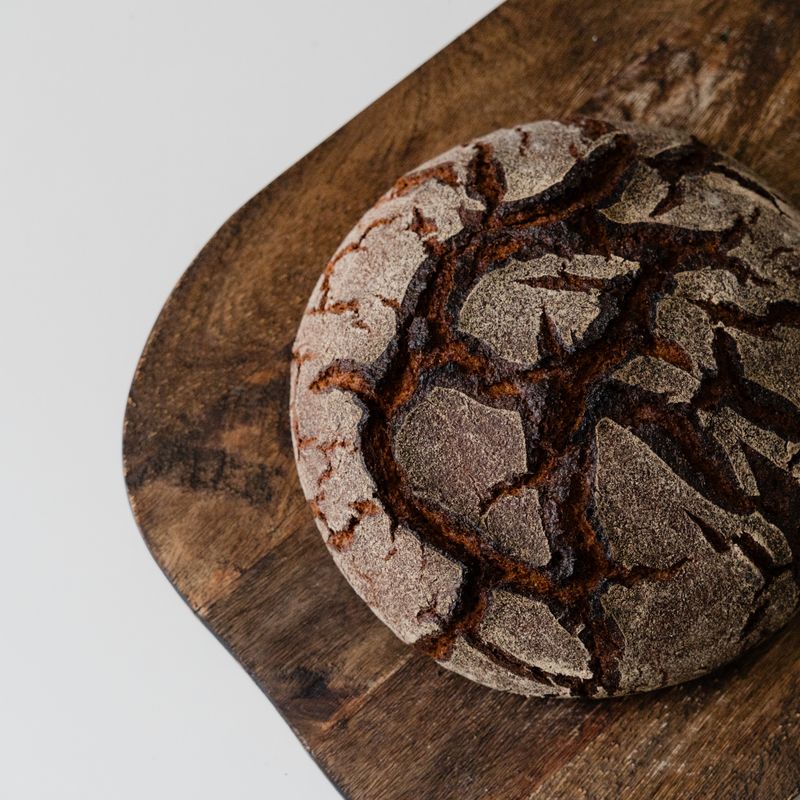
Sourdough Overnight Tangzhong Loaf
A fusion bread that marries sourdough's deep flavor with tangzhong's incredibly soft, milk-bread texture. A roux of flour and milk creates a gelatinized base that locks in moisture, while the sourdough starter provides complex fermentation and tang. The overnight cold fermentation develops flavor without rushing, resulting in an open crumb, subtle sourness, and pillowy softness.
- Prep
- 25 min
- Cook
- 35 min
- Wait
- 9 hr 10 min
- Total
- 10 hr 10 min
- Makes
- 1 loaf (10–12 slices)
Steps
Before you start
- Make sure your sourdough starter is active and bubbly, fed 4–8 hours ahead.
- All ingredients (flour, milk, butter, starter) should be at cool room temperature (65–70°F / 18–21°C).
- You'll need a banneton or bowl lined with a floured kitchen towel for the final proof.
- Have a Dutch oven (5–6 quart / 4.7–5.7 L) ready and preheat it 30 minutes before baking.
Make the tangzhong rouxOven 170°F / 75°C
- In a small saucepan, whisk together 2 tablespoons (16 g) bread flour with 0.5 cup (120 ml) milk and 0.25 cup (60 ml) water until smooth and lump-free.
- Place over medium heat and stir constantly with a whisk.
- The mixture will thicken as it heats—it should reach a paste-like consistency after 2–3 minutes.
- You'll see it bubble gently and pull away slightly from the sides of the pan.
- Once thickened, it's done.
- The temperature should be around 160–170°F (71–76°C).
- Transfer to a bowl and let cool to room temperature, about 15 minutes.
+ Show details− Hide details
Ready when: Mixture thickens to a paste-like consistency and reaches 160–170°F (71–76°C); a wooden spoon leaves a brief trail when dragged through
Tip: Whisk constantly to avoid lumps. Don't skip cooling—hot tangzhong can damage the yeast in your starter.
Mix the dough
- In a large mixing bowl, combine the cooled tangzhong, 3.5 cups (450 g) bread flour, 0.75 cup (180 g) active sourdough starter, 0.5 cup (120 ml) water, 1 tablespoon (13 g) sugar, and 1.5 tablespoons (21 g) softened butter.
- Stir with a dough scraper or wooden spoon until all flour is hydrated and you have a shaggy, sticky dough with no dry streaks.
- The dough should be quite wet—this is normal for enriched sourdough.
- Don't knead yet.
+ Show details− Hide details
Ready when: All flour is hydrated and incorporated; no dry streaks remain
Tip: Don't worry if it's sticky—tangzhong doughs are wetter than typical sourdough. The texture will firm up as you build strength.
Salt the dough
- Sprinkle 1.75 teaspoons (10 g) fine sea salt over the dough.
- Using your damp hand or a dough scraper, squeeze and fold the dough on itself 20–30 times, working the salt in evenly.
- The dough will begin to feel more cohesive.
- This is a gentle way to incorporate salt and build initial gluten structure without aggressive kneading.
+ Show details− Hide details
Ready when: Salt is fully incorporated and the dough feels more cohesive and slightly less sticky
Tip: Keep your hand damp to prevent sticking. Fold and squeeze methodically—this builds strength without overworking the dough at this early stage.
Bulk fermentation with folds
- Leave the dough in the bowl at room temperature (65–70°F / 18–21°C).
- After 30 minutes, perform a set of 4–6 coil folds or stretch-and-folds: wet your hand, grab one side of the dough, stretch it up and fold it over the center, rotate the bowl 90°, and repeat.
- You're looking to build tension and integrate the dough.
- Repeat this process 4–5 times over the next 2–3 hours, spacing folds 30–45 minutes apart.
- By the last fold, the dough should feel smoother, slightly stronger, and a bit airy (you may see small bubbles).
- The total bulk fermentation time is 3–4 hours.
+ Show details− Hide details
Ready when: Dough has increased in volume by 30–50%, feels airy with visible bubbles on the surface, and jiggles slightly when the bowl is moved
Tip: If your kitchen is cooler than 65°F (18°C), extend bulk fermentation by 30–60 minutes. Watch the dough, not the clock—visual cues matter more than exact timing.
Pre-shape the dough
- Turn the dough out onto a lightly floured work surface.
- Use a dough scraper to gently pull the dough into a round, pre-shaping it by folding the edges toward the center a few times.
- Don't overwork it.
- Let it rest on the counter, uncovered, for 20–25 minutes.
- This resting period allows the gluten to relax and the dough to firm up slightly before final shaping.
+ Show details− Hide details
Ready when: Dough has relaxed and feels less tense; it no longer springs back aggressively when poked
Tip: A 20-minute rest prevents tearing during final shaping and helps the dough hold its shape better during overnight fermentation.
Final shape and banneton
- Lightly flour the top of the dough and your work surface.
- Flip the dough over so the floured side is down.
- Fold the top edge down toward the center, press gently, then fold the left and right edges toward the center.
- Roll the dough away from you, creating tension as you go, and seal the seam with the heel of your hand.
- The shaped loaf should be taut and round.
- Place it seam-side up in a 9-inch (23 cm) banneton or medium bowl lined with a well-floured kitchen towel.
+ Show details− Hide details
Ready when: Loaf is evenly rounded with tension across the surface and sits seam-side up in the banneton
Tip: Tension is key—it helps the loaf rise up and open well in the oven. Don't make the seam too thick, or your loaf may split unevenly.
Cold overnight fermentation
- Cover the banneton with a plastic bag or beeswax wrap and place it in the refrigerator at 38–40°F (3–4°C) for 12–16 hours, or up to 18 hours.
- This extended cold fermentation builds deep sourdough flavor, allows the gluten network to fully develop, and makes scoring and baking easier because the cold dough is more stable.
+ Show details− Hide details
Ready when: Loaf has risen 25–40% and feels slightly puffy when poked gently; the dough is cold and firm
Tip: Longer fermentation (16–18 hours) develops more sour flavor; shorter times (12–14 hours) result in milder tang. You're in control of flavor intensity.
Preheat the Dutch ovenOven 450°F / 230°C
- About 30 minutes before baking, preheat your 5–6 quart (4.7–5.7 L) Dutch oven in a 450°F (232°C) oven with the lid on.
- The oven and pot should both be fully preheated and very hot.
- Preheat your oven to 450°F (232°C).
+ Show details− Hide details
Ready when: Oven thermometer reads 450°F (232°C) and Dutch oven is very hot to the touch (careful!)
Tip: A properly preheated Dutch oven is essential for steam, which drives the loaf's rise and creates a beautiful, crispy crust.
Score and load the loafOven 450°F / 230°C
- Carefully remove the hot Dutch oven from the oven (use oven mitts).
- Place a piece of parchment paper on a work surface and gently turn the banneton over so the loaf lands seam-side down on the parchment.
- Using a very sharp knife or lame, score the loaf with a single confident slash at about 30° angle, roughly 0.25 inch (6 mm) deep, across the top.
- Or make an X-shaped score.
- Transfer the loaf (still on parchment) into the hot Dutch oven.
- Cover with the lid.
+ Show details− Hide details
Ready when: Loaf is scored cleanly and sitting in the hot Dutch oven; lid is on
Tip: A cold loaf going into a screaming-hot oven will expand rapidly—the score directs that expansion and creates the signature ear. Confidence matters: one sharp cut is better than sawing.
Bake covered (steam phase)Oven 450°F / 230°C
- Bake the loaf covered at 450°F (232°C) for 20 minutes.
- The lid traps steam, which keeps the crust soft during the first stage of baking, allowing the loaf to expand fully.
- You should hear some crackling and see steam escaping—this is perfect.
+ Show details− Hide details
Ready when: Steam is visible; loaf has risen and is beginning to brown slightly at the edges
Tip: Don't peek! Opening the lid releases steam and disrupts the baking process. Trust the timing.
Bake uncovered (crust phase)Oven 450°F / 230°C
- Carefully remove the lid (watch for steam!) and continue baking for 15–18 minutes at 450°F (232°C).
- The loaf should now brown deeply.
- The crust will darken from light golden to deep mahogany or chestnut.
- The loaf should feel very firm and hollow-sounding when tapped on the bottom.
+ Show details− Hide details
Ready when: Crust is deep golden-brown to chestnut-colored; internal temperature reads 205–210°F (96–99°C); loaf sounds hollow when tapped on the bottom
Tip: Don't underbake—a fully baked loaf has a crispy, resonant crust and a perfectly set crumb. Underbaked loaves are gummy inside.
Cool completely
- Remove the loaf from the Dutch oven and place it on a wire rack at room temperature.
- Resist the urge to slice for at least 1 hour—ideally 2–3 hours.
- As the loaf cools, the interior continues to set and the crumb structure stabilizes.
- A loaf cut too early will be gummy and fall apart.
+ Show details− Hide details
Ready when: Loaf is completely cool to the touch; interior crumb has set and is no longer steaming
Tip: Cool on a wire rack, not on the baking sheet, so air circulates and the bottom crust stays crispy instead of becoming soggy.
Good to know
Tips
- Tangzhong is a Japanese technique (also called 'roux' method) that gelatinizes flour in liquid, creating a paste that locks in moisture. This creates incredibly soft bread even with sourdough's typically drier character.
- Sourdough starter strength matters: use a starter that's been fed 4–8 hours prior and is at peak (visibly bubbly and about to collapse, or just starting to recede). Weak starter = slow fermentation and flat loaves.
- Temperature control is key to overnight fermentation. A fridge at 38–40°F (3–4°C) is ideal. Warmer (45–50°F / 7–10°C) may overproof; colder (below 35°F / 1.5°C) will ferment very slowly.
- Don't skip the cooling step. The interior of sourdough continues to bake and set as it cools. Cutting too early results in a gummy, torn crumb. Two to three hours is ideal; overnight cooling is even better if you can wait.
Make ahead
You can hold the shaped, cold loaf in the banneton in the refrigerator for up to 24 hours. If you want to bake it later than 18 hours, remove it from the fridge, let it come to room temperature (about 2–3 hours), and bake normally. Alternatively, you can freeze the shaped loaf (in the banneton, wrapped well) for up to 1 month; bake directly from frozen, adding 10–15 minutes to the total baking time.
Storage & reheating
Room temperature (cut side down on a cutting board or in a bread box): 2–3 days. Wrap the cooled loaf in a clean kitchen towel or place in a paper bag to keep the crust crispy and the interior soft. For longer storage, slice and freeze in an airtight container or freezer bag for up to 3 months. Toast from frozen to refresh, or thaw at room temperature for 2–3 hours before serving.
Substitutions
- bread flour → All-purpose flour (use the same weight, 450 g). All-purpose flour has slightly less protein and will yield a softer, less structured crumb. Bulk fermentation may be 15–30 minutes shorter. The loaf will be just as flavorful but slightly less open in the crumb.
- whole milk → Heavy cream or full-fat Greek yogurt (thinned with water to 120 ml total), or use milk + 1 teaspoon milk powder. Richer tangzhongs (cream or yogurt) yield even softer, more luxurious crumbs. Yogurt will add mild tang and requires slightly more whisking to smooth out.
- active sourdough starter → Stiff sourdough starter or levain (adjust water by –2–3 tablespoons / 30–45 ml if using stiff starter). If your starter is very thick (stiff starter), reduce the water in the dough to avoid over-hydration. Liquid starter and stiff starter ferment at slightly different rates, so monitor the dough visually.
- unsalted butter → Neutral oil (use 1 tablespoon / 15 ml instead of 1.5 tablespoons butter). Oil creates a slightly more tender crumb but less layering. Use a mild oil like grapeseed or light olive oil to avoid overpowering the sourdough flavor.
More yeast breads
See all →


Find more like this
- Meal
- Breakfast
- Diet
- VegetarianHalal
- Method
- Oven
- Quick & Easy
- Make AheadFreezer Friendly