
Sourdough Korean Gamja-Cheese Garlic Bread
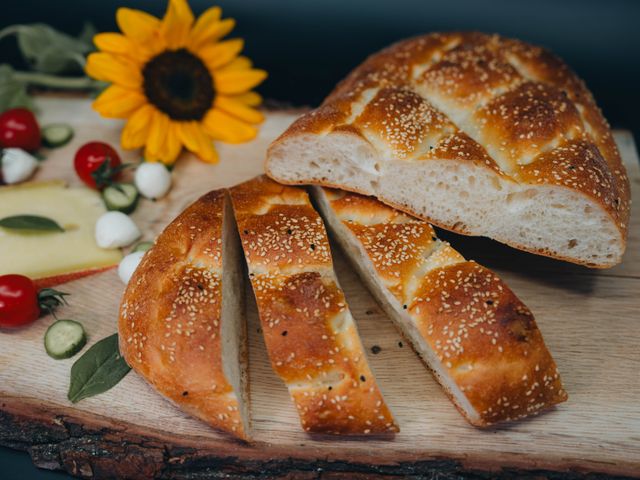
A playful fusion of tangy sourdough and Korean-style cheese bread. Pillowy dough enriched with potato starch for a delicate crumb and dramatic stretch, filled with garlicky mozzarella and a crispy potato-starch coating. The result is a pull-apart loaf with a craggy, golden crust and molten cheese pools.
- Prep
- 30 min
- Cook
- 35 min
- Wait
- 8 hr
- Total
- 9 hr 5 min
- Makes
- 1 loaf (8-10 slices)
Steps
Before you start
- Feed your sourdough starter 4-6 hours before mixing (it should be bubbly and doubled at peak)
- Have all ingredients at room temperature (65-70°F / 18-21°C)
- Preheat your oven 20 minutes before baking
- Prepare a banneton or bowl lined with a well-floured kitchen towel
Mix dough
- In a large bowl, combine 150 g active sourdough starter, 350 g bread flour, 50 g potato starch, and 240 ml room-temperature water.
- Stir until all flour is hydrated and a shaggy dough forms (no dry bits remain).
- Cover and rest for 30 minutes at room temperature—this autolyse allows flour to fully absorb water.
+ Show details− Hide details
Ready when: All flour is moistened and dough looks unified
Tip: Mixing by hand or with a stand mixer both work; the dough will be slightly sticky, which is correct.
Add salt and butter
- After the rest, sprinkle 8 g fine sea salt and add 30 g softened unsalted butter into the dough.
- Using a stand mixer on low speed for 4-5 minutes or by hand with a folding motion, incorporate the salt and butter fully.
- The dough will initially look shaggy, then gradually become smoother and more cohesive.
- You're looking for the butter to be evenly distributed and the salt dissolved.
+ Show details− Hide details
Ready when: Dough is smooth, elastic, and butter is fully incorporated
Tip: If using a stand mixer, keep speed low to avoid overworking. If folding by hand, wet your hand to prevent sticking.
Bulk fermentation
- Transfer dough to a clean, lightly oiled bowl.
- Cover with a damp kitchen towel or plastic wrap.
- Let it rise at room temperature (68-72°F / 20-22°C) for 4 hours, performing 3-4 sets of stretch-and-fold at 30-minute intervals during the first 2 hours.
- After the first 30 minutes, gently grab one side of the dough, stretch it up and fold it over the center; rotate the bowl 90 degrees and repeat 4 times.
- The dough should feel airy, puffed, and roughly 50% larger by the end.
+ Show details− Hide details
Ready when: Dough is puffy, jiggly, shows visible bubbles, and is roughly 1.5 times original size
Tip: Watch dough rise, not a clock—if your kitchen is cool, it may take 5 hours. Poke gently; if the indent springs back slowly, it's ready.
Prepare garlic-cheese filling
- While dough ferments, prepare the filling.
- Finely mince 8 garlic cloves and place in a small bowl.
- Add 45 g softened unsalted butter, a pinch of sea salt, and freshly ground black pepper.
- Mix until combined.
- Have 200 g chilled mozzarella cheese, cut into 1/2-inch (1 cm) cubes, ready.
+ Show details− Hide details
Ready when: Garlic butter is mixed and smooth; cheese is cubed and cold
Tip: Keep mozzarella cubes cold so they don't melt into the dough during shaping.
Shape and fill
- Turn fermented dough onto a lightly floured work surface (do not punch down; be gentle).
- Gently stretch it into a 10×12-inch (25×30 cm) rectangle.
- Spread the garlic butter evenly over the surface, leaving a 1/2-inch (1 cm) border on all sides.
- Scatter the chilled mozzarella cubes evenly across the garlic butter.
- Starting from the short end (10-inch / 25 cm side), tightly roll the dough into a log, then coil it into a spiral or shape it into an oval loaf.
- Place seam-side up in your floured banneton or proofing bowl.
+ Show details− Hide details
Ready when: Dough is shaped and seams are sealed; filling is enclosed
Tip: Roll tightly to prevent large air pockets, but don't compress the dough. Seal the final seam well so cheese doesn't leak during baking.
Final proof
- Cover the banneton loosely with plastic wrap.
- Let the shaped dough proof at room temperature for 1.5-2 hours.
- It should rise noticeably but not double (you want it puffy, not overproofed).
- Alternatively, you can refrigerate overnight (8-12 hours); if chilled, let it come to room temperature for 30 minutes before baking.
+ Show details− Hide details
Ready when: Dough is visibly puffy; a gentle poke leaves a slow-springing indentation
Tip: Cold overnight proof adds depth; shorter room-temp proof is faster but slightly less tangy.
Prepare oven and potato starch coatingOven 475°F / 245°C
- Preheat your oven to 475°F (245°C) with a Dutch oven inside for 30 minutes.
- Pour 60 g potato starch into a shallow baking dish.
- Beat 1 large egg with 15 ml water in another small bowl.
- Have these ready near your work station.
+ Show details− Hide details
Ready when: Oven is fully preheated and Dutch oven is piping hot
Tip: The potato starch coating will create a crispy, craggy exterior—this is the signature Korean cheese bread texture.
Coat and glaze
- Carefully turn the proofed dough out of the banneton onto parchment paper.
- Brush the entire surface with the egg wash, then immediately dredge or roll the dough in the potato starch, coating all sides evenly.
- If desired, sprinkle with white sesame seeds.
- The dough should be generously coated—this creates the signature crispy exterior.
+ Show details− Hide details
Ready when: Dough is evenly coated with potato starch and egg wash
Tip: Work quickly so egg wash doesn't dry out. The potato starch should stick to the wet egg wash.
Score and transfer
- Using a sharp lame or knife, score the top of the loaf with 2-3 diagonal slashes (1/4-inch / 6 mm deep).
- Carefully transfer the parchment with the dough to the preheated Dutch oven (the bottom of the Dutch oven will be very hot—use kitchen towels and be careful).
- Cover with the lid.
+ Show details− Hide details
Ready when: Dough is scored and safely inside the Dutch oven
Tip: Scoring prevents random bursts and directs oven spring; it also allows steam to escape more evenly.
Bake coveredOven 475°F / 245°C
- Bake covered at 475°F (245°C) for 20 minutes.
- During this time, steam is trapped inside, helping the crust develop and giving the bread maximum oven spring.
- You will hear and feel the dough expanding—this is normal and desirable.
+ Show details− Hide details
Ready when: Steam has built up inside; dough has visibly risen
Tip: Don't open the oven during this phase, or you'll lose valuable steam.
Bake uncoveredOven 475°F / 245°C
- Remove the lid carefully (steam will be hot) and continue baking for another 15 minutes at 475°F (245°C).
- The loaf should develop a deep golden-brown crust with the potato starch forming a craggy, crispy exterior.
- Watch for dark browning, especially around the edges and on top.
+ Show details− Hide details
Ready when: Crust is deep golden-brown to light mahogany; potato starch coating is crispy and craggy
Tip: If the top is browning too fast, tent loosely with foil for the last 5 minutes.
Cool completely
- Remove the bread from the oven and transfer to a wire cooling rack.
- Let it cool for at least 1 hour before slicing.
- The interior will continue to set as it cools, and the cheese will firm slightly.
- Resist the urge to slice into warm bread, as the crumb structure is still setting.
+ Show details− Hide details
Ready when: Bread is fully cool to the touch and feels firm
Tip: The bread will smell incredible during cooling—this is the sourdough tang and garlic aroma combined.
Good to know
Tips
- Sourdough starter strength matters: your starter should be at peak (visibly doubled, jiggly, and bubbly) when you mix the dough. If it's sluggish, feed it again and wait another 2-3 hours. A weak starter results in underproofed dough.
- The potato starch coating is key to the texture: it creates a crispy, almost shattered exterior that contrasts beautifully with the chewy, tangy sourdough crumb and molten cheese inside. Don't skip this step.
- Garlic flavor blooms when infused in warm butter; the mozzarella cubes stay distinct and gooey rather than melting into the crumb if kept cold until shaping. This is what gives you those dramatic cheese pulls.
- This is a moderately wet dough (about 70% hydration); it will be slightly sticky, which is correct. The potato starch in the dough makes it more extensible and gives the finished bread its silky, delicate texture.
Make ahead
You can bulk ferment overnight in the fridge (step 3): after stretch-and-fold cycles, cover the bowl with plastic wrap and refrigerate for 8-12 hours. Shape and proceed with step 5 the next morning. You can also shape the loaf (step 5) and refrigerate in the banneton overnight; let it come to room temperature for 30 minutes before baking.
Storage & reheating
Room temperature (loosely wrapped in a kitchen towel): 2 days. Refrigerator (in an airtight container or wrapped): 4 days; reheat briefly at 300°F (150°C) for 10 minutes. Freezer: up to 1 month (slice before freezing); toast from frozen at 375°F (190°C) for 8-10 minutes. The bread is best enjoyed within 1 day when the crust is crispiest and cheese pockets are most dramatic.
Substitutions
- whole-milk mozzarella cheese → fontina or smoked mozzarella. Fontina adds a deeper, nuttier flavor; smoked mozzarella brings extra savory depth. Use the same weight and keep cubes chilled.
- garlic cloves → 3-4 teaspoons (10-15 ml) roasted garlic puree. Roasted garlic is milder and sweeter. Use less volume and distribute thoroughly through the butter.
- potato starch → cornstarch or tapioca starch. Both create a crispy coating, though potato starch gives the most authentic Korean cheese bread texture and crackle.
- active sourdough starter, fed and bubbly → 200 ml buttermilk plus 1/2 teaspoon (2.5 g) instant yeast. This sacrifices the tangy depth but yields a quicker loaf (2-3 hours total). Reduce water to 180 ml. The result will be milder and less complex.
More yeast breads
See all →

Find more like this
- Meal
- Breakfast
- Cuisine
- Korean
- Main ingredient
- Mozzarella
- Method
- Oven