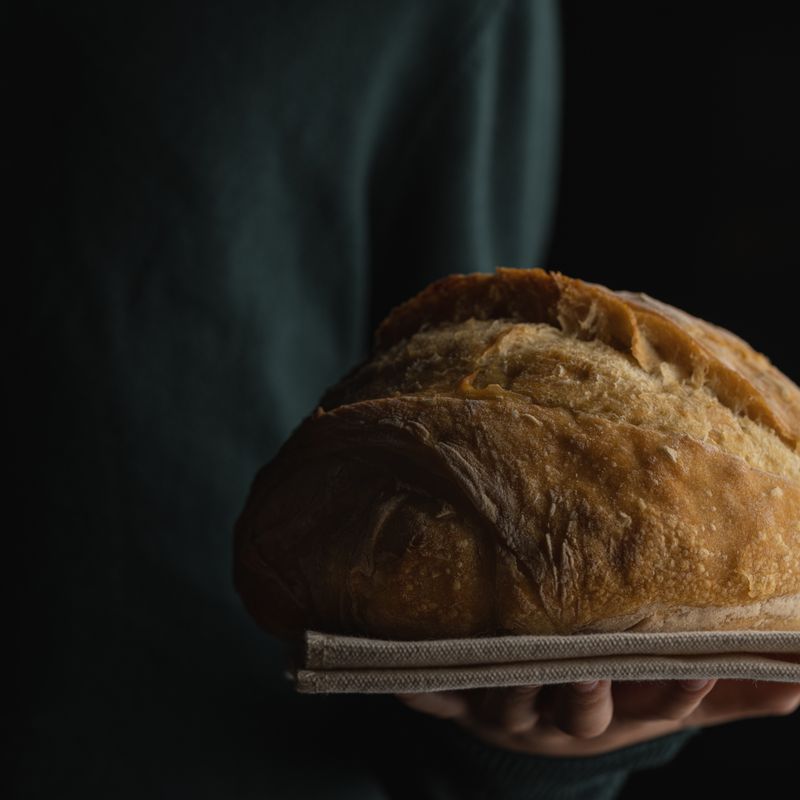
Sourdough Egyptian Aish Baladi Whole Grain
A traditional Egyptian whole grain bread reimagined with natural sourdough fermentation. Aish Baladi—literally "country bread"—combines whole wheat and barley flours for a deeply flavorful, slightly nutty loaf with excellent keeping qualities. This long-fermented version develops complex flavor and superior digestibility compared to the quick yeasted original, while honoring the bread's humble, nourishing roots.
- Prep
- 20 min
- Cook
- 45 min
- Wait
- 11 hr
- Total
- 12 hr 5 min
- Makes
- 2 round loaves (about 1 lb / 450g each)
Steps
Before you start
- Remove sourdough starter from refrigerator and bring to room temperature (1–2 hours)
- Use a mature, active starter that doubles reliably within 4–8 hours at 70–75°F (21–24°C)
- Line two bannetons or small bowls with linen or cotton cloths and flour them generously
- Preheat your oven to 475°F (245°C) at least 30 minutes before baking; place a Dutch oven on the middle rack
Mix dough
- In a large bowl, combine 200g active sourdough starter, 330ml water, 350g whole wheat flour, and 150g barley flour.
- Stir with your hands or a wooden spoon until all dry flour is hydrated and a shaggy mass forms (no dry bits remain).
- The dough will feel quite wet and sticky.
- Cover the bowl loosely with a damp towel or plastic wrap and let rest for 30 minutes at room temperature.
+ Show details− Hide details
Ready when: All flour fully hydrated into a cohesive, wet dough
Tip: Whole grain flours absorb water differently than white flour; this dough will be stickier than typical sourdough.
Add salt and knead
- Sprinkle 10g fine sea salt evenly over the dough.
- Using wet fingers or a bench scraper, work the salt in by folding the dough onto itself repeatedly for 3–4 minutes, rotating the bowl as you go.
- The dough will become smoother and slightly firmer as the salt is incorporated.
- Cover again with the damp towel.
+ Show details− Hide details
Ready when: Salt fully incorporated and dough feels more cohesive and elastic
Tip: Salt will dehydrate the dough slightly, making it less sticky and easier to handle.
Bulk fermentation begins (stretch and fold)
- Over the next 2–3 hours, perform four sets of stretch-and-folds at 30-minute intervals.
- For each set: wet one hand, grab one side of the dough and pull it up and over the center, rotating the bowl 90° and repeating until you've made four folds from each direction.
- The dough will gradually become smoother, more elastic, and hold its shape better.
- Between sets, cover loosely.
- Room temperature should be 70–75°F (21–24°C) for best results.
+ Show details− Hide details
Ready when: Dough becomes noticeably lighter, airier, with visible bubbles throughout; should increase 50–75% in volume
Tip: Whole grain doughs ferment faster than white-flour doughs; watch for visual cues rather than strict timing.
Final bulk rest
- After the fourth set of stretch-and-folds, cover the bowl and let the dough rest undisturbed for 30–60 minutes at room temperature.
- It should look puffy and relaxed, with bubbles visible at the surface and sides.
- Perform the poke test: gently poke the dough with a floured finger; it should spring back slowly but not completely, taking 2–3 seconds.
+ Show details− Hide details
Ready when: Dough visibly increased in volume, poke test shows slow recovery, surface shows active bubbles
Tip: Underbaking leads to dense bread; overbaking causes collapse. Use the poke test to judge timing.
Pre-shape dough
- Turn the dough out onto a lightly floured work surface.
- Using a bench scraper, gently pre-shape it into a round by folding the edges toward the center, creating surface tension.
- Let it rest on the counter for 20–25 minutes (a "bench rest"), covered lightly with a towel.
- This allows the gluten to relax and makes final shaping easier.
+ Show details− Hide details
Ready when: Dough is soft but holds its round shape; surface is smooth
Tip: Don't skip this rest; it prevents the dough from shrinking too much during final shaping.
Divide and shape boules
- Using a bench scraper, gently divide the dough in half (roughly 450g each).
- Shape each half into a tight boule (round loaf) by folding the edges under and rolling gently toward you, creating surface tension.
- Place each boule seam-side up into a floured banneton or bowl lined with a towel.
- Dust the tops lightly with flour to prevent sticking.
+ Show details− Hide details
Ready when: Two even, round loaves with taut surface, seam-side facing up in bannetons
Tip: Gentle handling prevents degassing; aim for tension, not violence. Whole grain doughs are forgiving.
Cold retard overnight (or 8–12 hours)
- Cover both bannetons with plastic wrap or a linen cover and place in the refrigerator at 38–40°F (3–4°C) for 8–12 hours, or overnight.
- The cold stops yeast activity and allows flavor to develop further while making the dough easier to score.
- (Alternatively, for a shorter proof: bulk ferment for 4–5 hours total, then shape and do a final proof at room temperature for 1–2 hours before baking, but overnight retard produces superior flavor.)
+ Show details− Hide details
Ready when: Loaves are firm and cold; poke test shows slow spring-back even when very cold
Tip: The dough will proof slowly in cold; this is intentional. Do not shorten this step if you want the best flavor.
Preheat and prepareOven 475°F / 245°C
- Remove the refrigerated loaves 20–30 minutes before baking (optional; you can bake from fully cold).
- Preheat the oven to 475°F (245°C), with the Dutch oven on the middle rack, for at least 30 minutes.
- The oven and pot must be fully preheated.
- Have a lame, sharp bread knife, or scoring tool ready.
+ Show details− Hide details
Ready when: Oven reaches 475°F; Dutch oven is very hot to the touch
Tip: A fully preheated Dutch oven traps steam and creates a shatteringly crisp crust. Don't skip this.
Score and bake coveredOven 475°F / 245°C
- Carefully remove the Dutch oven from the oven.
- Turn one cold loaf out of its banneton onto parchment paper (seam-side down).
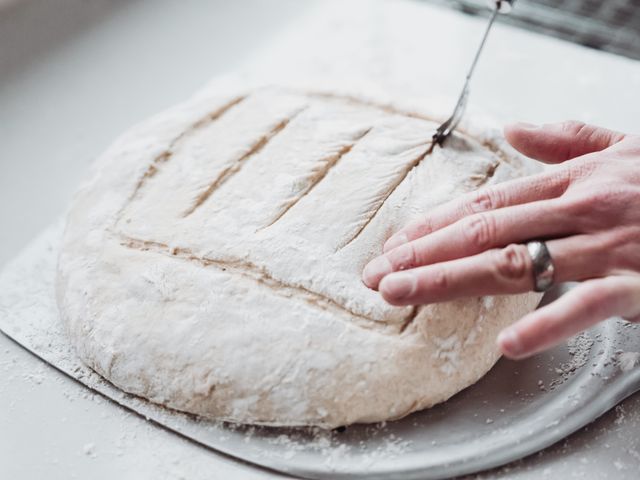
- Using a lame or sharp knife, score the top with a single long slash or an X pattern, about ¼ inch (6 mm) deep.
- Gently transfer the loaf (still on parchment) into the preheated Dutch oven.
- Cover with the lid and bake for 25 minutes.
- The covered pot creates a steam chamber that helps the crust develop.
+ Show details− Hide details
Ready when: Loaf is golden and has risen significantly; steam visible when lid is lifted
Tip: Parchment paper makes transfer easier and prevents sticking.
Finish baking uncoveredOven 450°F / 230°C
- Remove the Dutch oven lid and reduce the oven temperature to 450°F (232°C).
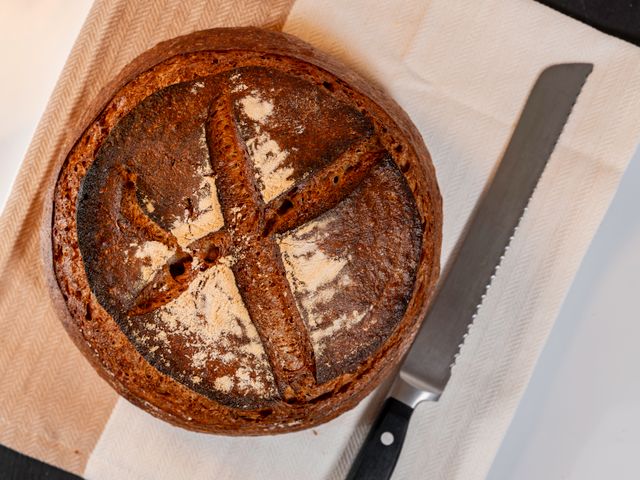
- Bake uncovered for 18–22 minutes, until the crust is deep golden-brown and the loaf sounds hollow when tapped on the bottom.
- The internal crumb should reach 205–210°F (96–99°C) on an instant-read thermometer inserted into the thickest part (avoiding air pockets).
+ Show details− Hide details
Ready when: Crust is deep mahogany-brown; loaf sounds hollow when tapped; internal temp 205–210°F
Tip: Every oven bakes differently; watch color, not time. Whole grain breads need darker crust than white bread for full flavor.
Cool first loaf, bake secondOven 450°F / 230°C
- Transfer the first loaf to a cooling rack.
- Repeat steps 8–9 with the second loaf, starting from a cold state if it has been in the fridge, or allowing 20 minutes for the Dutch oven to return to full temperature between bakes.
- Score and bake covered for 25 minutes, then uncovered at 450°F for 18–22 minutes.
+ Show details− Hide details
Ready when: Second loaf is deep golden-brown and sounds hollow; internal temp 205–210°F
Tip: Allow the Dutch oven to fully reheat before baking the second loaf to ensure consistent results.
Cool completely
- Transfer the second loaf to the cooling rack.
- Let both loaves cool completely at room temperature for at least 1–2 hours before slicing.
- The crumb continues to set as the bread cools; cutting too early results in a gummy texture.
- Egyptian bread is traditionally served at room temperature.
+ Show details− Hide details
Ready when: Loaves are cool to the touch; interior no longer steaming when sliced
Tip: Whole grain breads improve slightly after 24 hours as flavors develop and crumb firms up.
Good to know
Tips
- Whole grain flours ferment faster than refined flour because bran particles accelerate yeast activity. Watch the dough, not the clock; visual cues (puffiness, bubble activity, poke-test recovery) are more reliable than strict timing.
- If your kitchen is cool (below 70°F / 21°C), extend bulk fermentation and proofing times by 25–50%. If warmer (above 78°F / 26°C), reduce times accordingly. Aim for a dough temperature around 75–78°F (24–26°C) after mixing for predictable fermentation.
- Barley flour is lower in gluten than wheat and produces a slightly tender, crumbly crumb. This is traditional and desirable; the bread will slice more easily than a tight sourdough. Don't overmix or overproof, as the dough becomes fragile.
- For authentic Egyptian flavor, serve warm or at room temperature with a smear of labneh (strained yogurt), fresh herbs (mint, parsley), or simply dusted with salt. This bread is meant to be humble and nourishing, a vehicle for other flavors.
Make ahead
Dough can be shaped and retarded in the refrigerator for 8–12 hours (or up to 18 hours) before baking. This is the recommended method for best flavor development. Alternatively, bulk fermentation can be done at room temperature (4–5 hours total with stretch-and-folds), then shaped and proofed at room temperature for 1–2 hours before baking, though flavor will be less complex.
Storage & reheating
Store cooled loaves in a paper bag or cloth bread bag at room temperature for 2–3 days. For longer storage, wrap tightly and freeze for up to 1 month. To reheat: sprinkle frozen or room-temperature loaves lightly with water, wrap in foil, and warm in a 350°F (175°C) oven for 15–20 minutes until heated through and crust crisps up. Refresh stale bread by misting with water and toasting in a hot oven.
Substitutions
- barley flour → rye flour. Rye imparts a slightly earthier, more assertive flavor and darker color. Use the same weight (150g) but expect slightly faster fermentation and a denser crumb.
- barley flour → spelt flour. Spelt is nuttier and lighter than barley. Use 150g spelt; the dough may be slightly less sticky. Spelt is more extensible (stretches easily), so reduce bulk fermentation time by 20–30 minutes.
- whole wheat flour → einkorn or heritage wheat flour. Ancient grains add deeper nutty and floral notes, honoring traditional bread heritage. Use the same weight (350g); fermentation may be 15–20 minutes faster. These flours are more delicate; handle gently.
- active sourdough starter → 100g fed rye starter + 100g fed white flour starter. Rye starter ferments faster and adds a subtle tang. Keep total starter weight at 200g; adjust final water by 10ml if consistency differs.
More yeast breads
See all →

Find more like this
- Meal
- Breakfast
- Method
- Oven
- Quick & Easy
- 5 Ingredients or Less