Sourdough Thai Red Curry Tear Bread
A rustic sourdough tear bread infused with Thai red curry paste, coconut milk, and lime leaves. The complex flavors develop during a long fermentation, creating a fragrant, savory loaf with a crackling crust and open crumb. Tear off warm pieces and enjoy the interplay of tangy fermentation and spiced coconut notes.
- Prep
- 20 min
- Cook
- 35 min
- Wait
- 11 hr
- Total
- 11 hr 55 min
- Makes
- 1 loaf (8–10 large tear pieces)
Steps
Before you start
- Ensure your sourdough starter is active and bubbly (fed 4–8 hours prior)
- Measure all ingredients by weight for accuracy
- Have lime leaves at room temperature; dry them gently if damp
- Preheat Dutch oven in the oven for the last 45 minutes of bulk fermentation
Mix dough base
- In a large bowl, whisk together the sourdough starter (120 ml), room-temperature water (260 ml), and Thai red curry paste (45 g) until the paste is evenly distributed.
- The mixture will be speckled and slightly thick.
- Add the bread flour (390 g) and stir with a wooden spoon or bench scraper until all flour is hydrated and no dry bits remain.
- The dough will be shaggy and slightly sticky.
- Cover the bowl loosely with plastic wrap and let rest for 30 minutes (autolyse).
+ Show details− Hide details
Ready when: All flour is hydrated; dough holds together loosely.
Tip: Whisk the curry paste thoroughly into the water and starter before adding flour to avoid lumps.
Add salt and aromatics
- After the autolyse, add sea salt (10 g), coconut milk (80 ml), lime leaves (8 pieces, finely sliced), and fish sauce if using (2.5 ml).
- Pinch the dough and fold it over itself about 20 times, working gently from the edges toward the center, until all additions are fully incorporated.
- The dough will be tacky but should hold together.
- If using sesame oil, drizzle it over the surface and fold it in with 5–10 more gentle folds.
+ Show details− Hide details
Ready when: All ingredients are evenly distributed; dough is cohesive.
Tip: Tear the lime leaves into small fragments before folding so they distribute evenly and don't create tough bits.
Bulk fermentation (first 2 hours)
- Cover the bowl again and let the dough rest at room temperature (68–72°F / 20–22°C) for the first 2 hours.
- During this time, perform four stretch-and-folds: at the 30-minute, 60-minute, 90-minute, and 120-minute marks.
- For each fold, grasp one side of the dough, pull it up and over the center, rotate the bowl 90°, and repeat until you've folded all four sides.
- The dough will become smoother and stronger with each round.
+ Show details− Hide details
Ready when: Dough appears fuller, slightly domed, and feels airy when gently poked.
Tip: If your dough is too warm or too cold, fermentation will be slower or faster; watch for the visual cues of rise rather than relying solely on time.
Continue bulk fermentation (remaining 3–4 hours)
- After the final stretch-and-fold at 2 hours, cover the bowl and let it rise at room temperature for another 3–4 hours, undisturbed.
- The dough should increase in volume by 50–75%, with visible bubbles at the surface and sides.
- The dough is ready when it feels puffy and jiggles slightly when the bowl is gently shaken, and a poke with a lightly floured finger leaves a slow-to-spring-back dimple.
- Aim for a bulk fermentation of 5–6 hours total.
+ Show details− Hide details
Ready when: Dough has increased 50–75%, feels airy, and poke dimple springs back slowly (2–5 seconds).
Tip: A dough thermometer reading of 75–78°F (24–26°C) at the end of bulk fermentation indicates good fermentation progress.
Preheat Dutch ovenOven 500°F / 260°C
- About 45 minutes before you expect the bulk fermentation to be complete, preheat your Dutch oven (with lid) in a 500°F (260°C) oven.
- The vessel needs to be thoroughly hot so the dough gets a good oven spring and crust.
+ Show details− Hide details
Ready when: Dutch oven is very hot; you should see wisps of heat if you look inside carefully.
Tip: Use an oven thermometer to confirm the oven has reached 500°F (260°C); a sudden drop in temperature when you place cold dough inside is normal but will slow initial oven spring.
Shape and score
- Turn the fully fermented dough out onto a lightly floured surface.
- Gently pre-shape it into a loose round by folding the edges toward the center 3–4 times, rotating as you go.
- Let it rest, uncovered, for 15–20 minutes to relax.
- Then, flip it seam-side down onto a piece of parchment paper.
- Using a bread lame or sharp knife, score the top with two or three diagonal slashes, about ¼ inch (6 mm) deep, to control where the bread splits and allow steam to escape.
+ Show details− Hide details
Ready when: Dough is gently rounded and feels relaxed; surface is taut but not tight.
Tip: Don't overwork the dough when shaping; the weight of the fermented dough will do most of the work. A confident, quick scoring motion gives clean cuts.
Transfer and bake coveredOven 500°F / 260°C
- Carefully remove the preheated Dutch oven from the oven.
- Using the parchment paper as a sling, transfer the shaped dough (still on the parchment) into the hot Dutch oven.
- It's okay if a small edge of parchment sticks out; fold it back inside once the dough is centered.
- Quickly cover with the hot lid (be careful of steam).
- Return to the 500°F (260°C) oven and bake, covered, for 20 minutes.
- The dough will expand rapidly and the interior of the Dutch oven will fill with steam, crisping the crust.
+ Show details− Hide details
Ready when: Steam fills the Dutch oven; dough has expanded noticeably.
Tip: Don't lift the lid during the first 20 minutes; trapped steam is essential for crust development.
Uncover and bake until goldenOven 450°F / 230°C
- After 20 minutes, carefully remove the Dutch oven lid (watch for hot steam).
- Reduce the oven temperature to 450°F (232°C).
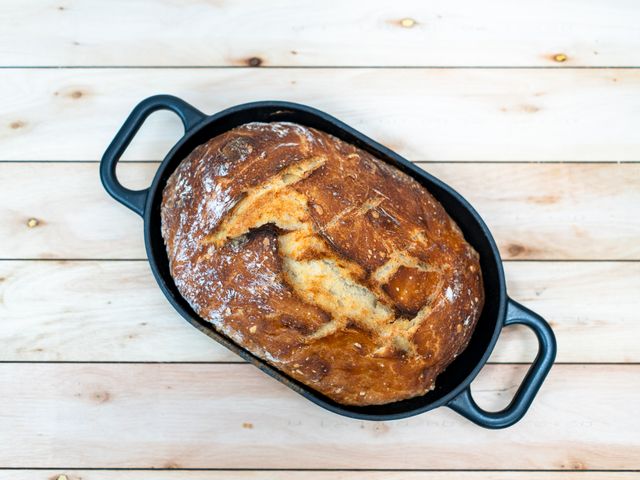
- Continue baking, uncovered, for 12–15 minutes, until the crust is deep golden brown on top and the sides are caramelized.
- The loaf should sound hollow when you tap the bottom (internal temperature should reach 205–210°F / 96–99°C).
+ Show details− Hide details
Ready when: Crust is deep golden to mahogany brown; bottom sounds hollow when tapped; internal temp 205–210°F (96–99°C).
Tip: If the crust is browning too quickly, tent it loosely with foil for the final 5 minutes, but remove it to allow the crust to fully set.
Cool completely
- Transfer the baked loaf to a wire rack and cool for at least 1 hour before slicing or tearing.
- During this time, the interior crumb sets and becomes easier to tear.
- The aroma of curry, lime, and caramelized crust will develop as it cools.
+ Show details− Hide details
Ready when: Loaf is cool to the touch and feels firm on the outside.
Tip: Resist slicing while the loaf is still warm; the crumb will tear and compress. One hour is a minimum; longer cooling (2–3 hours) is better.
Good to know
Tips
- Fermentation temperature is key: aim for 68–72°F (20–22°C) bulk fermentation. If your kitchen is warmer, the dough will ferment faster (reduce bulk time by 30–60 minutes). If cooler, it will take longer (add 30–60 minutes). Watch the dough, not the clock.
- The Thai red curry paste already contains salt, oil, and spices; don't substitute it with curry powder or fresh curry made with water, as the dough will become overly wet and the flavors will be muddy.
- If your sourdough starter is weak or inactive, the bulk fermentation will take much longer (7–8 hours). Feed your starter again, wait for it to double in volume and smell pleasantly sour, then start the recipe.
- Tear the bread warm into large chunks and enjoy it alongside soups, stews, or Thai curries where it can soak up sauce. Alternatively, toast cooled slices and eat them with butter or use them as a base for avocado toast.
Make ahead
The dough can be retarded (slow-fermented) in the refrigerator for 8–16 hours after the second hour of bulk fermentation. Shape the dough, place it in a banneton or bowl lined with plastic wrap, cover, and refrigerate. When ready to bake, score and bake directly from cold (add 10–15 minutes to the covered baking time). This develops deeper flavor and makes the dough easier to score.
Storage & reheating
Store the cooled loaf in a paper bag or loosely wrapped in a kitchen towel at room temperature for up to 2 days. For longer storage, wrap tightly in plastic wrap or place in an airtight bag and refrigerate for up to 5 days, or freeze for up to 3 months. To refresh: lightly spritz the crust with water and warm in a 350°F (175°C) oven for 8–10 minutes if stored at room temperature or in the fridge; from frozen, thaw at room temperature for 2–3 hours, then refresh the same way.
Substitutions
- Thai red curry paste → Thai green curry paste. Use the same weight (45 g). Green curry is slightly less sweet and more herbaceous; the bread will be lighter in color and have a fresher flavor profile.
- fresh or dried Thai lime leaves (kaffir lime) → Lime zest (finely grated) from 2 limes. Add the zest during the salt and aromatics step. The brightness is similar, though zest provides a more citrus-forward note than the complex, slightly floral flavor of lime leaves.
- unsweetened canned coconut milk (full-fat) → Water or unsweetened almond milk. Use 80 ml of either. The bread will be less rich and creamy, with a drier crumb; increase the red curry paste by ½ tablespoon (8 g) to compensate for lost depth.
- bread flour → All-purpose flour. Use the same weight (390 g). The bread will have a slightly less open crumb and may need an extra 1–2 minutes of baking. All-purpose flour has lower protein, so gluten development may be slightly softer.