
Sourdough Einkorn Whole Grain Loaf
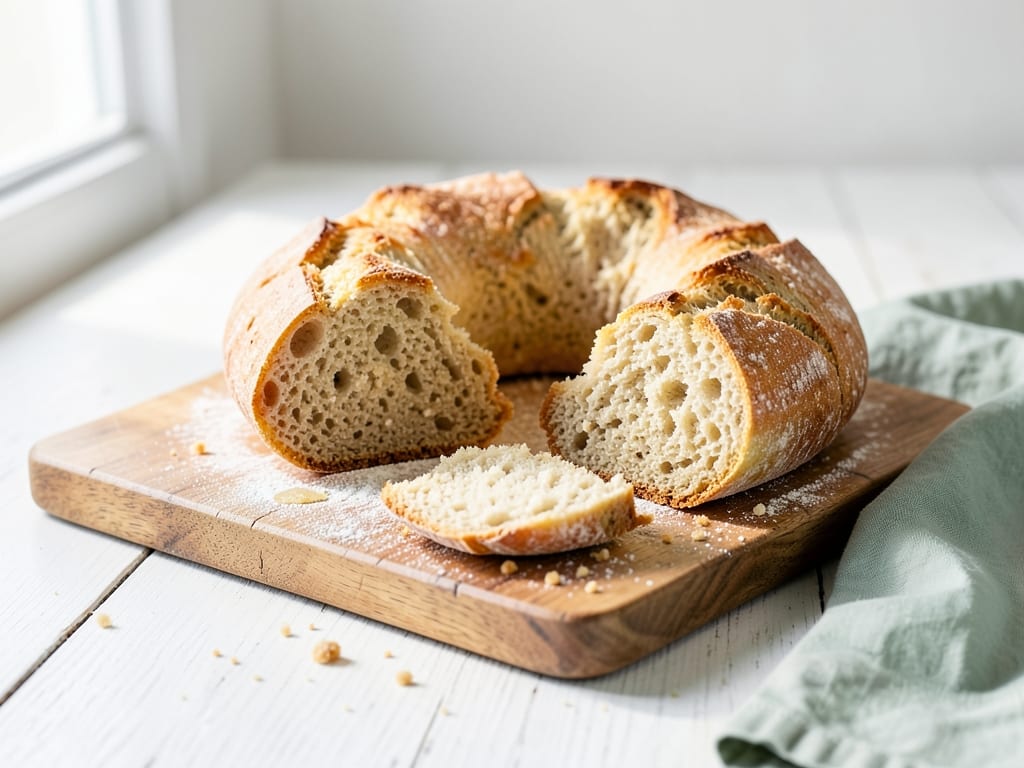
A naturally leavened loaf using heritage einkorn flour for a tender crumb and subtle, nutty flavor. The long, cool fermentation develops complex flavors while einkorn's unique gluten structure creates an open, delicate crumb. A cold overnight proof deepens flavor and makes scoring easier.
- Prep
- 25 min
- Cook
- 40 min
- Wait
- 1.1 days
- Total
- 1.2 days
- Makes
- 1 loaf (about 10–12 slices)
Steps
Before you start
- Feed your sourdough starter 4–8 hours before mixing; it should be bubbly and at peak rise
- Read through the full recipe to understand the timeline; bulk fermentation is roughly 12 hours, then overnight cold proof is 12–18 hours
- Keep your kitchen cool (60–72°F / 15–22°C ideal); warmer temps will speed fermentation
- Have a Dutch oven, banneton or proofing bowl, and a sharp bread lame or serrated knife ready
Mix dough
- In a large bowl, combine the active sourdough starter and room-temperature water.
- Stir to break up the starter slightly.
- Add the einkorn flour and mix with your hands or a wooden spoon until all the flour is hydrated and no dry bits remain.
- The dough will be shaggy and tacky.
- Work for about 1 minute total.
+ Show details− Hide details
Ready when: All flour is hydrated into a shaggy mass with no dry pockets
Tip: Einkorn absorbs water quickly; mix just until homogeneous to avoid overdeveloping gluten before autolyse
Autolyse rest
- Cover the bowl with a damp cloth or plastic wrap.
- Let the dough rest at room temperature for 30 minutes.
- This allows the flour to fully hydrate and begins gentle gluten development.
+ Show details− Hide details
Ready when: Dough appears smoother and less shaggy than before
Add salt and begin folds
- Sprinkle the fine sea salt evenly over the dough.
- Using the pincer method—pinching and folding the dough onto itself with wet fingers—incorporate the salt throughout.
- Wet your hand, grab a section of dough from one side, stretch it up and over the center, then rotate the bowl and repeat from the other three sides.
- This is the first stretch-and-fold; it takes about 1 minute.
- Cover and rest for 30 minutes.
+ Show details− Hide details
Ready when: Salt is evenly distributed; dough feels slightly tighter and holds some surface tension
Tip: Wet hands prevent sticking; einkorn's delicate gluten is easily damaged, so be gentle and confident rather than aggressive
Complete stretch-and-folds
- Perform three more stretch-and-fold sets at 30-minute intervals (at 90, 120, and 150 minutes total from initial mixing).
- Each fold takes about 1 minute.
- After the final fold, cover the dough and let it ferment undisturbed for the remaining bulk time—about 10 more hours at room temperature (66–72°F / 19–22°C).
- The dough should increase in volume by 50–75% (einkorn won't fully double like wheat bread).
- Fermentation is complete when you see bubbles across the surface and sides, and the dough jiggles slightly when you gently shake the bowl.
- It should smell pleasantly sour and yeasty.
+ Show details− Hide details
Ready when: Dough has risen 50–75%, shows visible bubbles throughout, jiggles when bowl is gently shaken, and has a pleasant sour aroma
Tip: Einkorn ferments 15–25% faster than modern wheat; watch the dough's rise, not the clock. If your kitchen is warmer (70–75°F / 21–24°C), fermentation may finish in 9–10 hours instead of 12. Do not let it overproof or it will spread rather than rise in the oven.
Pre-shape
- Turn the fermented dough out onto a lightly floured work surface.
- Using a dough scraper, gently coax it into a rough round shape without aggressive shaping—you're just organizing it loosely at this point.
- Let it rest uncovered for 20 minutes (bench rest).
- The dough will relax and become easier to shape on the second pass.
+ Show details− Hide details
Ready when: Dough has relaxed visibly and spread slightly; it's easier to handle than immediately after turning out
Final shape
- Flip the pre-shaped dough seam-side-up (smooth side now on the bench).
- Fold the top third down and press gently.
- Fold the bottom third up and press.
- Fold the left and right sides toward the center line, then roll the dough toward you in a tight, controlled motion, sealing the seam.
- Place seam-side-up in a floured banneton or a bowl lined with a linen cloth.
- The shaped dough should feel firm but not rigid.
+ Show details− Hide details
Ready when: Dough is in the banneton with seam facing up; the surface is taut and slightly domed
Tip: Einkorn dough is soft and delicate; gentle, confident shaping creates better surface tension than aggressive pulling, which can tear the gluten
Cold final proof
- Cover the banneton with plastic wrap or a cloth.
- Place in the refrigerator at 38–40°F (3–4°C) and proof for 12–18 hours (overnight is ideal).
- The cold fermentation develops deeper flavor and makes scoring easier.
- The dough will continue to rise slowly and become slightly stiffer.
- You can test readiness by gently poking the dough; it should spring back slowly, not immediately.
+ Show details− Hide details
Ready when: Dough jiggles slightly when banneton is gently shaken; poke test shows slow spring-back over 2–3 seconds; loaf shows no obvious overproofing (excessive dome without tension)
Tip: If you prefer more oven spring, remove the banneton 15–20 minutes before baking to let it warm slightly. For maximum spring and a crispier crust, bake straight from cold—but handle very carefully when removing from the banneton
Preheat oven and scoreOven 475°F / 245°C
- Place a Dutch oven (with lid on) in the center of your oven and preheat to 475°F (245°C) for at least 45 minutes.
- You want the pot extremely hot to trap steam.
- Meanwhile, line a small sheet of parchment paper or a peel with flour.
- Turn the proofed dough out onto the parchment, seam-side-down.
- Using a very sharp bread lame, razor blade, or serrated knife held at a 30–45° angle, score the top with one bold, decisive slash about ¼-inch (6 mm) deep.
- A dull blade will drag and tear rather than cut.
+ Show details− Hide details
Ready when: Dutch oven is smoking faintly or is too hot to hold your hand near; scored loaf shows a clean, deep cut
Tip: Do not skip preheating time; a cold Dutch oven will produce a pale, thick-bottomed crust instead of a crispy, blistered one
Bake coveredOven 475°F / 245°C
- Carefully remove the Dutch oven from the oven—use oven mitts and keep the lid on.
- Working quickly, transfer the scored loaf (still on parchment) into the pot.
- Cover with the lid.
- Bake at 475°F (245°C) for 20 minutes.
- The enclosed steam will accelerate oven spring and help the crust develop.
+ Show details− Hide details
Ready when: Loaf has expanded noticeably; steam is trapped inside, condensing on the lid
Tip: When removing the hot lid after 20 minutes, tilt it away from you and be very careful of the escaping steam
Bake uncovered and finishOven 450°F / 230°C
- Remove the Dutch oven lid carefully (watch for steam).
- Reduce oven temperature to 450°F (232°C).
- Continue baking uncovered for 18–22 minutes until the crust is deep golden brown with mahogany-colored edges.
- An instant-read thermometer inserted into the center should read 205–210°F (96–99°C).
- If the crust is browning too quickly, tent loosely with foil for the final 5 minutes.
+ Show details− Hide details
Ready when: Crust is deep golden brown to mahogany; internal temperature reads 205–210°F (96–99°C); loaf sounds hollow when tapped on the bottom
Tip: Einkorn's thin crust can darken quickly; watch closely in the final minutes and use foil if needed to prevent over-browning
Cool completely
- Carefully turn the loaf out onto a wire rack.
- Cool at room temperature for at least 1 hour before slicing.
- The interior crumb continues to set and firm up as the loaf cools; cutting too early results in a gummy, compressed texture.
- Wait the full hour even if it's hard to resist.
+ Show details− Hide details
Ready when: Loaf is cool to the touch; when pressed gently on the side, it springs back slowly; crumb is no longer steaming
Tip: If you must eat it sooner, slice after 45 minutes, but the crumb will not be fully set and may compress
Good to know
Tips
- Einkorn ferments 15–25% faster than modern wheat and may not double in volume—watch the dough for a 50–75% rise and visible bubbles, not the clock. Warm kitchens speed fermentation; cool kitchens slow it. Adjust timing accordingly.
- Einkorn's gluten is more delicate and extensible than modern wheat. Use gentle stretch-and-folds rather than aggressive kneading, and shape with confidence rather than force. This creates a tender crumb.
- The cold overnight proof is essential for einkorn: it develops flavor, makes scoring easier, and helps the dough hold its shape in the oven. Warm-proofed einkorn loaves often spread more and spring less.
- A warm, wet dough is normal for einkorn at this hydration (69%). Do not add flour to make it firmer; this will dry out the crumb. Your hands should be wet when handling the dough.
Make ahead
Prepare the dough through the cold final proof step and refrigerate for up to 48 hours before baking; score and bake from cold, adding 5–10 minutes to the uncovered bake time. You can also freeze shaped, proofed dough for up to 3 weeks; thaw in the refrigerator overnight before baking, or add 10 minutes to bake time if baking from frozen.
Storage & reheating
Room temperature (wrapped in linen or cloth): up to 3 days. Refrigerator: up to 5 days, wrapped. Freezer: sliced and wrapped, up to 3 months. To reheat: wrap thawed slices or the whole loaf loosely in foil and warm at 350°F (175°C) for 10 minutes, or toast slices from frozen.
Substitutions
- einkorn flour → Spelt flour. Use the same weight (400g / 2¾ cups). Spelt is slightly less extensible than einkorn, so fermentation may finish 10–15% faster and bulk rise might be only 40–60%. Watch the dough carefully.
- einkorn flour → Red fife or other heritage wheat flour. Use the same weight (400g / 2¾ cups). Heritage wheats vary in hydration and fermentation speed; you may need to reduce water by 10–15 ml if the dough feels overly slack.
- active sourdough starter → 100% hydration liquid starter. Use 75g of liquid starter (equal parts flour and water). The dough will be slightly more fluid; reduce added water to 245 ml (260 ml − 15 ml).
- fine sea salt → Kosher salt or non-iodized table salt. Kosher salt grains are larger and less dense; use 10g (about 1.5 teaspoons) by weight. Table salt is denser; use 7g (about 1 teaspoon) by weight.
More yeast breads
See all →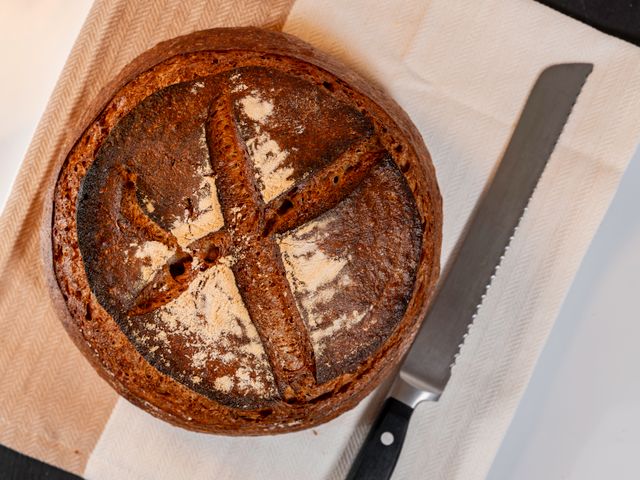

Find more like this
- Meal
- Breakfast
- Method
- Oven
- Quick & Easy
- 5 Ingredients or LessMake AheadFreezer Friendly