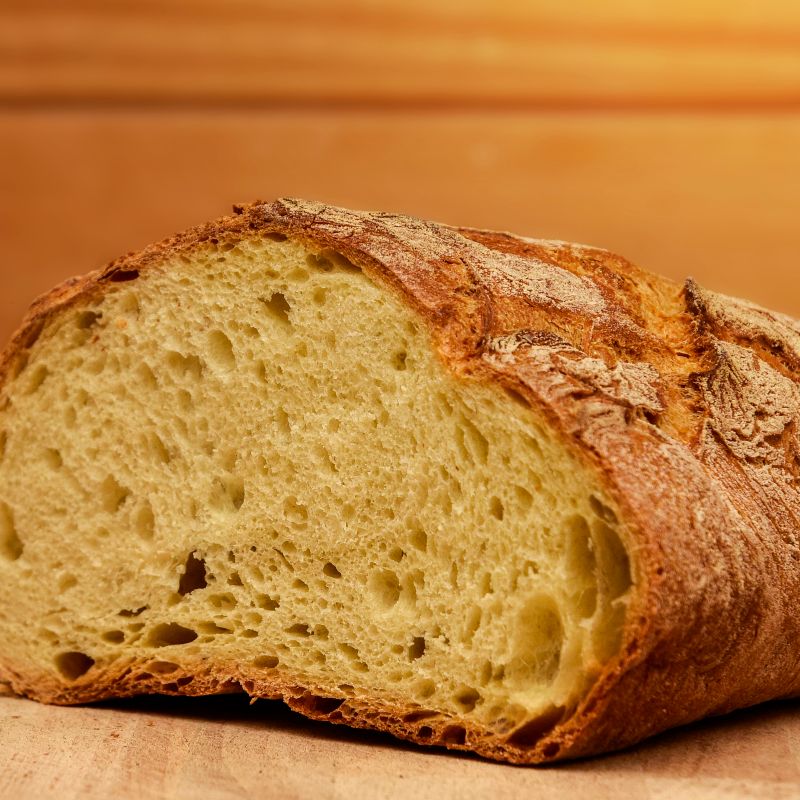
Sourdough Basic Crusty Boule
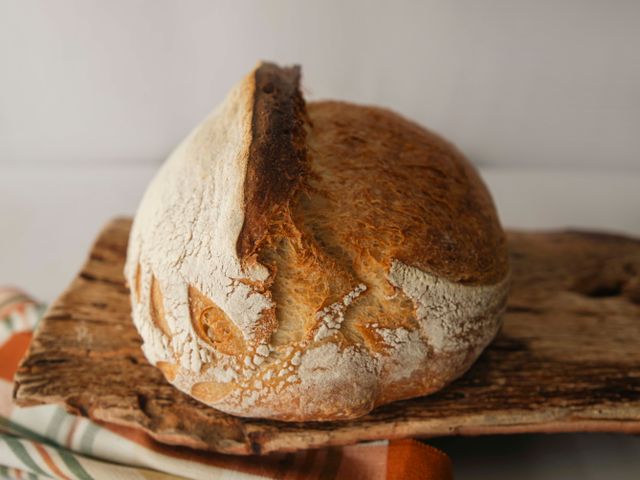
A classic French-style round sourdough loaf with a crackling crust and open, tangy crumb. This recipe uses an overnight cold fermentation in the refrigerator, which develops flavor while fitting naturally into your schedule. The result is a boule with a golden, crispy exterior and a chewy interior with irregular holes—true sourdough character.
- Prep
- 20 min
- Cook
- 35 min
- Wait
- 11 hr
- Total
- 11 hr 55 min
- Makes
- 1 boule loaf (about 14–16 oz / 400–450 g, 8–10 slices)
Steps
Before you start
- Have active, fed sourdough starter at room temperature (bubbly and roughly doubled from feeding)
- Use bread flour or all-purpose flour at room temperature
- Ensure your kitchen is between 68–72°F (20–22°C) for predictable fermentation
- Place an oven-safe Dutch oven or covered baking vessel in your oven to preheat
Mix dough
- In a large bowl, combine the bread flour (375 g), water (265 g), and active sourdough starter (75 g).
- Mix with your hands or a spoon until no dry flour remains and a shaggy dough forms.
- The dough will be slightly sticky.
- Cover the bowl with a damp kitchen towel or plastic wrap and let it rest at room temperature for 30 minutes.
- This rest is called autolyse and helps the flour fully hydrate.
+ Show details− Hide details
Ready when: Dough appears cohesive with no dry flour visible
Tip: Room temperature water (not cold) helps fermentation begin smoothly.
Add salt and knead
- After the 30-minute rest, sprinkle the fine sea salt (8 g) over the dough.
- Wet your hand slightly and pinch and fold the dough from all sides, working the salt in, for about 3–4 minutes.
- The dough will feel sticky; this is normal for sourdough.
- It should begin to tighten and feel slightly more cohesive as you knead.
+ Show details− Hide details
Ready when: Salt is fully incorporated and dough is cohesive
Tip: Use wet hands rather than flouring; this prevents excess flour from drying out the dough.
Bulk fermentation (first 4 hours)
- Cover the bowl and let the dough ferment at room temperature (68–72°F / 20–22°C) for 4 hours.
- During this time, perform 3–4 sets of stretch-and-folds at 30-minute intervals (starting 30 minutes after mixing).
- To stretch and fold: wet your hand, grab one side of the dough, pull it up and fold it over the center, rotate the bowl 90°, and repeat until you've folded all four sides.
- These folds build strength and structure without kneading.
+ Show details− Hide details
Ready when: Dough visibly rises and feels airy with bubbles visible on the surface; should increase by 50% in volume
Tip: If your kitchen is cooler than 70°F, extend the fermentation to 5 hours. Don't skip the stretch-and-folds—they're essential for strength.
Shape the boule
- Turn the dough out onto a lightly floured work surface.
- Using a bench scraper, gently pull the dough toward you in four directions to create tension on the surface, forming a round ball.
- Flip the boule seam-side up (seam is the rougher, gathered side).
- Place it seam-side up in a floured banneton proofing basket (or a medium bowl lined with a well-floured kitchen towel), ensuring the smooth, rounded side is facing down.
- This will become the top crust when baked.
+ Show details− Hide details
Ready when: Boule is a taut, round ball with visible surface tension
Tip: Don't overwork the dough—gentle, confident handling preserves the bubbles you've created.
Cold fermentation (overnight)
- Cover the banneton loosely with plastic wrap and place it in the refrigerator at 38–40°F (3–4°C) for 12–18 hours.
- The long, cold fermentation develops deep sourdough flavor and makes the dough easier to score.
- You can refrigerate it as short as 12 hours (for less tang and slightly larger oven spring) or as long as 18 hours (for more pronounced sourdough character).
+ Show details− Hide details
Ready when: Dough is cold, firm, and holds its shape; a gentle poke with a floured finger springs back slowly
Tip: Don't skip the cold fermentation—it is where most of the flavor develops and makes baking more convenient.
Preheat oven and Dutch ovenOven 450°F / 230°C
- Remove the boule from the refrigerator 15–30 minutes before baking (this slight warm-up helps with oven spring).
- Place a Dutch oven (or covered baking vessel) in your oven and preheat to 450°F (232°C) for 45 minutes.
- The hot Dutch oven creates steam, which is crucial for a crispy crust.
+ Show details− Hide details
Ready when: Dutch oven is smoking hot; oven reaches 450°F (232°C)
Tip: A properly preheated Dutch oven is essential—the trapped steam creates the characteristic sourdough crust.
Score and bake (covered)Oven 450°F / 230°C
- Carefully remove the hot Dutch oven from the oven using oven mitts.
- Turn the boule out of the banneton onto a sheet of parchment paper (or directly onto the Dutch oven bottom if you're confident).
- Using a lame or very sharp serrated knife, score the top of the boule with a single confident slash about ¼ inch (6 mm) deep at a 30° angle, or make an artistic cross or pattern if desired.
- Transfer the boule (still on parchment if using it) into the hot Dutch oven, put the lid on, and bake at 450°F (232°C) for 20 minutes.
- The covered vessel traps steam.
+ Show details− Hide details
Ready when: Steam is trapped in the covered pot; no visual cues yet
Tip: Score decisively and quickly to avoid heat loss. A sharp blade prevents tearing and allows controlled ear development.
Finish baking (uncovered)Oven 450°F / 230°C
- Carefully remove the lid from the Dutch oven (watch for escaping steam).
- Continue baking uncovered for 15 minutes, until the crust turns deep golden brown.
- The boule should sound hollow when you tap the bottom, and the internal temperature should read 205–210°F (96–99°C) when measured with a thermometer inserted into the center.
+ Show details− Hide details
Ready when: Crust is deep golden to chestnut brown; internal temperature is 205–210°F (96–99°C); tap test produces a hollow sound
Tip: If the crust is browning too quickly, tent loosely with foil for the uncovered phase.
Cool completely
- Transfer the boule to a wire cooling rack.
- Resist the urge to slice it immediately—the crumb is still setting.
- Allow it to cool for at least 1 hour at room temperature before slicing.
- This resting period allows the interior structure to set and prevents the crumb from appearing gummy.
+ Show details− Hide details
Ready when: Boule is cool to the touch and feels light and airy when held
Tip: Slicing hot bread will compress the crumb and give a dense texture. Patience results in better slices with visible open structure.
Good to know
Tips
- Active starter is crucial—it should be bubbly and risen noticeably (roughly doubled or more) 4–8 hours after feeding. Using starter at its peak or just past peak ensures reliable fermentation.
- Room temperature matters: at 68–72°F (20–22°C), fermentation is predictable. Cooler kitchens require longer fermentation; warmer ones (above 75°F / 24°C) ferment faster. Adjust timing accordingly.
- The cold fermentation is where most of the flavor develops. Shorter cold fermentation (12 hours) gives milder sourdough; longer (18 hours) yields deeper, tangier flavor. Choose based on your taste preference.
- A simple poke test checks fermentation: gently push the cold dough with a floured finger. It should spring back slowly (leaving a slight indent that doesn't fully close). If it springs back quickly, it needs more time; if the indent stays and doesn't spring back, it may be over-fermented.
Make ahead
This recipe is designed for make-ahead convenience. Prepare through step 5 (cold fermentation) up to 18 hours in advance. On baking day, simply preheat and bake. You can also bake the fully cooled loaf, wrap it well, and freeze for up to 3 weeks.
Storage & reheating
Room temperature (wrapped loosely in a kitchen towel or paper bag): up to 3 days; the crust will soften over time. Refrigerator (in an airtight container): up to 5 days; toast before serving to restore crust. Freezer (wrapped well in plastic wrap then foil): up to 3 weeks; thaw at room temperature for 2–3 hours, then warm in a 350°F / 175°C oven for 10 minutes to restore crust.
Substitutions
- bread flour (or all-purpose flour) → all-purpose flour (11–12% protein) or whole-wheat flour (up to 15% substitution). Bread flour (13–14% protein) produces the best oven spring and crust. All-purpose flour works but may yield slightly less rise. Whole-wheat flour adds nuttiness but absorbs more water—reduce water by 10 g if substituting more than 10% whole-wheat.
- water → filtered water or bottled water. Tap water works fine in most regions. If your tap water is heavily chlorinated, use filtered water, which ferments more predictably.
- sourdough starter → ripe rye or whole-wheat sourdough starter at the same weight. Different flours in your starter will slightly alter flavor (rye = earthier; whole-wheat = nuttier) but fermentation proceeds similarly at the same weight.
- fine sea salt → kosher salt or table salt. Use the same weight (8 g) with kosher salt; for table salt, reduce to 6 g as it is more dense. Sea salt is preferred for flavor and because it has no anti-caking agents.
More sourdough
See all →

Find more like this
- Meal
- Breakfast
- Quick & Easy
- 5 Ingredients or Less