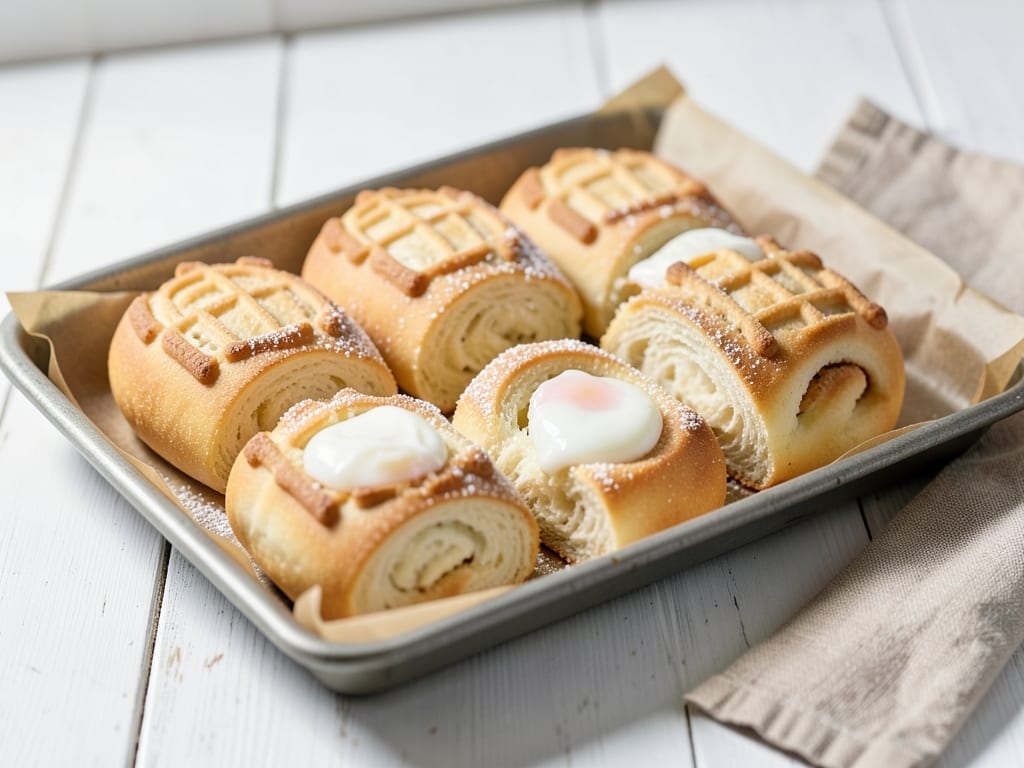
Melon Pan (Japanese Sweet Buns)
Soft, fluffy Japanese milk bread rolls topped with a buttery, crispy cookie crust stamped with a classic melon-like grid pattern. The tender crumb contrasts beautifully with the caramelized cookie exterior, and the interior has a subtle sweetness with notes of butter and vanilla.
- Prep
- 35 min
- Cook
- 20 min
- Wait
- 2 hr 30 min
- Total
- 3 hr 25 min
- Makes
- 8 melon pan rolls
Steps
Before you start
- Bring milk and eggs to room temperature (1 hour ahead)
- Have instant yeast and salt measured separately
- Preheat oven to 375°F (190°C) 15 minutes before baking
Mix bread dough
- In a large mixing bowl, whisk together flour, sugar, salt, and instant yeast.
- In a small bowl, combine room-temperature milk and egg.
- Pour the wet mixture into the dry ingredients and stir with a wooden spoon or the dough hook of a stand mixer until all flour is incorporated and you have a shaggy dough.
- Add salt and yeast separately to avoid killing the yeast.
+ Show details− Hide details
Ready when: All flour is incorporated; dough is shaggy and sticky
Tip: Don't worry if the dough looks wet—Japanese milk bread dough should be slightly sticky. Never salt the dough directly on top of yeast as salt can inhibit fermentation.
Knead and develop gluten
- Using a stand mixer on medium speed with the dough hook, knead for 5 minutes.
- The dough will begin to come together.
- Add the softened butter cubes gradually over 1–2 minutes while the mixer runs.
- Continue kneading on medium speed for another 5–6 minutes until the dough is smooth, elastic, and pulls away slightly from the bowl.
- The dough should feel soft and a bit tacky but hold together when pressed.
+ Show details− Hide details
Ready when: Dough is smooth, elastic, and pulls away from bowl; it springs back when poked
Tip: Add butter gradually so it incorporates smoothly rather than turning greasy. If kneading by hand, fold and press the dough for 10–12 minutes total. The dough should be soft and moist, not stiff.
First rise
- Form the dough into a ball and place it seam-side down in the same bowl (lightly oiled or wiped clean).
- Cover with plastic wrap or a shower cap.
- Let it rise at room temperature for 90 minutes, or until the dough roughly doubles in size.
- It should be light and pillowy; when you poke it gently, the indentation should spring back slowly but not completely.
+ Show details− Hide details
Ready when: Dough has increased roughly to double its original volume; poke test shows slow spring-back
Tip: Warmer kitchens (75–78°F / 24–26°C) speed rising; cooler ones slow it. The rise is more important than the time—watch the dough, not the clock.
Make melon cookie topping
- While the dough rises, prepare the topping.
- In a small bowl, cream together softened butter and sugar by hand or with an electric mixer until light and fluffy, about 2–3 minutes.
- Add the egg yolk and vanilla extract, mixing until smooth.
- Sift in the flour and fold gently with a spatula until just combined into a thick, paste-like dough.
- Do not overmix.
- The topping should be thick enough to hold its shape when piped or spread.
- Refrigerate until needed.
+ Show details− Hide details
Ready when: Mixture is light, fluffy, and creamy; flour is fully incorporated with no streaks
Tip: Do not overmix the topping or it becomes tough. The dough should be thick and spreadable, not runny. Chilling makes it easier to handle when spreading onto the rolls.
Divide and pre-shape dough
- Turn the risen dough onto a lightly floured surface and gently punch it down to release excess gas.
- Using a bench scraper or knife, divide the dough into 8 equal pieces (roughly 65–70 g each).
- Form each piece into a loose ball by folding the edges underneath and rolling it gently toward you.
- Let the pre-shaped balls rest on the floured surface for 5 minutes to relax.
+ Show details− Hide details
Ready when: Dough is divided into 8 equal pieces; each forms a loose, smooth ball
Tip: Use a kitchen scale or measure roughly equal pieces—uneven rolls bake unevenly. Handle gently to avoid deflating the dough.
Final shape and place on sheet
- Gently flip each dough ball seam-side down and place it on a parchment-lined 9×13-inch (23×33 cm) baking sheet, spacing them about 2 inches (5 cm) apart in two rows of four.
- You want enough space for them to expand during the second rise without touching.
+ Show details− Hide details
Ready when: All 8 rolls are evenly spaced on the baking sheet
Tip: Arrange rolls in a 2×4 grid (or 4×2 layout) to ensure even heat circulation and room for rising. Don't crowd them.
Second rise and proof
- Cover the baking sheet loosely with plastic wrap or a shower cap.
- Let the rolls rise at room temperature for 60 minutes, until they are about 1.5 times their original size and feel light and airy.
- They should not quite double, as they will continue to expand in the oven.
+ Show details− Hide details
Ready when: Rolls have increased 1.5× in size; they feel pillowy and spring back slowly when poked
Tip: Avoid over-proofing, which makes the rolls fragile. They should still feel structured when you gently poke them. If your kitchen is very warm, they may be ready in 45–50 minutes.
Top with melon cookie and scoreOven 375°F / 190°C
- Preheat the oven to 375°F (190°C) if not already done.
- Take the chilled cookie topping out of the refrigerator.
- Using a spoon or offset spatula, spread a thin, even layer (about ½ inch / 1.25 cm thick) of the topping over each roll, working quickly but gently to avoid deflating them.
- The topping should cover most of the top of each roll, leaving a thin border of dough visible around the edges.
- Using the tines of a fork or a toothpick, score a crosshatch or grid pattern into the topping, pressing gently so you create shallow parallel lines in both directions (like a melon's exterior).
- Do not press so hard that you cut through to the dough underneath.
+ Show details− Hide details
Ready when: All rolls are topped with a ½-inch layer of cookie dough; a crosshatch grid is scored into each
Tip: Work quickly so the rolls don't deflate while you're topping them. The grid pattern is the signature melon pan look—take your time with it, but don't press too hard or the fork will sink into the dough.
Bake until goldenOven 375°F / 190°C
- Place the baking sheet in the preheated 375°F (190°C) oven on the middle rack.
- Bake for 18–22 minutes, until the melon cookie topping is deep golden brown and the sides of the rolls are light golden.
- The cookie crust should be firm and caramelized, and you should smell a rich, buttery aroma filling your kitchen.
- If the tops are browning too quickly but the rolls still seem underbaked, lower the oven temperature to 350°F (175°C) for the final few minutes, or lightly tent with foil.
+ Show details− Hide details
Ready when: Melon topping is deep golden brown; sides are light golden; a toothpick inserted into a roll (not the topping) comes out clean with no sticky dough
Tip: Check the rolls at 18 minutes—baking times vary by oven. Every oven is different, so look for visual cues rather than strictly following the timer. The cookie topping should be caramelized and crispy when cool.
Cool completely
- Remove the baking sheet from the oven and let the rolls cool on the sheet for 15 minutes.
- Then transfer them to a wire rack to cool for at least 30 minutes more (or until completely cool) before serving.
- As they cool, the cookie topping hardens into a crispy shell, and the bread interior sets.
- Do not wrap them while warm, as steam will soften the crispy topping.
+ Show details− Hide details
Ready when: Rolls are cool to the touch; topping is hard and crispy
Tip: Patience here is key—if you wrap them while warm, steam will soften the crispy exterior. For the best texture, serve them at room temperature within a few hours of baking.
Good to know
Tips
- The melon pan's signature contrast comes from a tender, fluffy bread interior and a crispy, caramelized cookie exterior. If your topping doesn't crisp, it may be too thick or the oven too cool—aim for a light, even ½-inch (1.25 cm) layer and verify your oven temperature with an oven thermometer.
- Japanese milk bread doughs are characteristically softer and more hydrated than Western sandwich loaves. This dough should feel slightly sticky and soft, never stiff. If it seems too wet, resist adding extra flour—the texture is intentional.
- Do not skip the second rise. Even if the rolls look large after shaping, proofing gives them the final lift and airy crumb that makes melon pan special. Slightly under-proofed rolls bake denser; over-proofed ones may collapse.
- For the grid pattern, a fork or toothpick works best. Press gently so you create visible lines without tearing the dough. Some bakers use a specialized tool or knife, but a fork is traditional and gives a rustic look. The pattern bakes darker than the rest of the topping due to the edges of the scoring, creating visual definition.
Make ahead
Dough can be mixed and refrigerated overnight after the first rise. Bring to room temperature (1–2 hours) before shaping and proofing. Unbaked rolls (after shaping and topping) can be frozen for up to 2 weeks; thaw at room temperature for 1 hour, then bake as directed, adding 2–3 minutes to bake time.
Storage & reheating
Room temperature: up to 3 days in an airtight container. The topping softens slightly over time but remains delicious. Freezer: wrap individual rolls in plastic wrap and freeze for up to 1 month. Reheat thawed rolls at 300°F (150°C) for 8–10 minutes to refresh the topping's crispness (do not microwave, which will soften the cookie crust).
Substitutions
- whole milk → whole milk + 1 tablespoon heavy cream, or evaporated milk mixed with water at 1:1 ratio. Heavy cream enriches the dough and makes it slightly richer. Evaporated milk gives a deeper, slightly caramelized flavor.
- instant yeast (or bread machine yeast) → active dry yeast (use same amount, 1.5 tsp) or 3/4 teaspoon (2 g) fresh compressed yeast. Active dry yeast may produce slightly coarser crumb; fresh yeast delivers the most tender result but is harder to find.
- vanilla extract → almond extract (use 1/4 teaspoon only) or omit entirely. Almond extract adds subtle nuttiness; omitting makes a plainer, more classic Japanese version.
- all-purpose flour → cake flour or pastry flour. Cake flour produces a more tender, delicate cookie crust; all-purpose is more standard and slightly crisper.
More rolls & buns
See all →
Find more like this
- Meal
- Snack
- Cuisine
- Japanese
- Diet
- VegetarianHalal
- Method
- Oven