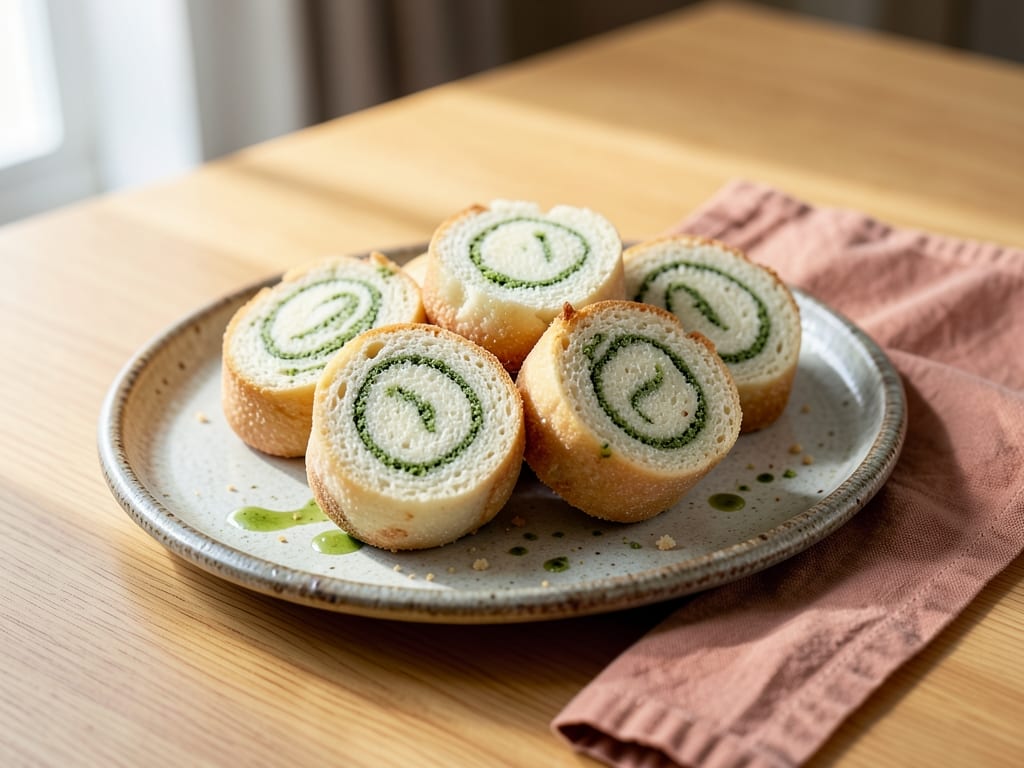
Matcha Milk Bread Rolls
Delicate Japanese-style milk bread rolls swirled with pale green matcha, baked until golden. A tangzhong dough creates an impossibly soft, velvety crumb that stays moist for days. Each roll is subtly sweet with a gentle earthiness from quality matcha powder. Perfect for breakfast or tea time.
Steps
Before you start
- Bring all ingredients to room temperature (milk, butter, egg) 1 hour ahead—cold ingredients will lower dough temperature and slow fermentation
- Prepare an 8×8-inch (20×20 cm) square baking pan by lightly buttering it or lining with parchment
- Use instant yeast (also labeled bread machine yeast), not active dry yeast, for proper rise timing
- Read through the timing so you understand the two rises; plan for 2.5–3 hours total from start to finish
Cook the tangzhongOven 150°F / 65°C
- In a small saucepan, whisk together the tangzhong flour (2 tbsp / 20 g) and tangzhong milk (3 tbsp / 45 ml) until no lumps remain.
- Set the saucepan over medium heat and stir constantly with a rubber spatula or wooden spoon.
- Cook for 2–3 minutes, stirring often, until the mixture reaches 149–150°F (65–66°C)—measured with an instant-read thermometer—and thickens into a smooth paste.
- The mixture should turn slightly translucent at the edges.
- Remove from heat and transfer to a small bowl.
- Cool to room temperature (about 10 minutes); it will thicken further as it cools.
+ Show details− Hide details
Ready when: Mixture reaches 149–150°F (65°C) and is smooth and slightly translucent
Tip: Do not skip cooling—hot tangzhong will kill the yeast. A room-temperature tangzhong is essential for fermentation.
Sift and prepare matcha
- While the tangzhong cools, sift the matcha powder (3 tbsp / 18 g) through a fine-mesh sieve into a small bowl.
- Sifting breaks up any clumps and ensures the matcha will be evenly distributed in the dough.
- Set aside.
+ Show details− Hide details
Ready when: Matcha is fluffy and lump-free
Tip: Sifting matcha is non-negotiable—lumps will not hydrate and will appear as green specks in the finished rolls.
Mix the dough
- Add the cooled tangzhong, sifted matcha powder, warm milk (¾ cup / 180 ml at 75–80°F), soft butter (3 tbsp / 42 g), sugar (3 tbsp / 37 g), salt (¾ tsp / 4 g), and instant yeast (1¼ tsp / 4 g) to the bowl of a stand mixer.
- Add the bread flour (2 cups / 260 g) last.
- Fit the dough hook and mix on low speed for 1 minute until the flour is incorporated and the mixture comes together into a shaggy mass.
- Increase speed to medium-low and knead for 8–10 minutes until the dough is smooth, elastic, and slightly tacky but not sticky.
- The dough should be soft enough to be dimpled easily by your finger, but firm enough to hold its shape.
+ Show details− Hide details
Ready when: Dough is smooth and elastic; windowpane test: a small piece stretches thin without tearing
Tip: If mixing by hand, this takes 12–15 minutes of continuous kneading. Do not over-knead or the rolls will be tough.
First rise (bulk fermentation)
- Transfer the dough to a lightly oiled bowl, turning it once to coat all sides.
- Cover with a damp kitchen towel or plastic wrap.
- Let rise at room temperature (68–72°F / 20–22°C) for 60–90 minutes, until the dough has increased in volume by about 50–75% and is noticeably puffy but not yet doubled (it will finish doubling after shaping).
- The dough should be airy but still hold its shape when poked.
+ Show details− Hide details
Ready when: Dough is puffy, increased in volume by 50–75%, and springs back slowly when poked
Tip: Avoid over-proofing; the dough should still be a bit under-risen at this stage. You want it active, not exhausted.
Divide and pre-shape
- Turn the dough out onto a lightly floured work surface.
- Gently pat it down without fully deflating it.
- Divide the dough into 6 equal pieces (each should weigh about 65–70 g).
- Shape each piece into a loose ball by folding the edges toward the center and rotating it slightly as you go.
- Cover with the damp towel and let rest for 10 minutes.
- This rest allows the gluten to relax so the final shaping is easier.
+ Show details− Hide details
Ready when: Dough pieces are loose balls; after rest, they are relaxed and slightly spread
Tip: Be gentle when dividing—rough handling will deflate the dough and slow the final rise.
Shape into rolls
- Take one dough ball and press it gently into a 3×3-inch (7.5×7.5 cm) square.
- Roll it up tightly from the top edge, pinching as you go to seal the seam.
- The roll should be compact and uniform.
- Place seam-side down in one corner of the buttered 8×8-inch baking pan.
- Repeat with the remaining 5 pieces, arranging them in a 2×3 grid (3 rows of 2 rolls).
- They should touch slightly—about ½ inch apart.
- This allows them to rise together and bake as a cohesive block.
+ Show details− Hide details
Ready when: 6 rolls are arranged in pan in a 2×3 grid, seam-side down
Tip: Don't pack the rolls too tightly or they won't rise upward; a little space between them is key.
Final rise (proof)
- Cover the pan with a damp kitchen towel or plastic wrap.
- Let rise at room temperature for 45–60 minutes, until the rolls are puffy, light, and nearly doubled in size.
- They should rise above the rim of the pan slightly and feel airy when you gently poke them.
- The rolls may touch and nestle together, which is fine.
+ Show details− Hide details
Ready when: Rolls are nearly doubled, puffy, and light; they spring back slowly when poked
Tip: Timing varies with room temperature. Cooler kitchens take 60 minutes; warmer ones, 45 minutes. The rolls should look airy, not dense.
Preheat and egg washOven 350°F / 175°C
- About 15 minutes before the rolls finish rising, preheat the oven to 350°F (175°C).
- When the rolls are fully proofed, brush the top of each roll gently with the beaten egg wash (1 egg beaten with 1 tbsp water), using a pastry brush.
- Apply an even, thin layer to the tops and sides.
- Do not drench them—a light coating is all that's needed.
+ Show details− Hide details
Ready when: Oven is preheated to 350°F (175°C); rolls are lightly and evenly coated with egg wash
Tip: Avoid egg wash pooling in the pan—it can make the bottoms soggy. A light brush is better than soaking.
Bake until goldenOven 350°F / 175°C
- Place the pan in the preheated 350°F (175°C) oven.
- Bake for 22–26 minutes, until the rolls are a light golden-brown color on top.
- The internal temperature should reach 190–200°F (87–93°C) when an instant-read thermometer is inserted into the center of one roll.
- The rolls should feel firm but tender when lightly pressed.
- If the tops are browning too quickly, tent the pan loosely with aluminum foil for the last 5–8 minutes.
+ Show details− Hide details
Ready when: Rolls are light golden-brown; internal temperature is 190–200°F (87–93°C)
Tip: Milk bread browns quickly because of the sugar. Watch after 20 minutes; every oven varies slightly.
Cool and serve
- Remove the pan from the oven and let the rolls cool in the pan for 5 minutes.
- Turn the rolls out onto a wire rack and cool to room temperature (about 30 minutes).
- Serve warm or at room temperature.
- The rolls will have a soft, tender crumb with a subtle matcha flavor.
+ Show details− Hide details
Ready when: Rolls are warm and set enough to handle; final cooling is complete
Tip: Do not cut the rolls while they are very hot—they are still setting inside and will crumble. A 20-minute rest is ideal before cutting.
Good to know
Tips
- Tangzhong is the secret to a tender, moist crumb that stays soft for 2–3 days. Do not skip this step or cool it improperly—it is a heat-treatment that gelatinizes the starches and traps moisture. Always cool to room temperature before adding to the dough.
- Matcha flavor is delicate; if using lower-quality matcha, increase to 3.5–4 tbsp (21–24 g) for stronger flavor. High-quality ceremonial matcha will shine with just 3 tbsp. Do not bake matcha into the rolls until it is sifted—lumps will stay hard and unpleasant.
- Dough temperature matters: aim for a final dough temperature (after kneading) of 76–78°F (24–26°C). If it is too warm, fermentation will be fast and uneven; if too cool, the rolls will take a very long time to rise. Use an instant-read thermometer in the dough after mixing.
Make ahead
Shaped rolls can be refrigerated in the baking pan, covered, for up to 14 hours before the final rise. Remove from the fridge, let them come to room temperature (20–30 minutes), then proceed with the final rise and baking. Unbaked rolls can also be frozen for up to 1 month; thaw overnight in the fridge, then proof and bake as usual.
Storage & reheating
**Room temperature:** Store in an airtight container or sealed plastic bag for 2 days. **Refrigerator:** Keep in an airtight container for up to 4 days. Refresh in a 300°F (150°C) oven for 8–10 minutes before serving. **Freezer:** Wrap cooled rolls individually in plastic wrap, then place in a freezer bag for up to 1 month. Thaw at room temperature (2 hours) or overnight in the fridge, then warm in a 300°F oven for 10–12 minutes.
Substitutions
- bread flour → all-purpose flour (3–5% lower protein). The dough will be slightly less elastic and the crumb slightly less tender, but results are still very good. Use the same weight.
- whole milk, warmed to 75–80°F (24–27°C) → unsweetened oat milk or coconut milk. Both work well; coconut milk adds a subtle richness. Use the same volume. Avoid milk with added sweeteners.
- matcha powder → 1–2 tbsp matcha (half the amount) if you prefer a subtler flavor, or omit entirely for plain milk bread rolls. If using less matcha, sift it the same way. Plain milk bread rolls will be a pale cream color instead of pale green.
- unsalted butter → neutral oil such as vegetable or canola oil (use 2 tbsp / 30 ml). Slightly less rich but still soft and tender. The rolls will have a lighter crumb. Do not use olive oil.
More rolls & buns
See all →
Find more like this
- Meal
- Breakfast
- Cuisine
- Japanese
- Diet
- VegetarianHalal
- Method
- Oven