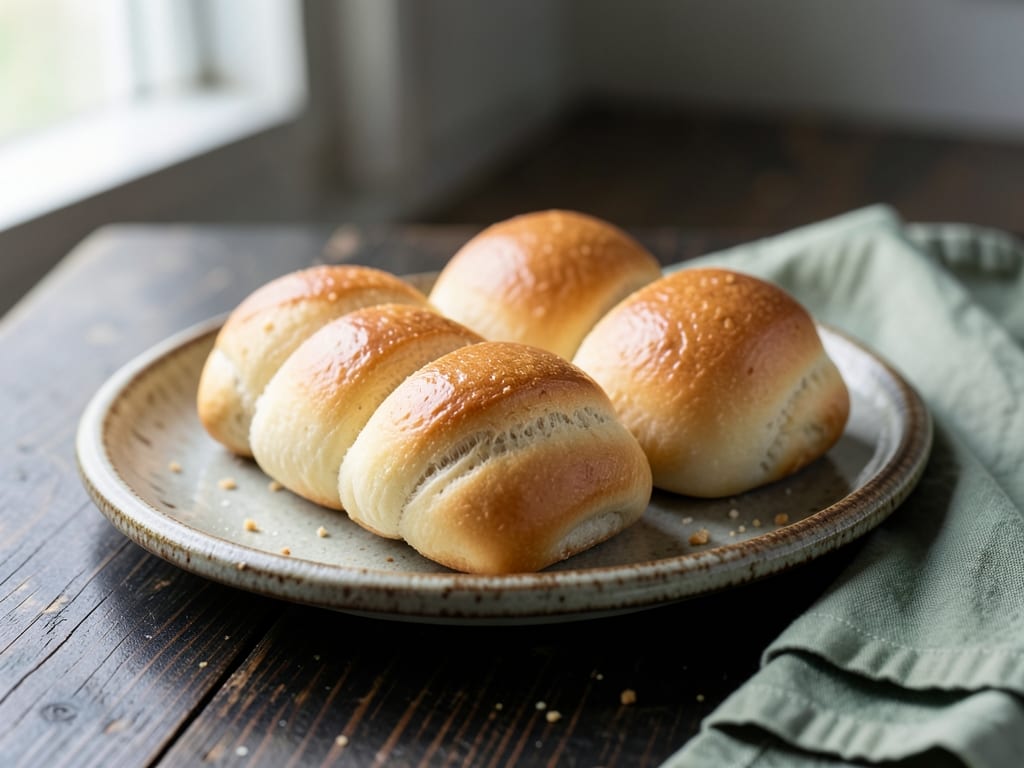
Japanese Milk Bread Rolls
Soft, pillowy Japanese milk bread rolls made with the tangzhong method—a cooked flour-water roux that keeps the bread moist and tender. These rolls are perfect for breakfast, sandwiches, or alongside any meal. The subtle sweetness and incredible texture make them worth the few hours of rise time.
Steps
Before you start
- Gather all ingredients and bring milk, butter, and eggs to room temperature (at least 1 hour ahead)
- Prepare a 9×13-inch (23×33 cm) baking pan by greasing it with butter or cooking spray
- Read through the entire recipe to understand the timing; total time is about 3 hours from start to eating
- Have a kitchen thermometer or instant-read thermometer on hand
Cook the tangzhong
- In a small saucepan, whisk together 50ml (3.4 tbsp) water and 50g (1/3 cup) bread flour until smooth.
- Place the saucepan over medium heat and cook, stirring constantly with a whisk, for about 2–3 minutes until the mixture thickens into a smooth, pudding-like paste.
- Continue cooking until the mixture registers 65°C (149°F) on a kitchen thermometer—you'll notice it becomes glossy and thick.
- Transfer the tangzhong to a small bowl and let it cool to room temperature for about 15 minutes, stirring occasionally to speed cooling.
+ Show details− Hide details
Ready when: Mixture is thick, smooth, glossy, and registers 65°C (149°F) on a thermometer
Tip: This roux-like paste will look slightly sticky and glossy—this is correct. It gelatinizes the flour, allowing it to absorb and retain liquid, which keeps the bread incredibly soft. Never skip this step.
Mix and knead the dough
- Once the tangzhong has cooled to room temperature, add it to a large mixing bowl along with 350g (2.75 cups) bread flour, 130ml (1/2 cup + 1 tbsp) whole milk at room temperature, 30g (2.4 tbsp) sugar, and 5g (1.5 tsp) instant yeast.
- Using a stand mixer fitted with the dough hook, mix on low speed for about 2 minutes until the ingredients are roughly combined into a shaggy dough.
- Add 5g (1 tsp) salt and mix for another 1 minute.
- Then add 35g (2.5 tbsp) unsalted butter, cut into small pieces.
- Increase the speed to medium and knead for 8–10 minutes until the dough becomes smooth, elastic, and barely sticky to the touch.
- If mixing by hand, combine the ingredients with a wooden spoon, then knead on a lightly floured surface for 12–15 minutes, adding the butter after the first 5 minutes of kneading.
+ Show details− Hide details
Ready when: Dough is smooth, elastic, and springs back slowly when poked; soft and slightly tacky but not sticky enough to stick to your fingers
Tip: Add the butter after initial mixing so it incorporates smoothly. If the dough seems too wet, add bread flour 1 tablespoon at a time. The dough should feel similar to a soft earlobe.
First bulk rise
- Shape the dough into a smooth ball and place it in a large greased mixing bowl.
- Cover the bowl with plastic wrap or a damp kitchen towel.
- Let the dough rise at room temperature (about 68–72°F / 20–22°C) for about 60 minutes until it roughly doubles in size.
- You'll know it's ready when you gently poke the dough with your finger and the indentation slowly springs back halfway (rather than all the way or not at all).
+ Show details− Hide details
Ready when: Dough has roughly doubled in size; a gentle poke leaves an indentation that slowly springs back halfway
Tip: If your kitchen is cold (below 68°F), place the covered bowl in a warm spot like an oven with just the light on, or use a proofing box. Avoid placing it near windows or drafts.
Divide and shape rolls
- Turn the risen dough out onto a lightly floured surface.
- It will be soft and slightly sticky—this is normal.
- Using a bench scraper or dough knife, divide the dough into 12 equal pieces (each piece will weigh about 55g).
- Working with one piece at a time, roll it into a smooth, tight ball by gently tucking the edges underneath to create tension on the surface.
- Arrange the rolls seam-side down in a greased 9×13-inch (23×33 cm) baking pan in 3 rows of 4.
- The rolls should be close but not quite touching at this point.
+ Show details− Hide details
Ready when: All 12 rolls are evenly sized, smoothly shaped, and arranged in the baking pan with sealed seams on the bottom
Tip: Keep the surface of each roll smooth and taut by tucking the dough under itself; this helps them rise evenly and gives them a uniform, attractive appearance. Avoid overworking the dough.
Second rise (final proof)
- Cover the baking pan with plastic wrap or a damp kitchen towel.
- Let the rolls rise at room temperature for about 45 minutes.
- They should become noticeably puffy and nearly doubled in height.
- The rolls will expand and may begin to touch each other—this is expected and desirable for soft, tender rolls.
- Avoid letting them over-proof; they should look full and pillowy but not so puffy that they look ready to burst.
+ Show details− Hide details
Ready when: Rolls are puffy and nearly doubled in height; they may be touching or nearly touching
Tip: Set a timer so you don't forget them. If they seem to be rising faster than expected (in a warm kitchen), check them at 35–40 minutes. Over-proofing can cause the rolls to rise too much and collapse in the oven.
Preheat oven and prepare egg washOven 375°F / 190°C
- About 15 minutes before the second rise is complete, preheat your oven to 375°F (190°C).
- In a small bowl, whisk together 1 large room temperature egg and 15ml (1 tbsp) whole milk until well combined and light yellow.
- Set the egg wash aside.
+ Show details− Hide details
Ready when: Egg wash is smooth, light yellow, and well combined
Tip: Using a room temperature egg makes whisking easier. The egg wash creates a beautiful golden-brown color and a light shine on the baked rolls.
Apply egg wash and bakeOven 375°F / 190°C
- Remove the plastic wrap from the baking pan.
- Using a pastry brush, gently brush the egg wash evenly over the tops of all the rolls—be careful not to deflate them.
- Place the baking pan in the preheated 375°F (190°C) oven.
- Bake for 18–22 minutes until the rolls are deep golden brown on top.
- The internal temperature should reach 190–195°F (87–90°C) when measured with an instant-read thermometer inserted into the center of one of the rolls.
- The rolls should sound hollow when tapped on the bottom.
+ Show details− Hide details
Ready when: Rolls are deep golden brown on top; internal temperature registers 190–195°F (87–90°C); they sound hollow when tapped
Tip: Don't open the oven door for the first 15 minutes, as the rolls are still rising. If the tops brown too quickly (before 18 minutes), loosely tent the pan with aluminum foil to slow the browning.
Cool and serve
- Remove the baking pan from the oven and place it on a wire cooling rack.
- Let the rolls cool in the pan for about 10 minutes.
- At this point, if desired, you can brush the warm rolls lightly with melted butter for added softness and a subtle shine.
- After 10 minutes, turn the rolls out onto the cooling rack or serve directly from the pan.
- They can be enjoyed warm, at room temperature, or reheated later.
+ Show details− Hide details
Ready when: Rolls are warm to the touch and firm enough to hold their shape
Tip: Brushing with melted butter while still warm adds richness and keeps the crust soft. Warm milk bread rolls are best served fresh.
Good to know
Tips
- Tangzhong is essential—it's a gelatinized flour paste that retains moisture in the dough, creating the signature soft, pillowy texture. Don't skip this step or the rolls will be drier.
- Room temperature ingredients are crucial for proper fermentation and dough development. Cold dough ferments slowly and may result in dense, heavy rolls.
- Avoid over-proofing during the second rise; the rolls should be puffy but not so puffy that they look ready to burst. If they seem too puffy before the second rise time is up, you can bake them early.
- If your kitchen is cool (below 68°F / 20°C), place the bowl of dough in a warm spot like an oven with just the light on, or use a proofing box, to ensure proper rise.
Make ahead
The tangzhong can be made up to 1 day ahead, cooled completely, and refrigerated; bring to room temperature before using. After shaping (step 4), the rolls can be covered and refrigerated overnight; let them come to room temperature for 30 minutes before egg washing and baking (or bake from cold for an extra 5–10 minutes).
Storage & reheating
Room temperature: 2 days in an airtight container. Refrigerator: 5 days in an airtight container; reheat gently in a 300°F (150°C) oven for 5–10 minutes. Freezer: 3 months; wrap individual rolls in plastic wrap and place in a freezer bag; thaw at room temperature for 2 hours, then reheat in a 300°F (150°C) oven for 10 minutes.
Substitutions
- whole milk → Heavy cream (30ml) + water (100ml) for richer rolls, or unsweetened oat or almond milk. Results will be slightly less rich with non-dairy milk, but still soft and delicious.
- bread flour → All-purpose flour in the same amount (350g / 2.75 cups). The crumb will be slightly softer with less structure, but the rolls will still be tender.
- unsalted butter → Neutral oil such as vegetable or canola oil (use 30ml / 2 tbsp instead of 35g / 2.5 tbsp). The rolls will be less rich but still soft and delicious.
- instant yeast → Active dry yeast (same amount, 5g / 1.5 tsp) or 7g (1.5 tsp) fresh yeast. If using active dry yeast, let it bloom in 2 tbsp warm milk for 5 minutes before adding to the dough.
More rolls & buns
See all →
Find more like this
- Meal
- Breakfast
- Cuisine
- Japanese
- Diet
- VegetarianHalal
- Method
- Oven