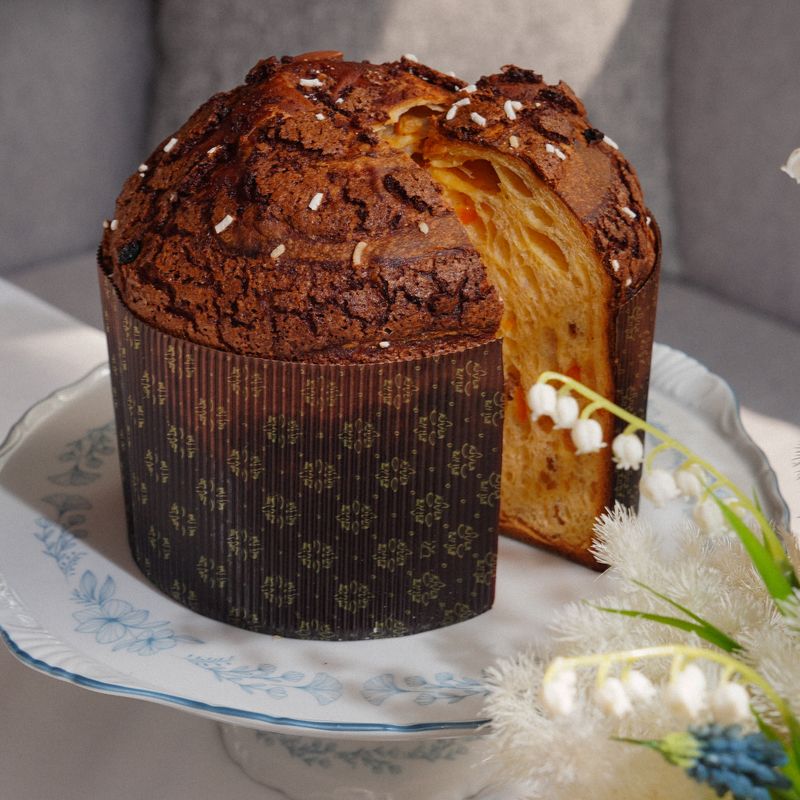
Italian Panettone-Inspired Breakfast Loaf with Candied Citrus
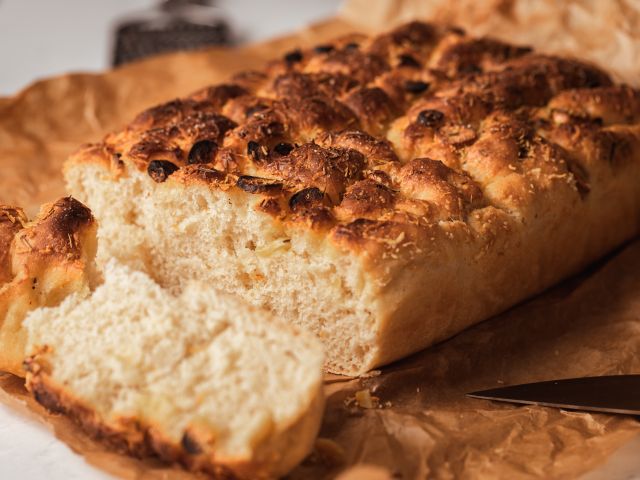
A golden, tender breakfast loaf inspired by the classic Italian panettone. Studded with plump raisins, candied orange peel, and a hint of vanilla and lemon zest, this enriched dough bakes into a moist crumb that is perfect for breakfast or brunch. The candied citrus provides bursts of brightness, while the brioche-like texture makes it luxurious enough to serve at any gathering.
- Prep
- 30 min
- Cook
- 45 min
- Wait
- 2 hr
- Total
- 3 hr 15 min
- Makes
- 1 loaf (12 slices)
Steps
Before you start
- Bring eggs and butter to room temperature 1 hour ahead (about 70°F / 21°C)
- Preheat oven to 375°F (190°C) and line a 9×5-inch (23×13 cm) loaf pan with parchment paper
- If your candied orange peel is large, chop it into ½-inch (1.3 cm) pieces
- Measure all dry ingredients and combine them in a bowl before mixing
Mix dry ingredients
- In a medium bowl, whisk together 325 g (2½ cups) bread flour, 6 g (2 teaspoons) instant yeast, and 5 g (1 teaspoon) salt.
- Set aside.
+ Show details− Hide details
Ready when: Dry ingredients are evenly combined with no yeast clumps
Tip: Whisk vigorously to distribute yeast evenly—this prevents dense pockets in the baked loaf
Combine wet ingredients
- In the bowl of a stand mixer, combine 120 ml (½ cup) warm milk, 100 g (½ cup) sugar, and 7 ml (1½ teaspoons) vanilla extract.
- Stir until the sugar dissolves, about 1 minute.
- Add 3 beaten room-temperature eggs and stir to combine.
+ Show details− Hide details
Ready when: Mixture is pale and homogeneous
Tip: Room-temperature eggs incorporate more smoothly into an enriched dough
Mix dough
- Add the dry ingredient mixture to the wet ingredients.
- Attach the dough hook and mix on low speed for 2 minutes until all flour is incorporated.
- The dough will be shaggy.
- Add 85 g (6 tablespoons) cold butter cubes, 3 to 4 pieces at a time, mixing on low speed for 20 seconds between additions.
- Once all butter is incorporated, increase speed to medium-low and knead for 8 minutes, until the dough is smooth, elastic, and slightly sticky.
+ Show details− Hide details
Ready when: Dough pulls away from bowl sides, springs back when poked, and is glossy and elastic
Tip: Add cold butter gradually so it emulsifies rather than creating greasy streaks. If kneading by hand, this step takes 12–15 minutes of vigorous working
Add fruit and zest
- With the mixer on low speed, add 3 g (1½ teaspoons) lemon zest.
- Mix for 30 seconds.
- Add 115 g (¾ cup) raisins and 80 g (½ cup) candied orange peel pieces.
- Mix on low speed for 2 minutes until fruit is evenly distributed throughout the dough.
+ Show details− Hide details
Ready when: Fruit is distributed throughout with no visible pockets of dry dough
Tip: Add fruit at the end of kneading so the dough's elasticity keeps everything suspended evenly
Shape and pan
- Transfer the dough to the lined 9×5-inch (23×13 cm) loaf pan, gently pressing it into the corners and smoothing the top with a wet hand.
- Cover the pan loosely with plastic wrap or a damp kitchen towel.
+ Show details− Hide details
Ready when: Dough fills about two-thirds of the pan
Tip: Use parchment paper rather than butter so the delicate crust doesn't stick
First rise
- Let the dough rise in a warm, draft-free place for 60 minutes, until the dough rises to just above the rim of the pan.
- It should increase by about 50% and feel light and airy when you gently poke it with a floured finger.
+ Show details− Hide details
Ready when: Dough rises to just above the pan rim; your finger leaves a slow-filling impression when poked
Tip: Too warm (above 80°F / 27°C) causes overproofing and a dense crumb; too cool and it rises unevenly
Apply egg wash
- When the dough has risen, prepare the egg wash by beating 1 egg with 15 ml (1 tablespoon) water until combined.
- Gently brush the egg wash over the top of the dough in an even, thin layer, being careful not to deflate the rise.
+ Show details− Hide details
Ready when: Top is evenly coated with a thin sheen
Tip: A light hand prevents the egg wash from pooling and creating an uneven, leathery crust
Second rise
- Cover the pan again with plastic wrap and let the dough rise for another 30 minutes at room temperature until it rises about ½ inch (1.3 cm) above the rim.
- The dough should jiggle slightly when you gently shake the pan.
+ Show details− Hide details
Ready when: Dough rises ½ inch (1.3 cm) above the rim and jiggles when pan is gently shaken
Tip: Do not skip the second rise; it ensures a tender crumb and good oven spring
Bake loafOven 375°F / 190°C
- Preheat the oven to 375°F (190°C) if not already done.
- Place the pan in the oven on the center rack.
- Bake for 40–45 minutes, until the top is deep golden brown and an instant-read thermometer inserted into the center reads 200°F (93°C).
- If the top browns too quickly (after 25 minutes), loosely tent it with aluminum foil to prevent over-browning while the inside continues to bake.
+ Show details− Hide details
Ready when: Top is deep golden brown; center reaches 200°F (93°C); loaf sounds hollow when tapped on the bottom
Tip: Tenting with foil prevents a burned crust while the inside finishes baking, especially if your oven runs hot
Cool in pan
- Remove the loaf from the oven and let it cool in the pan for 15 minutes.
- Run a thin knife around the edges to loosen the loaf from the pan, then turn it out onto a wire cooling rack.
+ Show details− Hide details
Ready when: Loaf pulls slightly away from the pan sides; internal crumb sets enough to support its weight
Tip: Cooling in the pan for the full 15 minutes prevents the tender crumb from splitting as it releases
Cool completely
- Transfer the loaf to a wire cooling rack and cool completely to room temperature, about 1 hour.
- The crumb continues to set as it cools.
+ Show details− Hide details
Ready when: Loaf is cool to the touch; interior is no longer steaming when sliced
Tip: Slicing warm bread releases too much steam and tears the crumb. Wait until cool for clean, even slices
Good to know
Tips
- For a glossy, shiny crust, brush the cooled loaf with a simple syrup made from equal parts sugar and water, heated until the sugar dissolves, then cooled slightly. Brush on just before serving.
- This loaf is wonderful sliced and toasted, then spread with butter or mascarpone cheese for a luxurious breakfast.
- If you do not have a stand mixer, knead the dough by hand on a lightly floured surface for 12–15 minutes until smooth and elastic, adding butter gradually. Hand-mixing is vigorous but rewarding.
- To test if the dough has proofed enough during the rise, use the 'poke test': gently press your floured finger into the dough about ½ inch (1.3 cm) deep. If it springs back slowly and leaves a faint impression, it is ready. If it springs back quickly, it needs more time. If it does not spring back, it has overproofed.
Make ahead
You can prepare the dough through step 4 and refrigerate it overnight in an airtight container. The next morning, let it return to room temperature (30 minutes) before shaping into the pan. Alternatively, bake the loaf and freeze it in an airtight container for up to 2 months.
Storage & reheating
Room temperature (in an airtight container or wrapped in plastic): 3 days. Refrigerator (airtight container): 5 days; rewarm in a 300°F / 150°C oven for 10 minutes before serving. Freezer (airtight container or freezer bag): 8 weeks; thaw at room temperature overnight, then warm as above if desired.
Substitutions
- candied orange peel → candied lemon peel or dried cranberries, chopped. Lemon peel amplifies citrus; cranberries add tartness instead of sweetness. Use the same weight.
- plump raisins → dried currants or chopped dried apricots. Currants are smaller and add subtle tartness; apricots are chewier and more pronounced. Use the same weight.
- bread flour → all-purpose flour. The loaf will be slightly less chewy but still tender. Reduce kneading time by 1–2 minutes.
- pure vanilla extract → rum extract or 1 tablespoon dark rum. Rum mimics traditional panettone flavoring. Use extract sparingly—it is potent—or the liquid rum in place of vanilla.