Italian Colomba Pasquale (Easter Dove Cake)
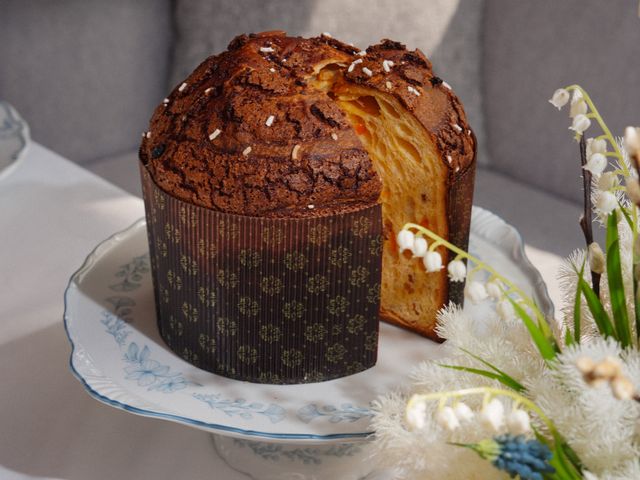
A stunning dove-shaped Easter cake from Milan with a soft, fragrant crumb studded with candied fruit and topped with pearl sugar. This traditional Italian sweet bread requires time and care but rewards you with an elegant, aromatic loaf perfect for celebrations. The enriched dough is studded with candied orange peel, lemon peel, and raisins, then topped with sliced almonds and pearl sugar for a jeweled finish.
- Prep
- 45 min
- Cook
- 50 min
- Wait
- 6 hr
- Total
- 7 hr 35 min
- Makes
- 1 dove cake (about 1.5 pounds; 12 slices)
Steps
Before you start
- Have all ingredients at room temperature (65–70°F / 18–21°C), especially butter and eggs, for proper emulsification
- If using a dove mold, grease and flour it thoroughly or line with parchment; a 2-pound loaf pan works as an alternative
- Begin this recipe in the morning to allow time for two long rises (3–4 hours each)
- Read through the full method before starting; the enriched dough technique requires patience and cool hands
Hydrate yeast and mix base dough
- In a stand mixer bowl, combine the warm water (105–110°F / 40–43°C), instant yeast, and 1 tablespoon (12 g) of the sugar.
- Let sit for 5 minutes until foamy and activated.
- Add the remaining flour, salt, remaining sugar, eggs, vanilla extract, and lemon zest.
- Fit the mixer with the dough hook and mix on medium speed for 6–8 minutes, until the dough comes together but is still slightly sticky.
- It should feel soft and slightly tacky to the touch.
+ Show details− Hide details
Ready when: Dough comes together in a shaggy mass and springs back slightly when poked
Tip: Do not overmix; the dough should be slightly sticky and soft. Overworking develops too much gluten and can toughen the final crumb.
Incorporate butter gradually
- With the mixer still on medium-low speed, add the softened butter in 3 pieces, waiting for each addition to fully incorporate before adding the next (about 2 minutes per addition).
- The dough will look broken and greasy at first but will gradually become smooth and elastic.
- Once all butter is incorporated, continue mixing for 3–4 more minutes until the dough is glossy, elastic, and pulls away from the bowl sides.
- The dough should reach about 80–82°F (27–28°C) at this point.
+ Show details− Hide details
Ready when: Dough is smooth, glossy, elastic, and slightly warm; butter is fully emulsified
Tip: Patience is crucial here. If butter is added too fast, the emulsion breaks and the dough becomes greasy rather than silky. Cold butter should be softened to 65–70°F.
Plump raisins while dough rises
- While the dough comes together, cover the raisins with 0.5 cup warm water (about 110°F / 43°C) and let them soak for 15 minutes.
- Drain thoroughly and pat dry with a clean kitchen towel.
- This plumps them and prevents them from drawing moisture from the finished loaf.
+ Show details− Hide details
Ready when: Raisins are swollen and soft
Tip: Pat them very dry after draining, or they can make the final dough too wet.
Fold in fruits and honey
- Reduce mixer speed to low.
- With the dough hook running, add the honey, then gradually fold in the chopped candied orange peel, candied lemon peel, and drained raisins.
- Mix on low for 2–3 minutes just until the fruits are evenly distributed.
- Do not overmix; you want distinct pieces of fruit throughout, not a fruit paste.
+ Show details− Hide details
Ready when: Candied fruit and raisins are evenly scattered throughout the dough
Tip: If the dough is too sticky after adding fruits, allow it to rest for 10 minutes; the flour will absorb moisture from the fruits and the dough will firm up slightly.
First rise (bulk fermentation)
- Transfer the dough to a lightly oiled bowl.
- Cover with plastic wrap or a shower cap to prevent drying.
- Place in a warm, draft-free location (around 75–78°F / 24–26°C).
- Allow to rise for 3–4 hours, until the dough has increased by about 50–75% in volume (not quite doubled, as this dough rises more slowly due to the enriched nature and fruit).
- The dough should feel bubbly and slightly domed.
- If your kitchen is cool, place the bowl in a turned-off oven with the light on, or use a proofing box set to 75°F (24°C).
+ Show details− Hide details
Ready when: Dough has risen 50–75% in volume; poke test shows an indent that springs back partially
Tip: This dough ferments more slowly than standard bread doughs because of the enrichment (eggs, butter, sugar). Patience is essential; rushing this step reduces flavor development.
Prepare mold and shape dough
- Generously grease and flour a dove-shaped mold (or a 9×5-inch / 23×13 cm loaf pan as an alternative).
- Gently turn the dough out onto a lightly floured surface without degassing it completely.
- Shape it into a rough ball or oval to fit the mold.
- For a dove shape, transfer the dough to the mold and gently press it into the corners.
- If using a loaf pan, shape it into a rough oval about 8 inches (20 cm) long and place it seam-side down in the pan.
- Cover loosely with plastic wrap.
+ Show details− Hide details
Ready when: Dough is gently shaped and settled in the mold
Tip: Avoid aggressive handling; you want to keep as many bubbles in the dough as possible. Over-kneading or pressing will deflate it and result in a dense crumb.
Second rise (final proof)
- Cover the mold with plastic wrap and place it in the same warm location (75–78°F / 24–26°C).
- Allow to rise for 2–3 hours until the dough has increased by about 50% and just reaches the top of the mold.
- It should feel airy and pillowy when gently pressed with a finger; the indent should spring back slowly.
- Do not allow it to rise too far above the rim of the mold, or it may overproof and collapse in the oven.
+ Show details− Hide details
Ready when: Dough has risen about 50% and nearly reaches the top of the mold; gentle poke leaves a slowly-rebounding indent
Tip: Overproofing is the most common pitfall. The dough should still feel slightly under-risen when it goes into the oven. Better to slightly underbake than overproof.
Preheat oven and prepare toppingOven 400°F / 205°C
- About 15 minutes before baking, preheat your oven to 400°F (200°C) with a rack positioned in the center.
- Prepare the egg wash by beating 1 large egg with 1 teaspoon water until smooth.
- Have the sliced almonds and pearl sugar ready in separate small bowls.
+ Show details− Hide details
Ready when: Oven reaches 400°F (200°C)
Tip: Preheat thoroughly; this dough needs immediate heat to set its structure and create a tender crust.
Apply egg wash and toppings
- Gently brush the entire surface of the risen dough with egg wash, being careful not to deflate it.
- Sprinkle the sliced almonds evenly over the top, then scatter the pearl sugar over the almonds.
- A light hand is important; you want a jeweled appearance, not a thick crust of toppings.
+ Show details− Hide details
Ready when: Entire surface is evenly coated with egg wash, almonds, and pearl sugar
Tip: Use a soft pastry brush and a very gentle hand to avoid deflating the dough at this critical stage. If the dough deflates slightly, let it rest for 5 minutes and gently brush again.
Bake the cakeOven 400°F / 205°C
- Place the mold on a baking sheet (to catch any drips) and transfer to the preheated 400°F (200°C) oven.
- Bake for 45–50 minutes, until the top is deep golden brown and an instant-read thermometer inserted into the thickest part of the loaf reads 190–195°F (87–90°C).
- The loaf should feel firm to the touch and smell fragrant and yeasty.
- If the top is browning too quickly, tent loosely with aluminum foil after 25 minutes.
+ Show details− Hide details
Ready when: Top is deep golden brown; internal temperature reaches 190–195°F (87–90°C); loaf sounds hollow when tapped on bottom
Tip: Use a meat thermometer inserted horizontally into the side of the loaf to avoid showing the probe on top. If the thermometer shows 185°F (85°C) but the crust is pale, lower the oven to 375°F (190°C) and continue baking 5–10 more minutes.
Cool and unmold
- Remove the cake from the oven and let it rest in the mold for 10 minutes.
- Turn it out gently onto a wire rack to cool completely, at least 2 hours, before slicing.
- The interior will continue to set as it cools.
- Do not wrap or store until completely cooled, or condensation will soften the crust.
+ Show details− Hide details
Ready when: Cake is completely cool to the touch and sounds hollow when tapped
Tip: Resist the urge to slice warm; the crumb is delicate and will tear. Slice with a serrated bread knife in a gentle sawing motion.
Make optional glaze
- If desired, whisk together the confectioners sugar, water (or milk for a richer sheen), and lemon juice until smooth and pourable.
- Drizzle over the cooled cake.
- Allow the glaze to set for 15 minutes before serving or wrapping.
+ Show details− Hide details
Ready when: Glaze is smooth, pourable, and coats the back of a spoon
Tip: Omit the glaze for an authentic look that showcases the pearl sugar and almond topping. If you do glaze, keep it thin and delicate.
Slice and serve
- Once completely cooled and glazed (if using), slice the dove cake with a serrated bread knife using gentle sawing motions.
- Serve at room temperature or lightly warmed.
- This cake pairs beautifully with espresso, weak tea, or Italian hot chocolate.
+ Show details− Hide details
Ready when: Slices are clean and reveal an even, tender, fragrant crumb studded with visible candied fruit
Tip: If the knife is dragging or tearing the crumb, it is likely still slightly warm. Wait another 10–15 minutes. A serrated bread knife works better than a chef's knife for this delicate cake.
Good to know
Tips
- This dough is enriched (high in eggs, butter, and sugar) and ferments more slowly than regular bread dough. Allow adequate time for the rises; rushing this cake results in a dense, less flavorful crumb. Patience is rewarded.
- Room temperature is crucial: Have butter, eggs, and all ingredients at 65–70°F (18–21°C) before starting. Cold ingredients do not emulsify properly, and the dough will be greasy rather than silky.
- If your kitchen is cool (below 72°F / 22°C), use a proofing box, turned-off oven with light on, or warm a bowl in hot water and set the dough bowl inside to maintain 75–78°F (24–26°C) for optimal fermentation.
- Slice with a serrated bread knife using gentle sawing motions once completely cooled. Warm slices briefly in a 300°F (150°C) oven for 8–10 minutes to restore the tender crumb texture if desired.
Make ahead
Make this cake up to 2 days ahead; it improves in flavor and moisture as it sits. Wrap in plastic wrap once completely cool, then store at room temperature. Glaze just before serving, if desired.
Storage & reheating
Room temperature: up to 5 days, wrapped in plastic wrap and stored in a breadbox or airtight container. Refrigerator: up to 1 week, wrapped well; slice and warm gently in a 300°F (150°C) oven for 8–10 minutes to restore crumb texture. Freezer: up to 3 months, wrapped tightly in plastic wrap and then foil; thaw at room temperature for 3–4 hours, then warm gently in a 300°F (150°C) oven for 10–12 minutes.
Substitutions
- candied orange peel → additional candied lemon peel, diced candied citron, or a mix of candied ginger and citrus peel. Use 1 to 1.5 cups (150–225 g) total candied fruit. Candied ginger adds a warm spice note if you like complexity.
- golden raisins or sultanas → diced dried apricots, dried cranberries, or a mix of dried fruits; for tradition, use a mix of golden and regular raisins. Plump all dried fruit in warm water before adding. Golden raisins give the most authentic flavor and appearance.
- sliced almonds → blanched sliced almonds, whole unblanched almonds, or chopped hazelnuts; for nut-free, omit and use pearl sugar only. Blanched almonds look more refined on top; unblanched give a nuttier flavor. Toast lightly to enhance nuttiness.
- pearl sugar (nib sugar) → Swedish pearl sugar, coarse sanding sugar, or turbinado sugar. Pearl sugar is traditional and doesn't dissolve into the crumb as easily as finer sugars. Sanding sugar is a good substitute and gives a slightly different but still elegant appearance.