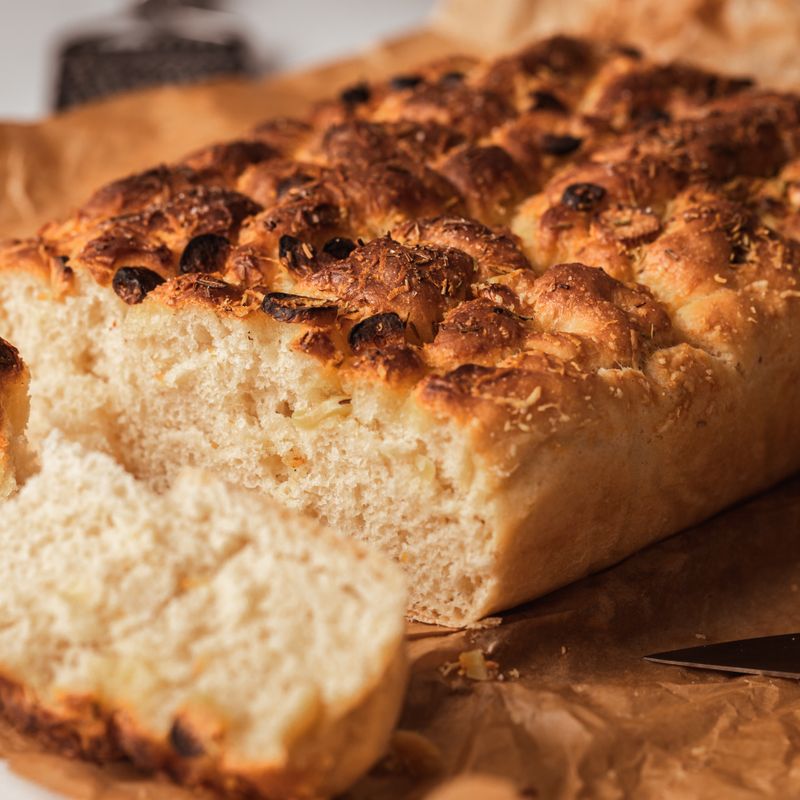
Italian Focaccia al Rosmarino with Sea Salt and Olive Oil
A classic Ligurian-style focaccia—a tender, dimpled flatbread with a crispy crust and soft, airy crumb. Fresh rosemary and fleur de sel sit atop a generous gloss of fruity olive oil, making this bread perfect for breakfast, lunch, or as an accompaniment to soup and salad. The dough is mixed with a little poolish (a preferment) for deeper flavor and better texture.
- Prep
- 30 min
- Cook
- 25 min
- Wait
- 5 hr
- Total
- 5 hr 55 min
- Makes
- One 9×13-inch focaccia (6 slices)
Steps
Before you start
- Make the poolish 8–12 hours ahead or overnight; it should be bubbly and fragrant
- Use a 9×13-inch (23×33 cm) rectangular baking pan
- Have room-temperature water (around 75°F/24°C) ready
- Fresh rosemary sprigs work best, but dried rosemary can substitute
Make the poolish
- In a medium bowl, whisk together ½ cup (60 g) flour, ½ cup (120 ml) cool water, and ⅛ tsp (0.4 g) instant yeast.
- Stir until smooth; no lumps should remain.
- Cover loosely with a kitchen towel or plastic wrap and let sit at room temperature (68–72°F / 20–22°C) for 8–12 hours, or overnight.
- The poolish should become bubbly, rise slightly, and smell pleasantly yeasty.
- You can use it even if it has collapsed a little.
+ Show details− Hide details
Ready when: Bubbly, risen slightly, fragrant yeast aroma
Tip: A cooler room temperature (around 70°F / 21°C) produces more flavor than a warmer one; the poolish can rest up to 18 hours.
Mix the dough
- Pour the poolish into a large mixing bowl.
- Add 2½ cups (300 g) flour, ¾ cup (180 ml) room-temperature water, ¼ tsp (0.8 g) instant yeast, and 1½ tsp (9 g) kosher salt.
- Using a wooden spoon or the hook attachment of a stand mixer, mix on low speed for about 2 minutes until all the flour is hydrated and no dry flour remains.
- The dough will be shaggy and slightly sticky.
+ Show details− Hide details
Ready when: No dry flour visible; dough is shaggy and cohesive but sticky
Tip: Add water slowly if your flour is very dry; focaccia dough should be wet and sticky, not stiff like sandwich bread dough.
Add oil and knead
- Pour 3 tbsp (45 ml) extra-virgin olive oil over the dough.
- If using a stand mixer, increase speed to medium and knead for 8–10 minutes until the dough becomes smoother, more elastic, and slightly less sticky.
- If mixing by hand, work the oil in using a wet hand technique: wet your hand with cool water and keep working the dough by folding it over itself for 10–12 minutes.
- The dough is ready when it pulls away from the bowl sides and feels soft but not wet.
+ Show details− Hide details
Ready when: Dough is smooth, elastic, springs back when poked, and slightly tacky rather than wet
Tip: Adding oil after the initial hydration helps develop gluten without making the dough harder to knead; don't rush—full gluten development takes time.
First rise
- Lightly oil a large mixing bowl or use the same bowl you've been working in.
- Shape the dough into a ball and place it seam-side down in the bowl.
- Cover with a damp towel or plastic wrap.
- Let the dough rise at warm room temperature (75–78°F / 24–26°C) for 2 to 2½ hours until nearly doubled in size.
- It should look puffy and jiggly when you gently shake the bowl.
+ Show details− Hide details
Ready when: Dough is about 1.5 times its original size; a finger poke springs back slowly but leaves a slight indent
Tip: Warmer rooms speed the rise; cooler rooms slow it down. You're aiming for gentle, even fermentation—not a hard, fast rise.
Prepare the pan
- While the dough rises, prepare a 9×13-inch (23×33 cm) rectangular baking pan.
- Lightly brush or drizzle it with a small amount of olive oil, coating the bottom and sides.
- If desired, line the bottom with parchment paper for easier release after baking.
+ Show details− Hide details
Ready when: Pan is evenly coated with oil and ready to receive dough
Tip: Parchment paper is optional but helpful for sliding the finished focaccia onto a cooling rack or serving board.
Shape and dimple
- Turn the risen dough out onto the oiled pan (it will be sticky—this is correct).
- Gently stretch it to fill the 9×13-inch pan, working from the center outward.
- The dough should reach the edges but doesn't need to fit perfectly; it will rise and relax.
- Let it rest uncovered for 15 minutes, then begin dimpling: lightly oil your fingertips and, using your fingers or the heel of your hand, press dimples all over the dough surface, spacing them about ½ inch (1.3 cm) apart.
- Do not deflate the dough completely; aim for half-inch-deep indentations.
+ Show details− Hide details
Ready when: Dough fills the pan; dimples are evenly spaced and about ½ inch deep
Tip: Oiled hands prevent sticking; if the dough springs back too much, wait another 5 minutes and try again. Light dimpling creates the classic focaccia texture.
Second rise
- Cover the shaped focaccia loosely with a damp towel or plastic wrap.
- Let it rise at warm room temperature (75–78°F / 24–26°C) for 45 minutes to 1 hour until puffy and nearly doubled.
- The dough should feel soft and rise to within about ¾ inch (2 cm) of the pan rim.
+ Show details− Hide details
Ready when: Dough is puffy, light, and rises close to the rim of the pan
Tip: This second rise is shorter than the first because some rise already happened during shaping. Don't let it over-proof or it will be puffy rather than crispy.
Preheat oven and finish toppingOven 425°F / 220°C
- About 20 minutes before the end of the second rise, preheat your oven to 425°F (220°C).
- When the dough has finished rising, drizzle it with 3 tbsp (45 ml) extra-virgin olive oil, letting it pool slightly in the dimples.
- Scatter the rosemary sprigs evenly across the surface, pressing them gently into the dough so they stay in place during baking.
- Finish with a generous sprinkle of fleur de sel or coarse sea salt (about 1½ tsp / 9 g total), distributing it evenly.
+ Show details− Hide details
Ready when: Oil and salt are evenly distributed; rosemary is in place
Tip: Use good-quality fleur de sel or sea salt; regular table salt can taste harsh. Save the finishing oil and salt for just before baking so they don't absorb into the dough.
BakeOven 425°F / 220°C
- Place the focaccia in the preheated 425°F (220°C) oven.
- Bake for 22–25 minutes until the top is deep golden brown and the edges are crispy and well-browned.
- The focaccia should sound hollow when you tap the bottom (if you can carefully lift it slightly with a spatula), and an instant-read thermometer inserted into the center should read 200–205°F (93–96°C).
+ Show details− Hide details
Ready when: Deep golden-brown top, crispy edges, hollow sound when tapped, internal temperature 200–205°F (93–96°C)
Tip: If the top browns too fast, loosely tent with foil after 15 minutes and continue baking. The bottom should be equally crispy—don't rush the bake time.
Cool and serve
- Transfer the focaccia to a wire rack or parchment-lined surface to cool for at least 10 minutes.
- The steam will escape and the crust will continue to crisp.
- Once cool enough to handle, slice into 6 pieces or tear into wedges.
- Serve warm or at room temperature.
+ Show details− Hide details
Ready when: Focaccia is warm or room temperature and the crust is firm
Tip: Warm focaccia is soft and tearing rather than cutting works best. For clean slices, wait until it cools completely.
Good to know
Tips
- A poolish (biga or pre-ferment) deepens the flavor and improves the crumb structure of focaccia. Even without it, you can mix the dough with all the flour, water, and yeast at once, but the result will be less complex.
- Focaccia dough is wetter than many bread doughs—this is what makes it tender and airy. If it feels too sticky to work with, resist the urge to add more flour; instead, oil your hands and work with a wet-hand technique.
- The key to crispy-bottomed focaccia is heat from below. If your oven tends to brown the top before the bottom crisps, preheat a baking stone or steel on the lower rack and bake the focaccia on that instead.
- Olive oil quality matters here since it's such a prominent ingredient. Use a fruity, peppery extra-virgin oil you enjoy tasting straight—it will shine on the finished bread.
Make ahead
The poolish must be made 8–12 hours ahead. Once mixed and covered, the focaccia dough can be refrigerated for up to 24 hours before the first rise; cold fermentation adds even more flavor. If chilling, let it come to room temperature (about 2 hours) before shaping and proceeding with the second rise.
Storage & reheating
Store cooled focaccia in an airtight container at room temperature for up to 2 days. For longer storage, wrap individual pieces tightly in plastic wrap and freeze for up to 3 months. To reheat, wrap thawed focaccia in foil and warm in a 350°F (175°C) oven for 8–10 minutes until heated through and the crust recrisps. Do not reheat in the microwave, as it will become tough and chewy.
Substitutions
- fresh rosemary sprigs → Fresh thyme, sage, or oregano. Use the same quantity and adjust based on how pungent the herb is; dried herbs can be used at half the amount.
- fleur de sel or coarse sea salt → Maldon salt or any large-grain sea salt. Avoid fine table salt, which will be absorbed too quickly. The visual appeal and texture of large crystals matter as much as the flavor.
- extra-virgin olive oil → Light olive oil or vegetable oil. Extra-virgin oil adds flavor; a lighter oil will still produce good texture but less fruity taste. Don't use the substitution for the topping oil.
- instant yeast → Active-dry yeast at the same weight. Instant and active-dry are roughly equivalent by weight; instant yeast dissolves faster and is slightly more potent, but the difference is minor in a preferment.