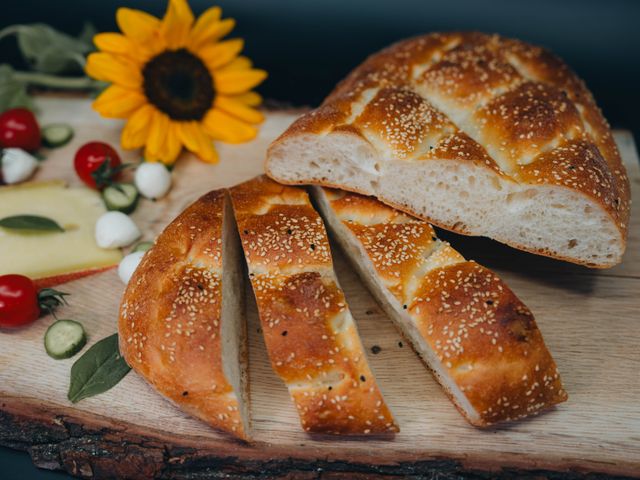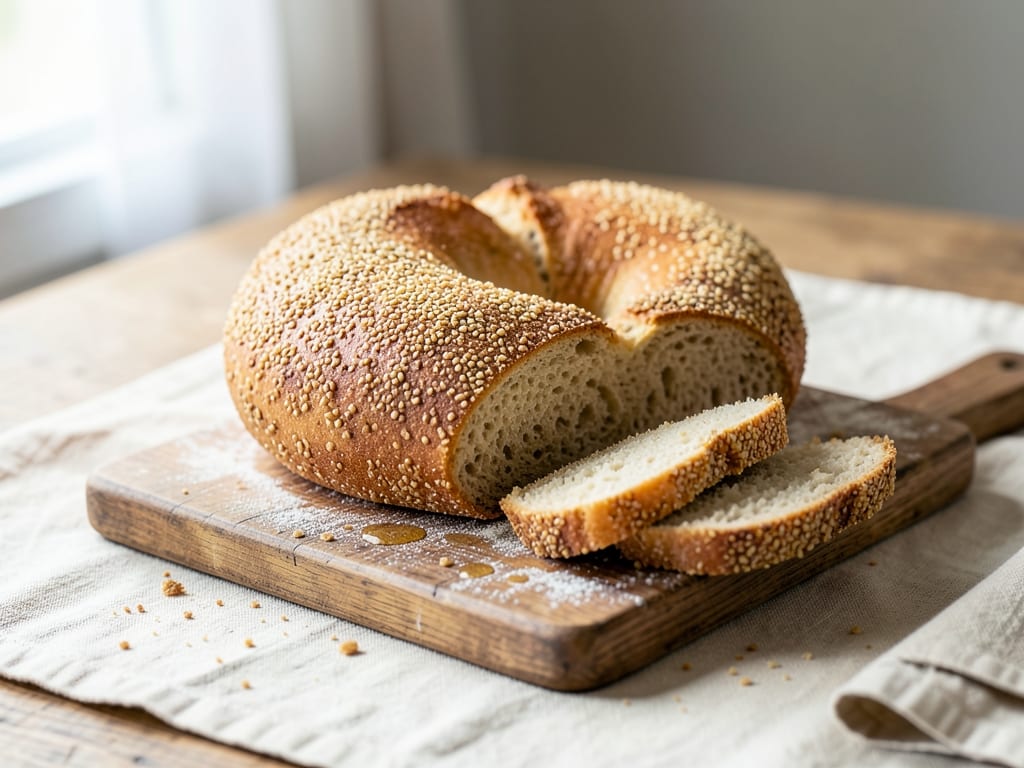
Italian Pane di Semola with Sesame Seeds
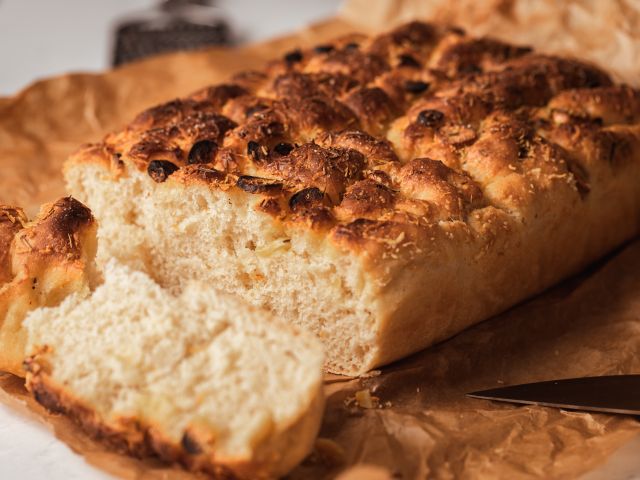
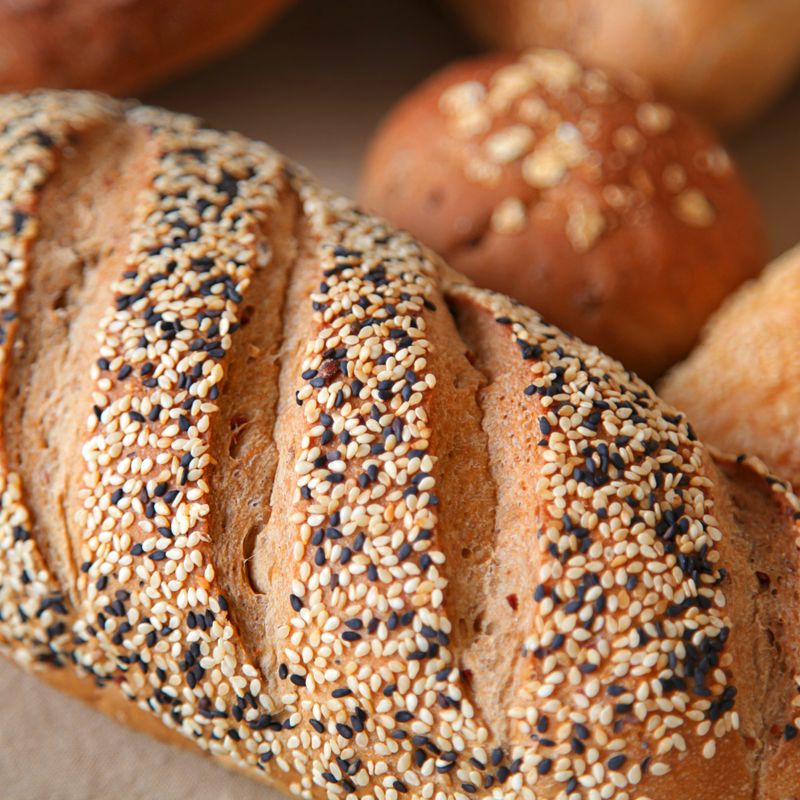
A rustic Sicilian-inspired bread made with durum wheat flour (semola) for a golden crumb and subtle nutty flavor. The dough develops through a slow fermentation, creating an open crumb structure and sturdy crust topped with toasted sesame seeds. This bread has excellent keeping qualities and a satisfying chew.
- Prep
- 20 min
- Cook
- 35 min
- Wait
- 8 hr
- Total
- 8 hr 55 min
- Makes
- 2 loaves (8–10 slices per loaf)
Steps
Before you start
- Read through the recipe—long fermentation is key to flavor
- Use a kitchen scale for accuracy with flour and water
- Have a banneton or bowl lined with a floured kitchen towel ready
- Preheat your oven with a baking stone or Dutch oven inside at least 45 minutes before baking
Mix the dough
- In a large bowl, combine lukewarm water, yeast, and salt.
- Stir until the yeast dissolves, about 1 minute.
- Add all the durum flour and mix with a dough scraper or wooden spoon until a shaggy mass forms and all flour is hydrated.
- The dough will be sticky and loose.
- Do not knead—just ensure no dry flour remains.
- Cover the bowl with a damp kitchen towel.
+ Show details− Hide details
Ready when: All flour is moistened into a shaggy, wet dough
Tip: Durum dough is naturally sticky. Do not add more flour; this moisture creates the open crumb you want.
First rise—bulk fermentation
- Let the dough rest at room temperature (68–72°F / 20–22°C) for 4 hours, covered loosely.
- During this time, perform 4 sets of stretch and folds: at 30 minutes, 60 minutes, 90 minutes, and 120 minutes into the rise.
- For each fold, wet your hand slightly, grab one side of the dough, stretch it up and over the center, rotate the bowl 90°, and repeat 4 times (once per side).
- The dough should become noticeably smoother and more structured.
+ Show details− Hide details
Ready when: Dough has increased in volume by 50–75%, smells sweet and yeasty, and shows visible bubbles on the surface
Tip: Stretch and folds strengthen gluten without kneading. Wet hands prevent sticking. Don't skip them—they make the crumb more open.
Pre-shape and rest
- Turn the dough onto a lightly floured work surface.
- Divide it in half with a dough scraper.
- Pre-shape each half into a loose round by gently pulling the edges toward the center, then flipping it seam-side down.
- Let them rest on the counter, uncovered, for 20 minutes.
- This relaxes the gluten so you can shape properly without the dough tearing.
+ Show details− Hide details
Ready when: Dough feels slightly relaxed and does not spring back when pressed
Tip: A dough scraper keeps your hands cleaner and prevents overworking the dough.
Final shape into boules
- Flip one pre-shaped dough round seam-side up onto your work surface.
- Fold the top third of the dough down toward the center and gently seal the seam with the heel of your hand.
- Fold the bottom third up over that and seal again, then flip it seam-side down.
- Using your hands and the work surface, roll the dough toward you, gently pulling it into a taut, round boule about 5 inches (13 cm) in diameter.
- Repeat with the second piece.
- Place each boule seam-side up in a banneton or bowl lined with a floured kitchen towel.
- Cover loosely with plastic wrap or a damp towel.
+ Show details− Hide details
Ready when: Two evenly shaped, round loaves with a taut surface, ready for final proofing
Tip: Proper shaping creates surface tension that helps the bread rise upward instead of spreading sideways.
Final proof—cold or room temperature
- Let the shaped doughs proof at room temperature for 2–3 hours until they increase by about 50%, or refrigerate overnight (8–16 hours) at 38–40°F (3–4°C).
- The cold overnight proof develops deeper flavor and makes scoring easier.
- If chilling, remove the baskets from the refrigerator 30 minutes before baking to take the chill off slightly.
+ Show details− Hide details
Ready when: When poked gently, the dough springs back slowly but not completely—a slight indent remains
Tip: Cold fermentation is ideal for flavor. Plan accordingly if making fresh loaves.
Preheat oven and prepare steamOven 475°F / 245°C
- Place a baking stone or baking sheet on the middle rack of your oven and preheat to 475°F (245°C) for at least 45 minutes.
- If using a Dutch oven or covered baking vessel, preheat it inside the oven as well.
- Have a spray bottle of water ready for creating steam.
- If toasting sesame seeds, toast them in a dry skillet over medium heat for 2–3 minutes until fragrant, then set aside.
+ Show details− Hide details
Ready when: Oven reaches 475°F (245°C) and stone is very hot
Tip: A hot stone or Dutch oven creates a steamy environment and a crispy, golden crust. Don't skip preheating.
Score and top with sesame
- Carefully turn one proofed dough out of its banneton onto a piece of parchment paper or directly onto a bread peel (if using).
- Brush lightly with olive oil, then sprinkle generously with about ¼ cup (30 g) of sesame seeds, pressing them gently so they adhere.
- Using a very sharp knife or bread lame, score the top with a single diagonal slash about ¼ inch (6 mm) deep, or an X pattern.
- This allows steam to escape and controls expansion.
- Repeat with the second loaf.
+ Show details− Hide details
Ready when: Both loaves are scored and topped with sesame seeds
Tip: A wet knife prevents sesame seeds from scattering during scoring. Decisive scoring prevents irregular splitting.
Bake with steamOven 475°F / 245°C
- Carefully transfer the first loaf (on parchment) onto the preheated baking stone.
- Immediately spray the inside walls of the oven with water 3–4 times to create steam, then close the door.
- Bake for 18 minutes without opening the oven.
- After 18 minutes, open the door briefly, transfer the second loaf onto the stone (or into the oven), spray steam once more, and close the door.
- Continue baking both loaves for another 15–17 minutes until the crusts are deep golden brown and sound hollow when tapped on the bottom.
+ Show details− Hide details
Ready when: Crusts are deep golden brown; loaves sound hollow when tapped on the bottom; internal temperature reaches 205–210°F (96–99°C)
Tip: Steam in the first 15 minutes is crucial for oven spring and a crispy crust. Work quickly when adding the second loaf to avoid heat loss.
Cool completely
- Transfer the baked loaves to a wire cooling rack.
- Let them cool at room temperature for at least 1 hour before slicing.
- The crumb continues to set as it cools.
- While still warm, the bread is fragile; resist the urge to slice it early.
+ Show details− Hide details
Ready when: Loaves are completely cool to the touch and the crumb is set
Tip: Slicing warm bread collapses the crumb. Full cooling ensures clean slices and better texture.
Good to know
Tips
- Durum flour has a lower gluten content than bread flour but higher protein than all-purpose, resulting in a tender, slightly coarse crumb and golden color. Embrace its sticky nature—it's not a mistake.
- The long, cool fermentation (bulk + final proof) is essential for flavor development and digestibility. Rushing the timeline results in bland, gummy bread.
- If your oven doesn't hold steam well, use a preheated Dutch oven: place the shaped dough on parchment inside the hot Dutch oven, cover, and bake covered for 20 minutes at 475°F, then remove the lid and bake uncovered for 12–15 minutes.
- Score decisively and confidently. Hesitant scoring creates ragged ears and uneven expansion. A sharp blade makes all the difference.
Make ahead
You can cold-ferment the shaped doughs in the refrigerator for up to 16 hours before baking, which actually improves flavor and makes scoring easier. Bring them to room temperature for 20–30 minutes before baking if baking from cold.
Storage & reheating
Room temperature: Store in a breadbox or paper bag for up to 3 days; the crust will soften slightly. Refrigerator: Wrap in plastic or foil and refrigerate for up to 5 days; reheat wrapped in foil at 350°F (175°C) for 15 minutes to refresh the crust. Freezer: Wrap tightly in plastic wrap and foil; freeze for up to 3 months. Thaw at room temperature for 2–3 hours, then reheat as above if desired.
Substitutions
- durum wheat flour (semola di grano duro) → All-purpose flour or a blend of 80% all-purpose and 20% whole wheat flour. You'll lose the distinctive golden color and subtle nutty flavor of durum, and the dough will be slightly less extensible, but the bread will still be good. Adjust water slightly if needed—all-purpose flour absorbs less water than durum.
- sesame seeds (unhulled or white) → Poppy seeds, nigella seeds, or a mix of seeds (sunflower, pumpkin). Each will give a different flavor and appearance. Use the same weight and toasting method.
- instant yeast (or active dry yeast) → ½ teaspoon (3 g) active dry yeast, or 1 tablespoon of a liquid starter (fed and active). Active dry yeast may require an extra 15–20 minutes of fermentation time. A starter will need adjustments to the bulk and final fermentation windows based on its strength.