Cheese and Garlic Biscuits
Tall, fluffy biscuits loaded with sharp cheddar and roasted garlic. The dough comes together quickly and bakes until golden with a crispy exterior and tender crumb. Perfect warm from the oven with butter, or alongside soups and stews.
Steps
Before you start
- Preheat the oven to 425°F (220°C)
- Cut the cold butter into small cubes and return to the refrigerator
- Measure all dry ingredients before mixing
Mix dry ingredients
- In a large mixing bowl, whisk together 2½ cups (310 g) flour, 2 teaspoons (10 g) baking powder, 1 teaspoon (6 g) kosher salt, ½ teaspoon (1 g) black pepper, and ¼ teaspoon (0.5 g) cayenne pepper if using.
- Make sure the baking powder is evenly distributed throughout.
+ Show details− Hide details
Ready when: Mixture is pale and uniform
Tip: Whisking the baking powder in first ensures even leavening without overmixing later
Cut in cold butter
- Add 6 tablespoons (85 g) cold butter cubes to the flour mixture.
- Using a pastry cutter or the tines of a fork, break up the butter into the flour until the mixture resembles coarse crumbs with pea-sized pieces of butter still visible.
- The cold butter is essential for flaky layers.
+ Show details− Hide details
Ready when: Texture resembles coarse sand with some pea-sized butter pieces
Tip: Work quickly and keep your hands cool. If butter begins to soften, chill the bowl for 5 minutes before continuing
Add cheese and garlic
- Stir in 1½ cups (170 g) finely grated sharp cheddar and 6 minced or mashed roasted garlic cloves.
- Toss gently with a fork to distribute evenly throughout the flour mixture.
+ Show details− Hide details
Ready when: Cheese and garlic are evenly scattered throughout
Tip: Use roasted garlic rather than raw for a sweeter, milder flavor. If using raw garlic, use only 3-4 cloves and mince finely
Add buttermilk
- Make a well in the center of the mixture.
- Pour in ¾ cup (180 ml) cold buttermilk and gently fold with a bench scraper or wooden spoon just until a shaggy dough forms.
- Do not overmix; some flour streaks are okay.
+ Show details− Hide details
Ready when: Dough just comes together with visible flour streaks
Tip: Overmixing develops gluten and makes biscuits tough. Stop as soon as the dough looks shaggy; it will come together as you shape
Turn out and pat down
- Lightly flour your work surface.
- Turn the dough out and gently pat it into a ¾-inch (2 cm) thick rectangle, roughly 6 inches (15 cm) wide.
- Handle it minimally—overworking creates dense biscuits.
+ Show details− Hide details
Ready when: Dough is a flat rectangle about ¾ inch thick
Tip: If the dough sticks, dust lightly with flour rather than kneading it in. The dough should still look slightly rough
Cut biscuits
- Using a 2½-inch (6.3 cm) round biscuit cutter, press straight down into the dough and lift away.
- Do not twist; twisting seals the edges and prevents biscuits from rising tall.
- Dip the cutter in flour between cuts.
- Gather scraps, gently re-pat to ¾ inch, and cut again.
+ Show details− Hide details
Ready when: 12 round biscuits cut and ready to place on baking sheet
Tip: Cutting straight down (not twisting) keeps the sides sealed so steam can push the biscuit up, not out
Prepare baking sheet
- Line a baking sheet with parchment paper.
- Arrange the cut biscuits 1½ inches (4 cm) apart so they have room to puff.
- They can touch slightly once baked, but need space to rise evenly.
+ Show details− Hide details
Ready when: Biscuits are spaced evenly on lined baking sheet
Apply egg wash
- Brush the tops of each biscuit with 1 beaten egg mixed with 1 teaspoon water.
- This creates a golden, shiny exterior.
- Don't brush the sides, which can seal them and prevent rising.
+ Show details− Hide details
Ready when: All biscuit tops are coated with egg wash
Tip: Egg wash makes biscuits glossy and golden. If you prefer a matte finish, skip this step
Bake biscuitsOven 425°F / 220°C
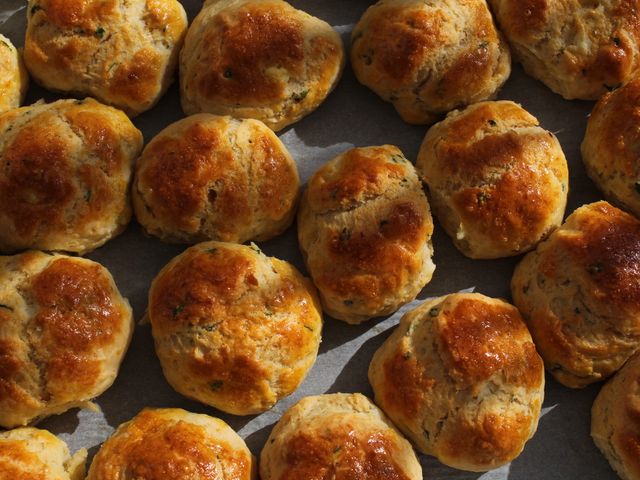
- Bake at 425°F (220°C) for 14–16 minutes, until the tops are golden brown and the biscuits have puffed up visibly.
- The bottoms should also be light golden.
- Rotate the baking sheet halfway through if your oven bakes unevenly.
+ Show details− Hide details
Ready when: Tops are deep golden brown and biscuits are puffed; internal temp is 200°F (93°C) when a thermometer is inserted into the center
Tip: Don't open the oven door in the first 12 minutes; steam is rising the biscuits. A high oven temperature is crucial for tall, fluffy biscuits
Cool slightly
- Remove from the oven and let the biscuits rest on the baking sheet for 2 minutes.
- Transfer to a wire rack or serve warm.
+ Show details− Hide details
Ready when: Biscuits are firm enough to move without breaking
Tip: Serve within 30 minutes of baking for the best texture. Reheat wrapped in foil at 350°F (175°C) for 5 minutes if needed later
Good to know
Tips
- Keep all ingredients, especially the butter and buttermilk, cold. Warm ingredients melt the butter and you lose those beautiful flaky layers.
- Use roasted garlic rather than raw; it's sweeter and won't overpower the delicate cheese flavor. You can buy roasted garlic in a jar, or roast a bulb at 400°F (200°C) for 40 minutes and squeeze out the cloves.
- A high-heat oven (425°F / 220°C) creates steam quickly, which puffs the biscuits and keeps the exterior crispy. Don't skip the preheat.
- Serve warm with a dollop of whipped honey butter or alongside a bowl of tomato soup for a classic pairing.
Make ahead
Prepare the dough up to the cutting stage, then refrigerate for up to 8 hours. Cut and bake directly from the cold; add 1–2 minutes to the baking time. Alternatively, cut biscuits and freeze on the baking sheet, then transfer to a freezer bag and bake from frozen, adding 3–4 minutes to the baking time.
Storage & reheating
Store room temperature in an airtight container for up to 2 days. Refrigerate for up to 4 days. Freeze baked biscuits in a freezer bag for up to 3 months. Reheat in a 350°F (175°C) oven wrapped in foil for 5–8 minutes.
Substitutions
- sharp cheddar cheese → Gruyère, aged Gouda, or smoked cheddar. Use the same quantity. Gruyère is nuttier; smoked cheddar adds depth. Avoid soft cheeses, which won't grate properly
- roasted garlic cloves → Fresh minced garlic, or garlic powder and fresh parsley. If using fresh garlic, use only 3–4 cloves minced very finely. For garlic powder, use ½ teaspoon and add ½ cup (15 g) fresh flat-leaf parsley, minced
- buttermilk → Greek yogurt thinned with milk, or regular milk soured with lemon juice. If using yogurt, mix 3 tablespoons yogurt with ¾ cup milk. For soured milk, stir 2 tablespoons lemon juice into ¾ cup milk and wait 5 minutes
- kosher salt → Sea salt, in the same quantity. Fine sea salt works well; reduce to ¾ teaspoon if using table salt, which is denser