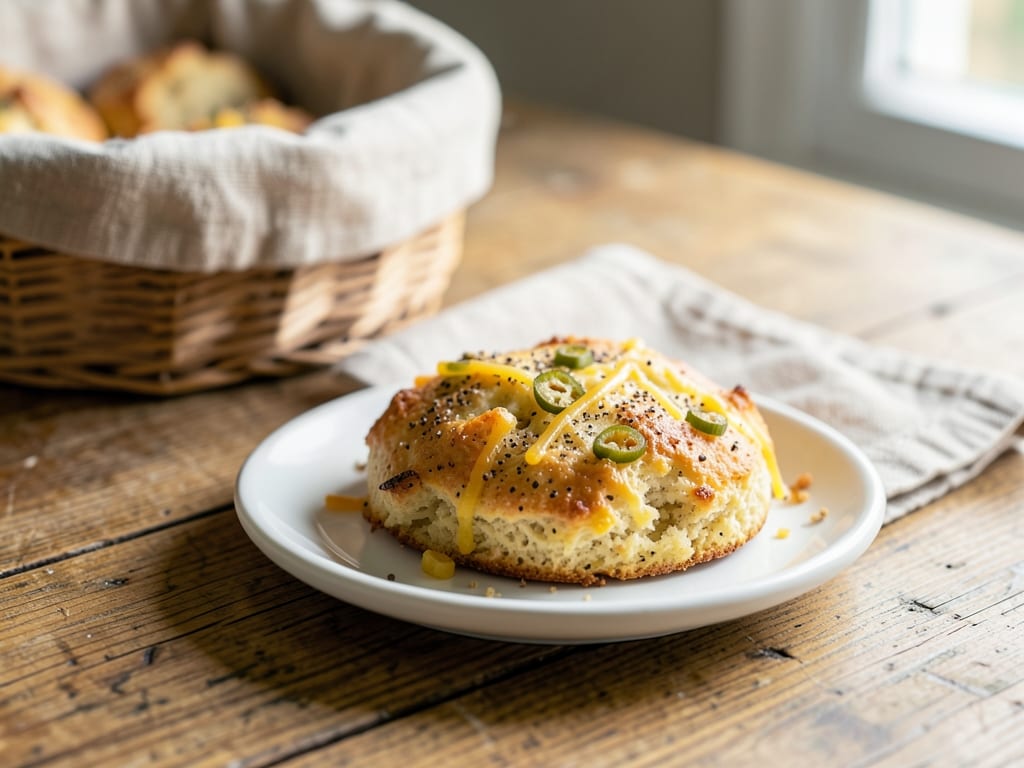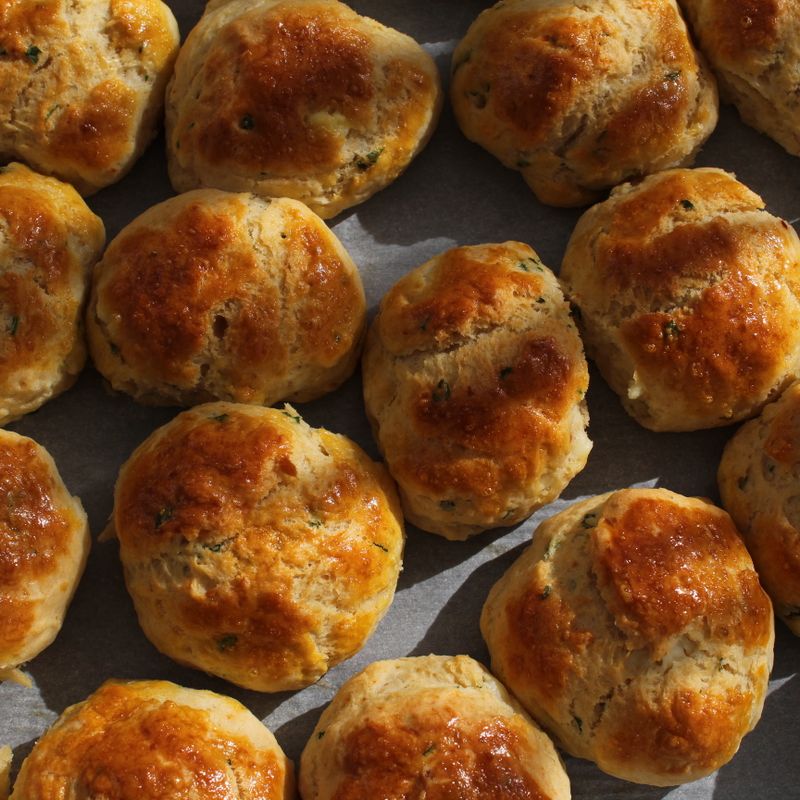
Sourdough Cheddar Scallion Drop Biscuits
Tender, flaky drop biscuits infused with the tang of sourdough and sharpness of aged cheddar cheese, with bright bursts of scallion flavor throughout. No rolling or cutting required—these come together quickly and are best served warm.
Steps
Before you start
- Use sourdough starter that is active and bubbly, fed 4–8 hours prior and at peak rise.
- Preheat your oven to 400°F (200°C) and have a baking sheet lined with parchment paper ready.
- Keep all ingredients, especially the butter, cold for the flakiest texture.
Preheat and prepareOven 400°F / 205°C
- Preheat your oven to 400°F (200°C).
- Line a 9×13-inch (23×33 cm) baking sheet with parchment paper.
- While the oven preheats (about 5 minutes), proceed with the remaining preparation steps.
- Place 4 oz (115g) cold, cubed unsalted butter in the freezer to keep it as cold as possible while you prepare the remaining ingredients.
+ Show details− Hide details
Tip: Starting the oven right away ensures it will be fully preheated by the time you finish shaping the dough.
Prepare mise en place
- Shred 3/4 cup (85g) sharp cheddar cheese if using a whole block (or use quality pre-shredded).
- Slice 3 to 4 scallions (about 30g total) into thin rings, including the white and light green parts; reserve any dark green tops for garnish if desired.
+ Show details− Hide details
Tip: Prep these ingredients just before mixing to keep them fresh and to ensure you're ready to fold them in without pause.
Mix dry ingredients
- In a large mixing bowl, whisk together 2 cups (250g) all-purpose flour, 2 teaspoons (10g) baking powder, and 1/2 teaspoon (3g) salt.
- Make sure the baking powder and salt are evenly distributed throughout the flour—no lumps of leavening should be visible.
+ Show details− Hide details
Ready when: Even distribution of leavening throughout flour
Cut in cold butter
- Remove the butter from the freezer and add the cold cubes to the flour mixture.
- Using a fork or pastry cutter, press and break the butter into the flour, creating pea-sized pieces throughout.
- Work quickly and do not let the butter warm up; it should remain in distinct, small pieces.
+ Show details− Hide details
Ready when: Mixture resembles coarse breadcrumbs with visible pea-sized pieces of butter throughout
Tip: Cold butter is essential—it creates steam pockets during baking that make biscuits light and flaky. If the butter starts to soften, place the bowl in the freezer for 2–3 minutes.
Combine wet ingredients
- In a small bowl, whisk together 1/2 cup (120ml) active, bubbly sourdough starter and 1/4 cup (60ml) buttermilk until combined.
- The mixture should be smooth with no streaks.
+ Show details− Hide details
Tip: Make sure your sourdough starter is at room temperature, not cold from the refrigerator, so it incorporates smoothly.
Bring dough together
- Pour the sourdough-buttermilk mixture into the flour-butter mixture.
- Using a spatula, fork, or wooden spoon, gently fold the wet and dry ingredients together until a shaggy dough just comes together.
- Stop while there are still streaks of flour and lumps visible—do not overmix, as this develops gluten and will make biscuits tough.
+ Show details− Hide details
Ready when: Shaggy, lumpy dough with flour streaks still visible throughout
Tip: Overmixing develops gluten and will make your biscuits tough and dense instead of tender and light. Lumps and streaks are perfectly fine—they cook out.
Add cheese and scallions
- Scatter the shredded cheddar cheese and the white and light green parts of the sliced scallions over the dough.
- Gently fold the mix-ins into the dough 4 to 5 times, being very careful not to overwork the dough.
- Stop as soon as the cheese and scallions are distributed throughout.
+ Show details− Hide details
Ready when: Cheese and scallions visible and distributed throughout the dough
Tip: Fold gently to avoid overworking the dough. Visible streaks of cheese and scallion are fine—they'll cook into every bite.
Shape and drop biscuits
- Using a 2-tablespoon (30ml) cookie scoop or two spoons, drop rounded mounds of dough onto the prepared baking sheet, spacing them about 2 inches (5 cm) apart.
- You should have approximately 12 biscuits.
- If desired, sprinkle the reserved dark green scallion tops on top of each biscuit for color and extra flavor.
+ Show details− Hide details
Ready when: 12 mounds of dough evenly spaced on baking sheet
Tip: Drop biscuits don't need to be perfectly round—rustic, irregular shapes are fine and actually look more appealing.
Bake until goldenOven 400°F / 205°C
- Place the baking sheet in the preheated 400°F (200°C) oven.
- Bake for 15 to 18 minutes, until the biscuit tops are deep golden brown and a toothpick inserted into the center of one biscuit comes out clean with no wet dough clinging to it.
+ Show details− Hide details
Ready when: Golden-brown tops; toothpick inserted into center comes out clean with no wet dough
Tip: If the tops are browning too quickly but the centers are not done, tent the baking sheet loosely with foil for the last few minutes.
Cool and serve
- Remove the baking sheet from the oven and let the biscuits cool on the sheet for 2 to 3 minutes.
- They will continue to cook slightly from residual heat.
- Transfer to a wire rack or serving plate.
- Serve warm, ideally within 30 minutes of baking, while they still have a tender crumb.
+ Show details− Hide details
Ready when: Biscuits have set slightly and are safe to handle
Tip: These biscuits are best enjoyed fresh and warm. If you need to hold them, keep them in a warm spot or wrap them in a clean kitchen towel.
Good to know
Tips
- Feed your sourdough starter 4 to 8 hours before making these biscuits and use it at peak—bubbly, risen, and ready to use. A weak starter will result in biscuits that don't rise well.
- Keep all ingredients cold, especially the butter and sourdough mixture. Cold dough produces flakier, lighter biscuits. If your kitchen is warm, chill the mixing bowl and even the flour before starting.
- Do not overmix the dough. Overmixing develops gluten and will make biscuits tough instead of tender and flaky. Fold gently and stop as soon as ingredients are combined.
- Drop biscuits are more forgiving than rolled-and-cut biscuits. They don't need precise shaping, and their rustic, bumpy appearance is part of their charm.
Make ahead
The dough can be shaped and refrigerated on the baking sheet for up to 2 hours before baking. Bake directly from cold, adding 2 to 3 minutes to the bake time.
Storage & reheating
Room temperature: Store in an airtight container for up to 2 days. Refrigerator: Keep in an airtight container for up to 5 days; reheat at 350°F (175°C) for 5 minutes to revive. Freezer: Freeze baked biscuits in a freezer-safe container for up to 3 months; thaw at room temperature and reheat at 350°F (175°C) for 8 to 10 minutes.
Substitutions
- active, bubbly sourdough starter → 1/2 cup plain Greek yogurt mixed with 1/4 cup whole milk + 1/4 teaspoon baking soda (whisk the soda into the yogurt mixture just before adding to dry ingredients). Greek yogurt provides tang and richness. The baking soda aids leavening. Flavor will be slightly different but delicious.
- sharp cheddar cheese, shredded → Aged Gruyère, smoked Gouda, or sharp white Vermont cheddar in equal amount. Use equally strong cheeses to maintain bold flavor. Mild cheeses will make the biscuits less flavorful.
- scallions (green onions) → Fresh chives, green onion tops only, or ramps (wild leeks), sliced similarly. Chives are more delicate; use the same amount. Ramps offer a garlicky note and are excellent in spring.
- buttermilk → Whole milk mixed with 1 tablespoon fresh lemon juice or white vinegar (let sit 5 minutes before using). Cultured buttermilk gives the best tang and texture, but milk with acid is a functional substitute.