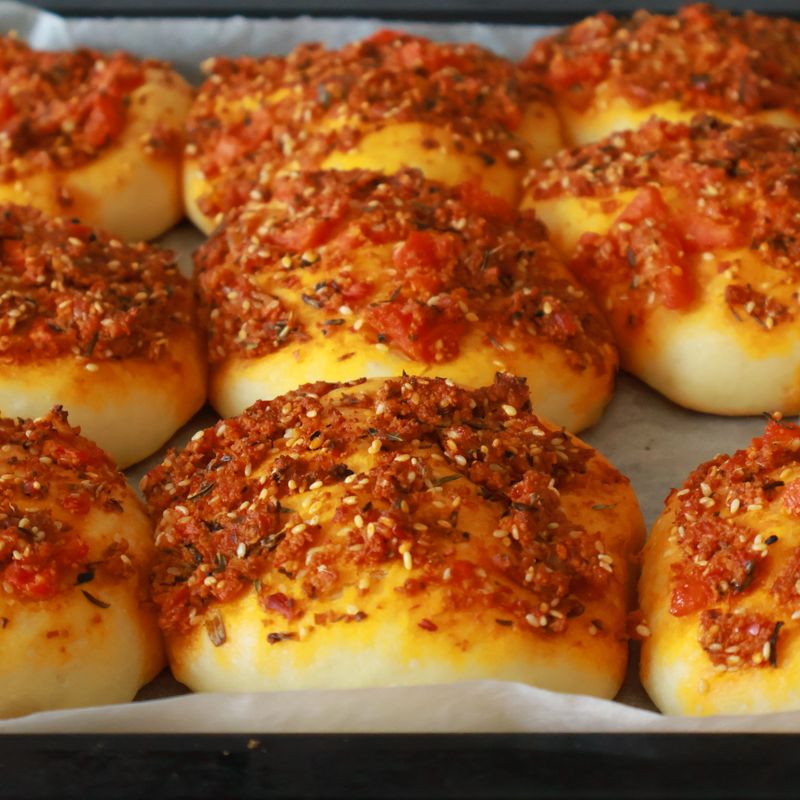
Za'atar Seasoned Flatbread Dough
A herbaceous, aromatic dough infused with za'atar spice blend, combining earthy thyme, tangy sumac, and nutty sesame seeds. This soft, pliable dough rises until puffy and light, then rests until relaxed and stretchy—ready to shape thin for cooking into Mediterranean-style flatbreads with built-in flavor throughout.
- Prep
- 20 min
- Cook
- —
- Wait
- 1 hr 30 min
- Total
- 1 hr 50 min
- Makes
- 1 batch (4–6 flatbreads)
Steps
Before you start
- Warm your water to about 110°F (43°C) before mixing
- Measure all ingredients in advance for smooth assembly
- Ensure your kitchen is at least 68°F (20°C) for proper rising
- Set aside a damp kitchen towel for covering the dough
Combine flour and za'atar
- In a large mixing bowl, whisk together 3 cups (375 g) all-purpose flour, 2.5 tablespoons (20 g) za'atar spice blend, and 1 teaspoon (5 g) salt.
- Whisk thoroughly to distribute the za'atar and salt evenly throughout the flour, ensuring the herbs and spices are consistent in every part of the finished dough.
+ Show details− Hide details
Ready when: Dry ingredients are evenly combined with no visible spice clumps
Incorporate water and oil
- Pour 1 cup (240 ml) warm water (about 110°F / 43°C) and 2 tablespoons (30 ml) olive oil into the center of the dry ingredients.
- Using a wooden spoon, stir the mixture, gradually incorporating the dry ingredients from the sides into the wet center until a shaggy dough forms with no dry flour remaining.
+ Show details− Hide details
Ready when: All flour is incorporated and a rough, cohesive dough has formed
Develop dough elasticity
- Turn the shaggy dough onto a lightly floured work surface.
- Knead for 8–10 minutes, pushing the dough away from you with the heel of your hand, folding it back over itself, and rotating it a quarter turn each time.
- After about 5 minutes, the dough should lose its stickiness and become smooth and supple.
- Continue kneading until the dough is smooth, elastic, and springs back immediately when you poke it with a finger.
+ Show details− Hide details
Ready when: Dough is smooth, slightly tacky, elastic, and springs back when poked
Tip: Resist the urge to add too much extra flour while kneading. The dough should be soft and slightly sticky; adding too much flour will result in tough, difficult-to-stretch dough.
Let dough rise until puffy
- Place the kneaded dough back into the large bowl.
- Lightly brush the top with the remaining olive oil (about 0.5 tablespoon / 8 ml) to prevent a crust from forming.
- Cover the bowl with a damp kitchen towel or plastic wrap.
- Let the dough rise at room temperature (ideally 68–72°F / 20–22°C) for about 1 hour, until it has increased in volume by roughly 50% and feels puffy and airy.
+ Show details− Hide details
Ready when: Dough has risen by about 50% and springs back slowly when poked but still holds a slight indentation
Tip: If your kitchen is cool (below 68°F / 20°C), place the dough in the warmest spot available—a sunny windowsill, an oven with just the light on, or a cooler with a bowl of warm water. Slower rises at cooler temperatures will actually develop deeper flavor.
Release gas and final rest
- Gently punch down the risen dough with your fist to release the gas and bring it back down to roughly its original size.
- Cover the bowl again with the damp towel and let the dough rest for 30 minutes at room temperature.
- During this time, the gluten relaxes, making the dough much easier to stretch and shape into flatbreads.
+ Show details− Hide details
Ready when: Dough is relaxed and soft, ready to divide and shape
Good to know
Tips
- Za'atar fades quickly once opened. Store it in an airtight container away from heat and light, and check the date before using—replace it every 6 months for the best flavor.
- If your kitchen is chilly, place the rising dough in a warm spot such as an oven with just the light on, a proofing box, or even a cooler with a bowl of warm water inside to speed fermentation.
- This dough is forgiving and tolerates longer, slower rises at cooler temperatures, which actually improves flavor and texture through extended fermentation.
- Once the dough finishes its final 30-minute rest, divide it into 4–6 equal portions (about 2 oz / 60 g each for larger flatbreads, or smaller for pocketbread-size). Stretch and cook immediately, or wrap portions individually and refrigerate for up to 8 hours.
Make ahead
The dough can be prepared up to 2 days ahead. After the first rise and punch-down, cover the dough tightly with plastic wrap or transfer it to an airtight container and refrigerate. Cold fermentation will develop deeper, more complex flavors. Remove from the fridge and let it come to room temperature for 20–30 minutes before dividing and shaping.
Storage & reheating
Room temperature: Cover loosely and use within 2 hours. Refrigerator: Wrap tightly with plastic wrap or store in an airtight container for up to 2 days. Freezer: Divide into individual portions, wrap each tightly in plastic wrap, and freeze for up to 1 month; thaw at room temperature for 2–3 hours before using.
Substitutions
- za'atar spice blend → 1 tablespoon (7 g) dried oregano plus 1 tablespoon (7 g) dried thyme plus 1 tablespoon (9 g) toasted sesame seeds, with a small pinch of sumac if available. This combination approximates za'atar's herbaceous and nutty character, though the flavor will be noticeably different without the authentic spice blend.
- water → Room-temperature water. The dough will rise more slowly, adding 15–20 minutes to the first rise time. Cooler rises can actually develop deeper flavor.
- olive oil → Neutral oil such as grapeseed oil, avocado oil, or light vegetable oil. The dough will work perfectly, but you'll lose the fruity, savory notes that olive oil contributes to the finished flatbread.
More flatbread doughs
See all →
Find more like this
- Meal
- Breakfast
- Cuisine
- Middle Eastern
- Quick & Easy
- 5 Ingredients or LessEasyBeginner