Lebanese Manakish Dough
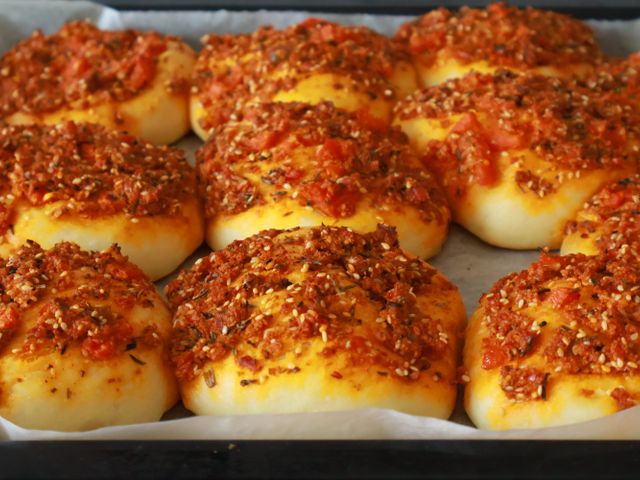
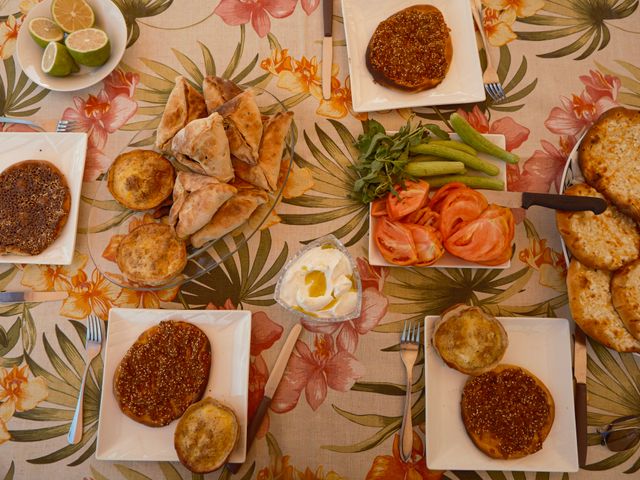
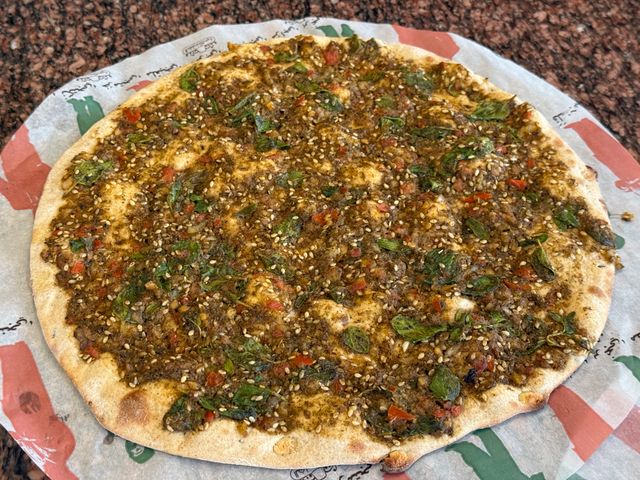
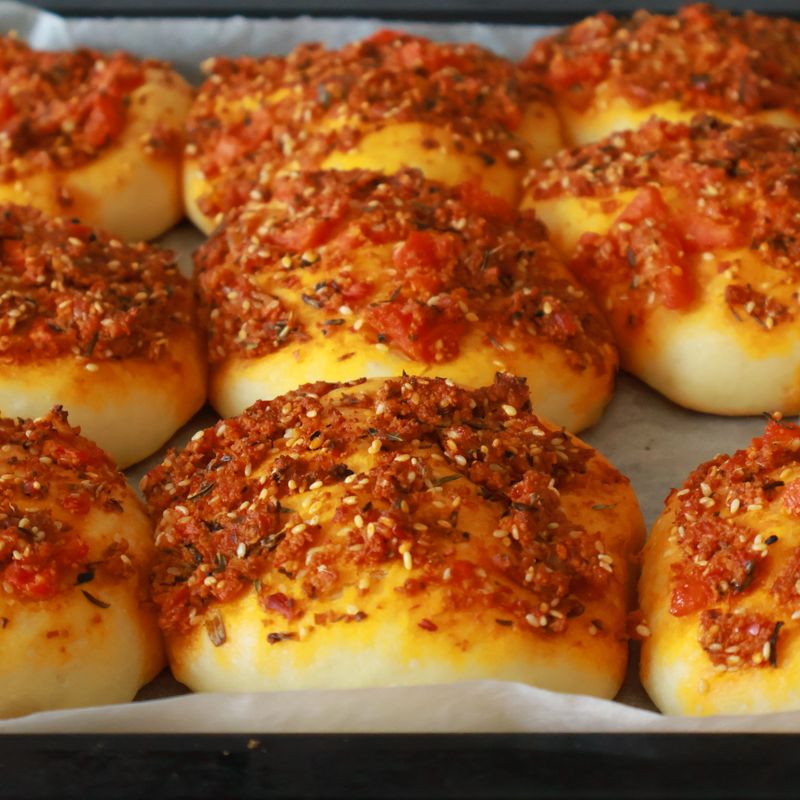
A soft, pillowy, olive-oil-enriched flatbread dough that is the base for Lebanese manakish. It bakes into chewy rounds with golden edges and a tender center, and it's ready for za'atar, cheese or any topping you like.
- Prep
- 35 min
- Cook
- 18 min
- Wait
- 1 hr 30 min
- Total
- 2 hr 23 min
- Makes
- 8 manakish rounds (about 7 inches / 18 cm each)
Steps
Before you start
- Plan on about 2½ hours from start to finish, including a 1-hour rise.
- Check your water with a thermometer: it should be 105–110°F (40–43°C). Hotter water can kill the yeast.
- Measure the flour by weight if you can. Scooping with a cup can add up to 20% more flour and make the dough dry.
- Have two large rimless baking sheets (or two upside-down rimmed sheets) and parchment paper ready.
Activate the yeast
- Pour the warm water (105–110°F / 40–43°C) into a large bowl or the bowl of a stand mixer.
- Stir in the sugar and instant yeast.
- Let it sit until the surface looks foamy.
+ Show details− Hide details
Ready when: A thin layer of foam or bubbles covers the surface and it smells yeasty
Tip: If there is no foam after 10 minutes, the yeast is dead. Start again with fresh yeast.
Mix the dough
- Add the flour, salt and the 3 tablespoons (45 ml) of olive oil for the dough to the yeast mixture.
- Stir with a wooden spoon, or mix on low speed with the dough hook, for 1–2 minutes until no dry flour is visible and a shaggy, sticky dough forms.
+ Show details− Hide details
Ready when: No dry flour remains and the dough looks shaggy
Tip: Keep the salt from sitting directly on the yeast for a long time. Adding the flour first, then the salt, helps.
Knead until smooth
- Knead for 8 minutes by hand on a lightly floured counter (or 6 minutes on medium-low speed in a mixer).
- Dust with flour only 1 teaspoon at a time if the dough sticks badly to your hands.
- The dough should be soft and slightly tacky, not dry.
+ Show details− Hide details
Ready when: The dough is smooth and elastic and springs back slowly when poked with a finger
Tip: A soft, slightly tacky dough makes the most tender manakish. Resist adding a lot of extra flour.
First rise
- Brush the inside of a large clean bowl with 1 tablespoon (15 ml) of the finishing olive oil.
- Shape the dough into a ball, turn it once in the bowl to coat it, and cover with a towel or plastic wrap.
- Leave at warm room temperature, about 75°F (24°C), for 1 hour.
+ Show details− Hide details
Ready when: The dough has doubled in size and a floured fingertip pressed in leaves a dent that fills back in slowly
Tip: In a cool kitchen, rise in an oven that is off with the light on.
Divide and shape balls
- Turn the dough onto a lightly floured surface and gently press out the large air bubbles.
- Weigh the dough (it should be about 870 g) and cut it into 8 equal pieces of about 110 g each.
- Roll each piece under your cupped palm into a tight, smooth ball.
- Place the balls on a floured counter or a lined baking sheet, spaced 2 inches (5 cm) apart.
+ Show details− Hide details
Ready when: Each ball is smooth on top with a tight seam on the bottom
Tip: Keep the balls covered with a towel while you work so they do not form a dry skin.
Rest and preheatOven 475°F / 245°C
- Cover the balls with a towel and let them rest for 20 minutes.
- While they rest, place two baking sheets in the oven on the middle and lower racks and preheat to 475°F (245°C).
- Heating the sheets gives the bottoms a crisp, golden base.
+ Show details− Hide details
Ready when: The balls look puffy and relaxed and the oven has reached 475°F (245°C)
Tip: Use an oven thermometer if you can. Many home ovens run cooler than the dial says.
Stretch and dimple
- Cut 2 sheets of parchment to fit your baking sheets.
- Working with 4 balls at a time (keep the others covered), flatten each ball on a lightly floured counter and stretch or roll it into a round about 7 inches (18 cm) across and ¼ inch (6 mm) thick.
- Set the rounds on the parchment.
- Press your fingertips firmly all over the surface to make dimples, leaving a ½-inch (1.25 cm) edge.
- Brush each round with about 1 teaspoon of the remaining finishing olive oil.
+ Show details− Hide details
Ready when: The rounds are an even ¼ inch thick with deep dimples across the surface
Tip: If the dough springs back as you shape it, cover it and rest it for 5 minutes. Then try again.
Bake first batchOven 475°F / 245°C
- Carefully slide the parchment with the 4 rounds onto the hot baking sheet in the oven (on the middle rack).
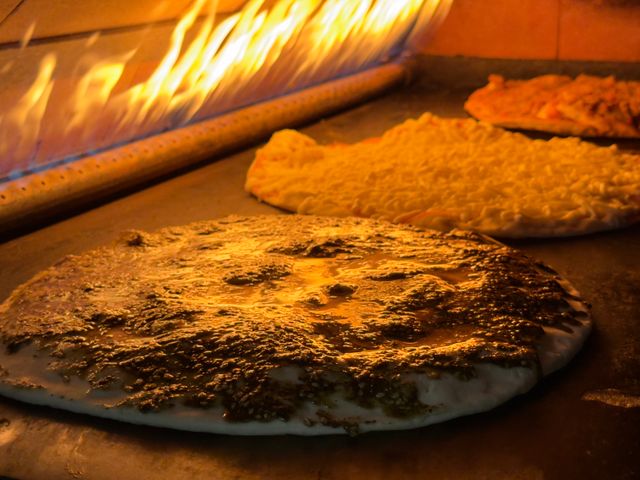
- Bake at 475°F (245°C) for 8–10 minutes.
+ Show details− Hide details
Ready when: The edges are golden brown, the dimpled surface is lightly golden in spots, and the bottoms are firm and browned
Tip: Do not over-bake. Pale gold and soft is correct. Dark, crisp manakish will turn dry and cracker-like.
Bake second batchOven 475°F / 245°C
- Move the first batch to a wire rack.
- Stretch, dimple and oil the remaining 4 balls as in the shaping step on a fresh sheet of parchment.
- Bake them the same way at 475°F (245°C) for 8–10 minutes.
+ Show details− Hide details
Ready when: The edges are golden and the bottoms are browned and firm
Cool slightly and serve
- Let the baked rounds cool on a wire rack for 5 minutes.
- Serve them warm.
- Or add toppings as you like and return them to the oven for a few minutes.
+ Show details− Hide details
Ready when: The bread is soft and flexible and no longer steaming heavily
Tip: Stack and cover with a clean towel to keep the manakish soft until serving.
Good to know
Tips
- Weigh the dough balls so the rounds are even and bake at the same time.
- A preheated baking sheet or a baking steel gives the best crisp-bottomed, soft-topped result.
- Keep the rounds no thicker than ¼ inch (6 mm) so they bake through in under 10 minutes.
- For a topped version, spread toppings on before baking, and bake for the same time or 1–2 minutes longer.
Make ahead
Make the dough through the first rise, then shape into balls, put them on an oiled tray, cover tightly and refrigerate for up to 24 hours. Bring them to room temperature for 45 minutes, then stretch and bake as directed. You can also freeze the shaped balls (see Storage).
Storage & reheating
Baked rounds keep at room temperature, wrapped, for 1 day, or in the fridge for up to 4 days. Freeze them for up to 3 months. Reheat in a 350°F (175°C) oven for 5–6 minutes, or in a dry skillet over medium heat for 1 minute per side. Unbaked dough balls freeze well for up to 1 month. Thaw them overnight in the fridge, then bring to room temperature before shaping.
Substitutions
- instant yeast → active dry yeast. Use the same amount (2¼ tsp / 7 g). Let it foam in the warm water for 10 minutes in step 1.
- all-purpose flour → bread flour. Gives a chewier crumb. Add 1–2 tbsp (15–30 ml) more water if the dough feels stiff.
- all-purpose flour → half whole wheat flour (250 g) and half all-purpose flour. The dough will be denser and may need 2–3 tbsp (30–45 ml) more water.
- granulated sugar → honey. Use 2 tsp (14 g). It feeds the yeast just as well.