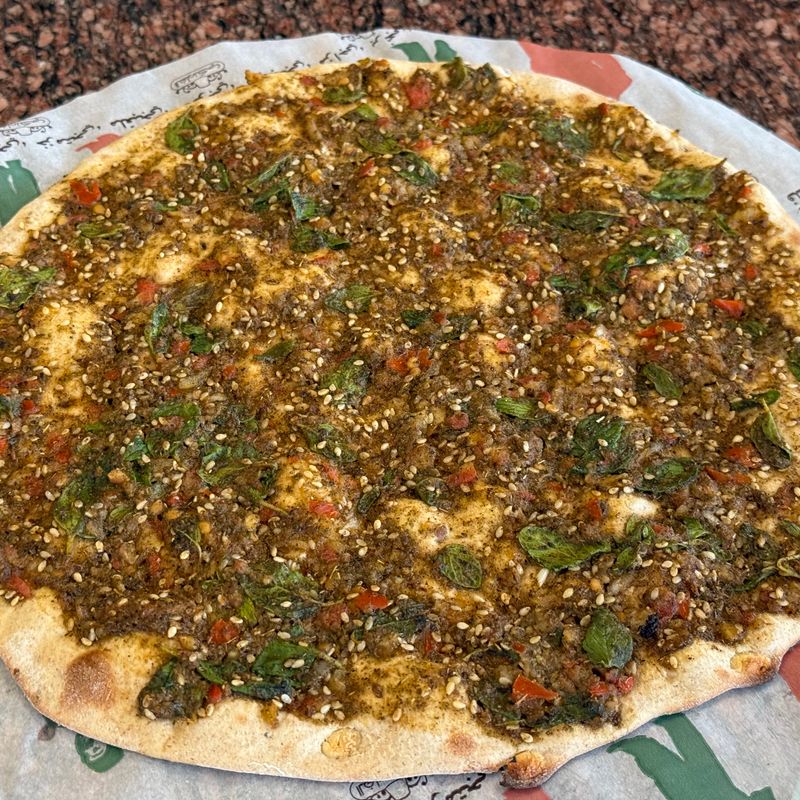
Manakish Za'atar (Lebanese Za'atar Flatbread)
Soft, chewy Lebanese flatbreads with a golden, slightly crisp edge, topped with a fragrant paste of za'atar, olive oil and tangy sumac. Serve them warm for breakfast or a snack, with labneh, tomatoes, cucumber and mint.
- Prep
- 49 min
- Cook
- 18 min
- Wait
- 1 hr 32 min
- Total
- 2 hr 39 min
- Makes
- 8 flatbreads (about 6 inches / 15 cm each)
Steps
Before you start
- Plan on about 2 hours 40 minutes in total, most of it hands-off rising and resting time.
- Use a ready-made za'atar blend that already contains thyme, sesame seeds and sumac. If you only have dried thyme, make a 6-tablespoon stand-in: mix 4 tablespoons dried thyme, 2 tablespoons toasted sesame seeds and 2 teaspoons ground sumac, and use it in place of the za'atar blend (keep the 1 teaspoon sumac in the topping too).
- Your water should feel comfortably warm on your wrist (about 105–110°F / 40–43°C). Hot water will kill the yeast.
- Give your oven a full 20 minutes to preheat with the baking sheets inside. The hot pans give the bread its lift and crisp base.
Activate the yeast
- Pour the warm water into a large mixing bowl.
- Stir in the sugar and yeast.
- Let it stand for about 7 minutes.
+ Show details− Hide details
Ready when: The surface is covered with a thick layer of cream-colored foam and smells yeasty.
Tip: If there is no foam after 10 minutes, the yeast is dead or the water was too hot or cold. Start again.
Mix the dough
- Add the flour, salt and 4 tablespoons (60 ml) olive oil to the bowl.
- Stir with a wooden spoon, then your hand, until no dry flour remains and a shaggy, sticky dough forms.
+ Show details− Hide details
Ready when: The dough is a rough, tacky mass with no dry patches.
Tip: Salt can slow yeast if it sits directly on it, so stir the flour and salt in together rather than dropping salt straight into the foam.
Knead until smooth
- Turn the dough onto a lightly floured counter.
- Knead for 8 minutes, pushing it away with the heel of your hand, folding it back and turning it.
- Dust with only a teaspoon or so of extra flour if it sticks badly.
+ Show details− Hide details
Ready when: The dough is smooth, soft and springs back slowly when you poke it with a fingertip.
Tip: The dough should stay slightly tacky. Too much flour makes dry, tough bread.
First rise
- Rub the inside of the bowl with 1 teaspoon olive oil, place the dough in it and turn to coat.
- Cover with a towel or plastic wrap.
- Leave in a warm spot for 60 minutes.
+ Show details− Hide details
Ready when: The dough has doubled and a floured fingertip leaves a dent that fills back slowly.
Tip: In a cool kitchen, set the bowl in an oven that is off with the light on.
Make the topping
- In a small bowl, stir together the za'atar, 6 tablespoons (90 ml) olive oil and the sumac into a loose, spreadable paste.
- Set aside.
- It will thicken a little as it sits, so stir again before using.
+ Show details− Hide details
Ready when: The mixture looks like a glossy, green-brown paste that spreads easily.
Tip: If it feels stiff, add 1 teaspoon more oil. It should spread without tearing the dough.
Divide, rest and preheatOven 475°F / 245°C
- Place two baking sheets on the middle and lower racks and preheat the oven to 475°F (245°C) for at least 20 minutes.
- Meanwhile, punch down the dough and divide it into 8 equal pieces (about 100 g each).
- Roll each into a smooth ball by cupping it under your palm and rotating on the counter.
- Arrange the balls on a lightly floured surface, cover with a towel and rest for 20 minutes.
+ Show details− Hide details
Ready when: The balls look puffy and relaxed, and flatten slightly when touched.
Tip: Keep unused balls covered at all times so they do not form a dry skin.
Shape and top first batch
- Working with 4 balls, roll each on a lightly floured counter into a 6-inch (15 cm) round about ¼ inch (6 mm) thick.
- Press your fingertips firmly all over the surface to make dimples.
- Spoon about 1 tablespoon of topping onto each round and spread it with the back of the spoon, leaving a ½-inch (1 cm) border bare.
- Re-stir the topping as you go.
+ Show details− Hide details
Ready when: Each round is evenly dimpled and covered in topping, with a clean border.
Tip: The dimples keep the topping from sliding off and stop the dough puffing up like a pita.
Bake first batchOven 475°F / 245°C
- Carefully remove the hot baking sheets.
- Place 2 rounds on each sheet, using a floured board or peel to slide them on.
- Bake at 475°F (245°C) for 8–10 minutes, switching the pans between racks halfway through.
+ Show details− Hide details
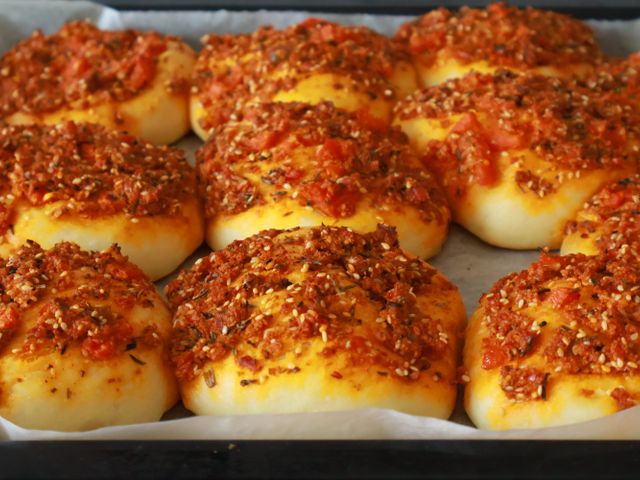
Ready when: The edges are golden brown, the bottoms are lightly browned and the topping is sizzling and fragrant.
Tip: Do not overbake. Manakish should stay soft and bendable, not crisp like a cracker.
Shape and bake second batchOven 475°F / 245°C
- Move the first manakish to a wire rack or towel.
- Roll, dimple and top the remaining 4 balls exactly as before.
- Slide them onto the hot pans and bake at 475°F (245°C) for 8–10 minutes, switching pans halfway.
+ Show details− Hide details
Ready when: The edges are golden brown and the topping is bubbling.
Tip: Let the oven return to full heat for a minute after reopening it before loading the second batch.
Rest and serve
- Stack the hot manakish under a clean towel for 5 minutes so they soften.
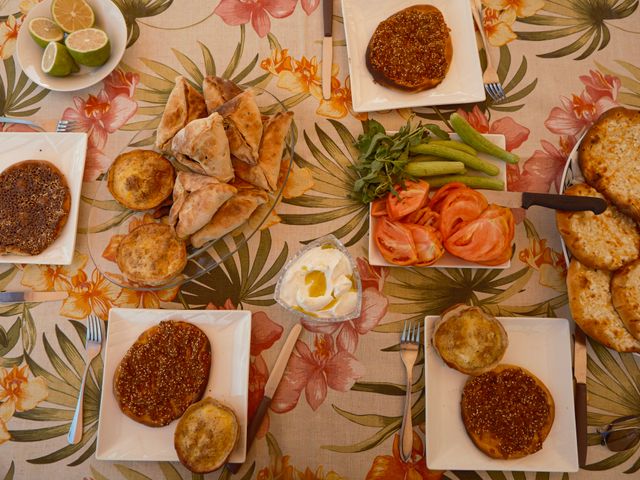
- Serve warm, whole or folded in half, with sliced tomatoes, cucumbers, fresh mint and labneh if you like.
+ Show details− Hide details
Ready when: The bread bends without cracking.
Good to know
Tips
- Weigh the dough balls for even rounds that bake in the same time.
- Do not overload the topping. Too much oil makes the dough soggy in the center.
- A preheated baking steel or stone also works well. Bake on it one or two rounds at a time.
- For a fresher, cooler contrast, serve with labneh drizzled with olive oil, or roll up with fresh mint and sliced cucumber.
Make ahead
The dough can rise in the fridge instead: after kneading, cover the oiled bowl and refrigerate for 8–24 hours. Bring it to room temperature for 45 minutes, then divide, rest and bake as directed. The topping can be mixed up to 3 days ahead and stored covered in the fridge. Bring to room temperature and stir before using.
Storage & reheating
Room temperature: wrap cooled manakish in a towel or airtight bag for up to 1 day. Fridge: up to 4 days in an airtight container. Freezer: freeze in a single layer, then stack in a freezer bag for up to 3 months. Reheat from the fridge or frozen on a baking sheet at 350°F (175°C) for 5–8 minutes, or in a dry skillet over medium heat for 1–2 minutes per side.
Substitutions
- all-purpose flour → bread flour. Gives a chewier bread. Add 1–2 tablespoons more water if the dough feels stiff.
- za'atar blend → 4 tablespoons dried thyme, 2 tablespoons toasted sesame seeds and 2 teaspoons ground sumac, mixed (about 6 tablespoons total). A fair homemade stand-in for the 6 tablespoons of blend. Use it in the same amount, and still add the 1 teaspoon sumac to the topping.
- instant or active dry yeast → fresh yeast, 18 g. Crumble it into the warm water and add 5 extra minutes to the activation time.
- ground sumac → 1 teaspoon lemon zest. Brings a similar tangy brightness, but with a slightly different flavor.