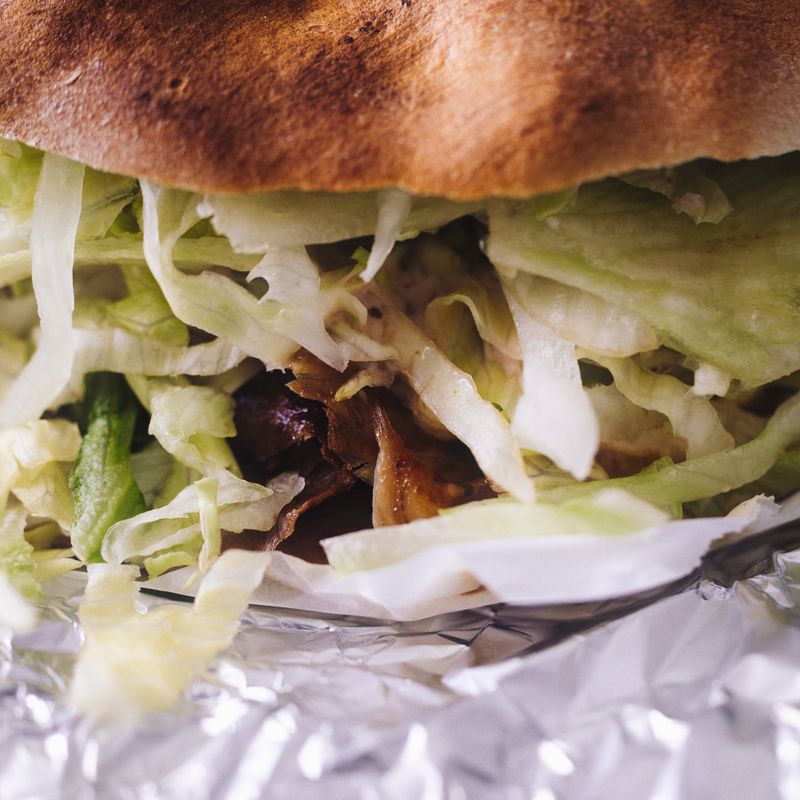
Homemade Pita Bread for Gyros and Shawarma
Soft, pillowy pitas that puff into pockets in a blazing-hot oven. Sturdy enough to wrap around shawarma or gyro meat, yet tender and chewy, with a little olive oil for flavor.
- Prep
- 40 min
- Cook
- 12 min
- Wait
- 1 hr 28 min
- Total
- 2 hr 20 min
- Makes
- 8 pitas, about 7 inches (18 cm) wide
Steps
Before you start
- Plan on about 2 hours 20 minutes from start to finish, including a 1-hour rise.
- Place a baking stone, baking steel, or a heavy rimless baking sheet turned upside down on the lowest oven rack, then preheat during the last 30-40 minutes of the rise. A very hot surface is what makes the pitas puff.
- Use warm water that feels comfortably warm on your wrist, about 105-110°F (40-43°C). Hot water will kill the yeast.
- Weigh the flour with a kitchen scale if you can. Scooped cups can pack in extra flour and give dry, stiff pitas.
Activate the yeast
- In a large mixing bowl (or the bowl of a stand mixer), stir together the warm water, instant yeast, and sugar.
- Let it sit for 5 minutes.
+ Show details− Hide details
Ready when: The surface looks foamy and smells yeasty
Tip: If nothing foams after 10 minutes, the yeast is dead or the water was too hot or cold. Start over with fresh yeast.
Mix the dough
- Add the flour, salt, and 2 tbsp (30 ml) olive oil to the yeast mixture.
- Stir with a wooden spoon, or mix on low speed with the dough hook, for about 2 minutes, until no dry flour remains and a shaggy dough forms.
+ Show details− Hide details
Ready when: No dry flour is left in the bowl and the dough is shaggy and sticky
Knead until smooth
- Knead on low-medium speed with the dough hook for 6-8 minutes, or turn the dough out onto a lightly floured counter and knead by hand for 8-10 minutes.
- Add flour 1 tbsp at a time only if the dough sticks stubbornly to your hands.
+ Show details− Hide details
Ready when: The dough is smooth, elastic, and slightly tacky, and springs back slowly when poked
Tip: Don't add too much flour. A slightly tacky dough makes softer pitas that puff better.
Let the dough riseOven 500°F / 260°C
- Grease a clean large bowl with the 1 tsp olive oil.
- Shape the dough into a ball, turn it in the bowl to coat, and cover with plastic wrap or a damp towel.
- Let it rise in a warm spot for 1 hour.
- About 30-40 minutes into the rise, put a baking stone or upside-down baking sheet on the lowest oven rack and preheat the oven to 500°F (260°C).
+ Show details− Hide details
Ready when: The dough has doubled in size and a floured finger leaves a dent that fills back in slowly
Tip: Give the baking surface at least 30 minutes in the hot oven so it is fully heated.
Divide and rest
- Turn the dough onto a lightly floured counter and gently press out the air.
- Cut into 8 equal pieces, about 105 g (3.7 oz) each.
- Roll each piece into a tight, smooth ball by cupping your hand over it and rotating against the counter.
- Cover with a towel and rest for 15 minutes.
+ Show details− Hide details
Ready when: The balls look puffy and relaxed, and flatten slightly when pressed
Roll out the rounds
- Dust the counter lightly with flour.
- Roll each ball into a round about 7 inches (18 cm) wide and ¼ inch (6 mm) thick, rolling from the center outward and turning often.
- Keep the thickness even, with no thin spots or tears, because steam escapes through them and the pita won't puff.
- Lay the rolled rounds on a floured towel and cover loosely.
- Don't stack them.
+ Show details− Hide details
Ready when: Each round is an even ¼ inch (6 mm) thick with no holes
Tip: Brush off excess flour before baking so it doesn't scorch on the hot surface.
Bake in batchesOven 500°F / 260°C
- Bake 2-3 pitas at a time.
- Carefully lay the rounds directly on the hot stone or baking sheet in the 500°F (260°C) oven.
- Bake for 3-4 minutes, without opening the oven, until each pita balloons up and is pale golden with a few light brown spots.
- Repeat with the remaining rounds, giving the surface 1 minute to reheat between batches.
+ Show details− Hide details
Ready when: Puffed into a full balloon, pale golden with a few light brown spots, and still soft when pressed
Tip: Don't overbake. Pitas that go dark brown turn crisp like crackers and won't fold around fillings. If one doesn't puff, it is still delicious and soft.
Steam and cool
- Use a spatula to move the hot pitas to a clean kitchen towel.
- Wrap them loosely in the towel as you go.
- Let them rest for about 10 minutes.
- The puffs will deflate, and trapped steam softens the crust so the pitas fold without cracking.
+ Show details− Hide details
Ready when: The pitas are soft and pliable, and fold in half without cracking
Tip: Split open or fill the pockets while the pitas are still warm, or warm them briefly before serving.
Good to know
Tips
- The hot baking surface is the key to puffing: the bottom of the dough cooks instantly and traps steam inside.
- Roll rounds evenly and don't stretch them. Uneven thickness and pinholes are the most common reasons pitas fail to puff.
- For a stovetop alternative, cook rolled rounds in a very hot dry cast-iron skillet over medium-high heat for about 1 minute per side, until bubbles form and the pita puffs.
- For gyros, warm the pitas and fold them around the meat without splitting them open. For shawarma, split them open or roll them as a wrap.
Make ahead
Make the dough through the kneading step, then refrigerate it in an oiled, covered bowl for up to 24 hours. Let it sit at room temperature for 45 minutes, then continue with dividing. You can also bake the pitas up to a day ahead and store them wrapped.
Storage & reheating
Room temperature: up to 2 days in a zip-top bag or airtight container. Fridge: up to 5 days. Freezer: up to 3 months, stacked with parchment between pitas in a freezer bag. To reheat, wrap in foil and warm in a 350°F (175°C) oven for 5-8 minutes, or warm for 20-30 seconds per side in a dry skillet over medium heat. Thaw frozen pitas first at room temperature.
Substitutions
- all-purpose flour → Bread flour. Gives a chewier pita. You may need 1-2 tbsp more water.
- all-purpose flour → Half whole wheat flour. Use 250 g all-purpose and 250 g whole wheat, and add 2-3 tbsp more water. The pitas will be denser and nuttier.
- instant yeast → Active dry yeast. Use the same amount. Let it foam in the warm water for 10 minutes before adding the flour.
- extra-virgin olive oil → Neutral vegetable oil. Gives a milder flavor but the same soft texture.
More flatbread doughs
See all →
Find more like this
- Meal
- Dinner
- Cuisine
- Middle Eastern
- Method
- Oven
- Quick & Easy
- 5 Ingredients or LessBudget