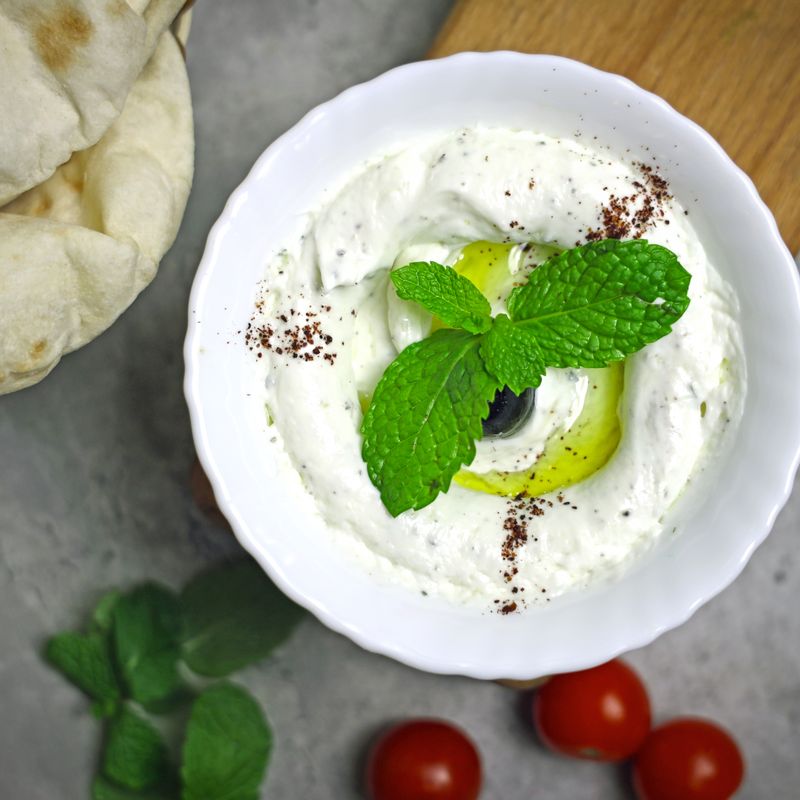
Two-Ingredient-Style Greek Yogurt Flatbread
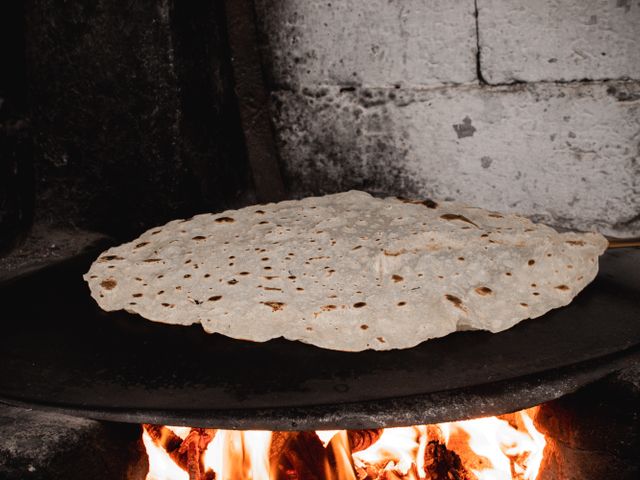
Soft, blistered pan-fried flatbreads made from a simple yogurt dough that needs no yeast and no rising. Brushed with garlicky olive oil, they are perfect for scooping dips, wrapping kebabs, or serving alongside soup.
- Prep
- 15 min
- Cook
- 15 min
- Wait
- 20 min
- Total
- 50 min
- Makes
- 6 flatbreads (about 6 inches / 15 cm each)
Steps
Before you start
- Use full-fat or 2% plain Greek yogurt; thin or nonfat yogurt makes a sticky dough that needs much more flour.
- Take the yogurt out of the fridge 20 minutes ahead so the dough comes together easily.
- Have a plate and clean kitchen towel ready to keep cooked flatbreads warm and soft.
- The dough rests 20 minutes, so start it before you need the bread.
Mix dry ingredients
- In a large bowl, whisk 2 cups (250 g) flour, the baking powder, and fine salt for 20 seconds until evenly combined with no baking powder clumps.
+ Show details− Hide details
Ready when: Mixture looks uniform and pale with no lumps.
Form the dough
- Add the yogurt and 1 tablespoon olive oil.
- Stir with a spatula until a shaggy mass forms, then squeeze and fold with your hands in the bowl for about 1 minute until no dry flour remains.
+ Show details− Hide details
Ready when: Dough is soft and slightly tacky but doesn't stick to clean fingers.
Tip: If it sticks to your hands, knead in extra flour 1 tablespoon at a time. If crumbly, add 1 teaspoon of water.
Knead briefly
- Turn the dough onto a lightly floured counter and knead gently for 1 minute, just until smooth.
- Over-kneading makes the bread tough.
- Return it to the bowl and cover with a towel.
+ Show details− Hide details
Ready when: Surface is smooth and springs back slowly when poked.
Rest the dough
- Let the covered dough rest at room temperature for 20 minutes.
- Meanwhile, stir the garlic and parsley, if using, into 2 tablespoons of the remaining olive oil in a small bowl.
+ Show details− Hide details
Ready when: Dough feels softer and stretches easily.
Divide and roll
- Divide the dough into 6 equal pieces (about 75 g each) and roll each into a ball.
- On a lightly floured surface, roll one ball into a round about 6 inches (15 cm) wide and ⅛ inch (3 mm) thick.
- Keep the other pieces covered with the towel.
+ Show details− Hide details
Ready when: Rounds are even and thin enough to see slight flexibility, not paper-thin.
Tip: Roll only as you cook so the rounds don't dry out or stick together.
Heat the skillet
- Heat a 12-inch (30 cm) skillet over medium-high heat for 2 to 3 minutes.
- Do not add oil to the pan yet; the flatbreads cook in a dry or barely oiled pan so they blister rather than fry.
+ Show details− Hide details
Ready when: A pinch of flour sprinkled in the pan sizzles and browns in about 30 seconds.
Tip: If the pan smokes heavily, lower the heat to medium.
Cook first side
- Lay one round in the hot skillet.
- Cook 1½ to 2 minutes, until the top surface puffs with bubbles and the underside has golden-brown spots.
+ Show details− Hide details
Ready when: Bubbles form across the top and the underside shows golden-brown freckles.
Flip and finish
- Flip with tongs and cook 1 to 1½ minutes more, pressing lightly with a spatula to encourage puffing, until the second side is spotted golden and the center is cooked through with no doughy look.
+ Show details− Hide details
Ready when: Both sides are spotted golden-brown and the bread feels springy, not wet.
Tip: Pale and gummy means the pan is too cool; deeply black means it is too hot.
Brush and keep warm
- Transfer the flatbread to a plate, brush immediately with garlic oil, and sprinkle with flaky salt if using.
- Cover with a clean towel.
- Repeat rolling and cooking with the remaining dough, stacking the finished breads under the towel.
+ Show details− Hide details
Ready when: Stack stays soft and pliable under the towel.
Tip: Stir the garlic oil before each brushing; garlic and parsley settle.
Serve
- Serve warm within 30 minutes, whole or torn, with dips, grilled meats, or soups.
Good to know
Tips
- Keep the dough soft and slightly tacky; extra flour makes dry, dense flatbreads.
- Roll to an even ⅛-inch (3 mm) thickness so the breads cook through before browning too much.
- Don't skip the rest; it makes rolling easier and the bread more tender.
- Stack and cover cooked breads right away: trapped steam keeps them soft and foldable.
Make ahead
"The dough can be made, wrapped tightly, and refrigerated up to 24 hours; let it sit at room temperature for 30 minutes before rolling. Cooked flatbreads can be made a few hours ahead and rewarmed."
Storage & reheating
"Room temperature: airtight up to 1 day. Fridge: up to 4 days in a sealed bag. Freezer: up to 2 months, with parchment between breads. Reheat in a dry skillet over medium heat for 30 to 45 seconds per side, or wrap in foil and warm in a 350°F (175°C) oven for 8 minutes."
Substitutions
- all-purpose flour → half whole wheat flour. Replace up to 1 cup (125 g) of the all-purpose; the dough may need 1 to 2 teaspoons extra yogurt or water.
- plain Greek yogurt, full-fat or 2% → thick full-fat regular yogurt, strained. Strain through a fine sieve for 30 minutes so it is as thick as Greek yogurt.
- baking powder → self-rising flour (no baking powder or salt). Use 2 cups (250 g) self-rising flour and omit both the baking powder and salt.
- extra-virgin olive oil → melted butter. Brush with melted butter for a richer flavor; use ghee for a nutty taste.
More flatbreads
See all →

Find more like this
- Meal
- Dinner
- Cuisine
- Mediterranean
- Method
- Stovetop
- Quick & Easy
- 5 Ingredients or LessEasyBudget