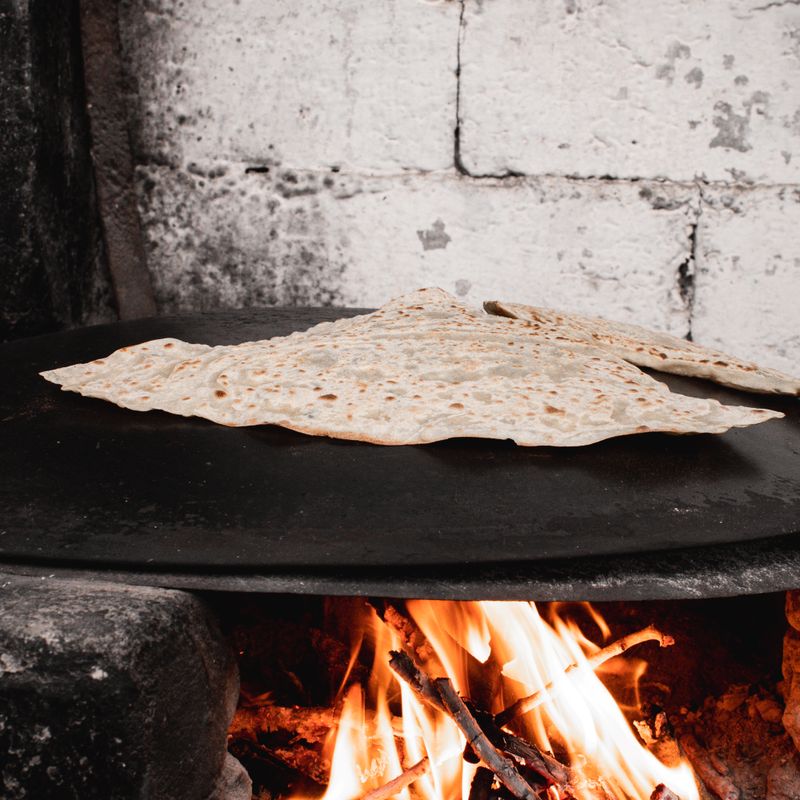
Armenian Lavash
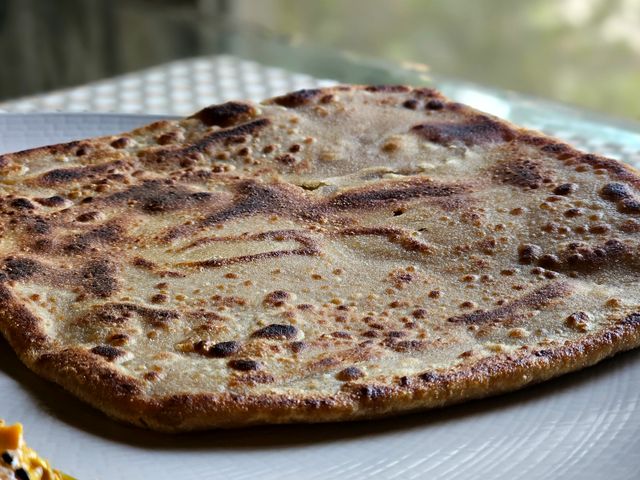
Paper-thin, soft and blistered Armenian flatbread made from just flour, water, and salt, then dusted with sesame seeds and baked on a blazing-hot surface in minutes.
- Prep
- 20 min
- Cook
- 15 min
- Wait
- 55 min
- Total
- 1 hr 30 min
- Makes
- 6 lavash breads (about 12 × 8 inches / 30 × 20 cm each)
Steps
Before you start
- Start the oven preheating with your baking steel, baking stone, or an inverted heavy rimless baking sheet inside it as soon as the dough begins its first rest. The surface needs at least 45 minutes to get fully hot.
- This dough has no yeast. The two rests let the gluten relax, which is what allows you to roll it paper-thin without it snapping back.
- Weigh the flour and water on a kitchen scale if you can. Dough hydration matters for rolling very thin.
- Clear a large work surface and keep a clean kitchen towel ready for covering the dough and wrapping the baked breads.
Mix the dough
- In a large bowl, whisk the 400 g (3¼ cups) flour and 10 g (1¾ tsp) salt together.
- Pour in the 240 ml (1 cup) lukewarm water and stir with a wooden spoon or your hand until no dry flour remains and a shaggy, fairly stiff dough forms.
+ Show details− Hide details
Ready when: No dry flour is visible and the dough holds together in a rough ball.
Tip: The dough should feel firm, not sticky. If it feels crumbly and will not come together, add water ½ teaspoon at a time.
Knead until smooth
- Turn the dough onto a lightly floured surface and knead firmly for 8 minutes, pushing with the heel of your hand, folding, and turning a quarter turn.
- Shape into a ball.
+ Show details− Hide details
Ready when: The dough is smooth, elastic, and springs back slowly when you press a finger into it.
Tip: A stiff dough needs real kneading. Rest for a minute if your arms tire; it will not hurt it.
First rest and preheatOven 500°F / 260°C
- Cover the dough with the bowl turned upside down or a damp towel and let it rest 30 minutes.
- During this time, place your baking steel, stone, or inverted heavy baking sheet on the middle oven rack and preheat the oven to 500°F (260°C).
+ Show details− Hide details
Ready when: The dough feels softer and stretches easily when gently pulled.
Tip: If your oven tops out at 450°F (230°C), use that and bake about 1 minute longer per bread.
Divide and rest again
- Cut the dough into 6 equal pieces of about 108 g each.
- Roll each into a smooth ball, place on a floured surface, and cover with a damp towel.
- Rest another 20 minutes.
+ Show details− Hide details
Ready when: The balls look slightly puffy and flatten easily under a fingertip.
Tip: Keep unused dough covered at all times. Exposed dough forms a skin that cracks when rolled.
Roll the first bread
- Dust the work surface lightly with flour.
- Roll one ball into a rough oval about 12 × 8 inches (30 × 20 cm), flipping and turning it often and dusting with flour only as needed.
- Roll until it is about 1 mm thick, thin enough to see the work surface faintly through it.
- Lightly brush the top with water and sprinkle with about 1 teaspoon of the sesame seeds, then gently press them in with your palm or the rolling pin.
+ Show details− Hide details
Ready when: The dough is translucent-thin, even, and the seeds are stuck on.
Tip: If the dough shrinks back, cover it, rest 3 minutes, then keep rolling. Brush water sparingly; too much makes it stick to the peel.
Bake the first breadOven 500°F / 260°C
- Carefully open the oven and lay the rolled dough directly on the hot steel or sheet, using your hands or a floured peel.
- Bake at 500°F (260°C) for 2 to 3 minutes.
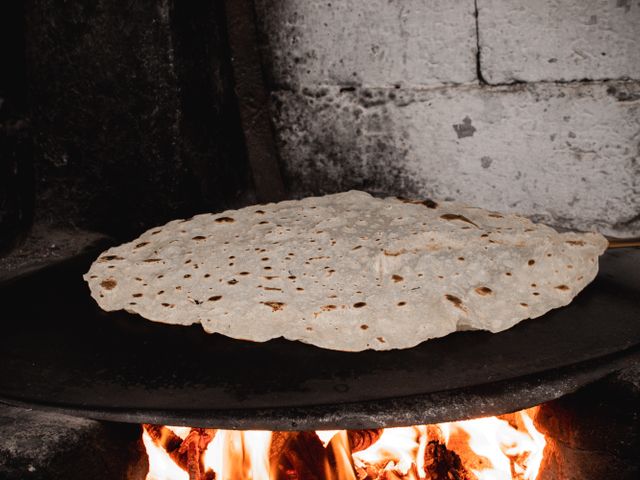
- It will puff in places and develop golden-brown spots.
- Remove with a spatula.
+ Show details− Hide details
Ready when: Bubbles puff up and the surface has light golden-brown freckles, still flexible when lifted.
Tip: Watch closely. Past 3 minutes it turns into a crisp cracker rather than a bendable bread.
Roll and bake the restOven 500°F / 260°C
- While each bread bakes, roll, brush, and seed the next ball the same way, using about 1 teaspoon of sesame per bread.
- Bake one at a time, 2 to 3 minutes each, until all 6 are done.
+ Show details− Hide details
Ready when: Each bread has golden-brown spots and bubbles but is still pliable.
Tip: Let the oven recover its heat for 30 seconds between breads if the steel seems to be cooling down.
Steam and cool
- Stack the hot breads as they come out and wrap them in a clean kitchen towel.
- Let them sit for 5 minutes so they soften.
- Serve warm, or cool completely before storing.
+ Show details− Hide details
Ready when: The breads bend and fold easily without cracking.
Tip: For crisp lavash crackers instead, skip the towel and let the breads cool flat on a rack.
Good to know
Tips
- Roll thin. About 1 mm is the target, which gives the signature bubbles and quick bake.
- A very hot baking surface is the key. It makes the bread puff instantly instead of drying out.
- No baking steel? A heavy rimless baking sheet turned upside down and preheated for 45 minutes works well.
- Use lavash for wraps, to scoop dips, or to serve alongside grilled meats and cheese; tear into pieces for sharing.
Make ahead
"Bake the lavash up to 2 days ahead and store as directed below. Rewarm just before serving. The dough can also be kneaded, wrapped tightly, and refrigerated up to 24 hours; bring to room temperature for 30 minutes before dividing."
Storage & reheating
"Room temperature: wrap in a towel then seal in a zip bag for up to 2 days. Refrigerator: up to 5 days in a sealed bag. Freezer: stack with parchment between breads, wrap airtight, and freeze up to 3 months. To reheat, sprinkle each bread lightly with water and warm in a dry skillet over medium heat for 20 to 30 seconds per side, or wrap in foil and warm in a 300°F (150°C) oven for 5 minutes."
Substitutions
- all-purpose flour → bread flour. Gives a chewier, stretchier bread. Add about 1 tablespoon (15 ml) more water if the dough feels very stiff.
- sesame seeds → nigella seeds or poppy seeds. Use the same amount; nigella is common on Armenian and Middle Eastern flatbreads.
- all-purpose flour → half whole wheat flour. Replace up to 200 g of the flour. Add 1 to 2 tablespoons (15 to 30 ml) more water and expect a slightly thicker, nuttier bread.
More flatbreads
See all →

Find more like this
- Meal
- Dinner
- Method
- Oven
- Quick & Easy
- 5 Ingredients or LessBudget