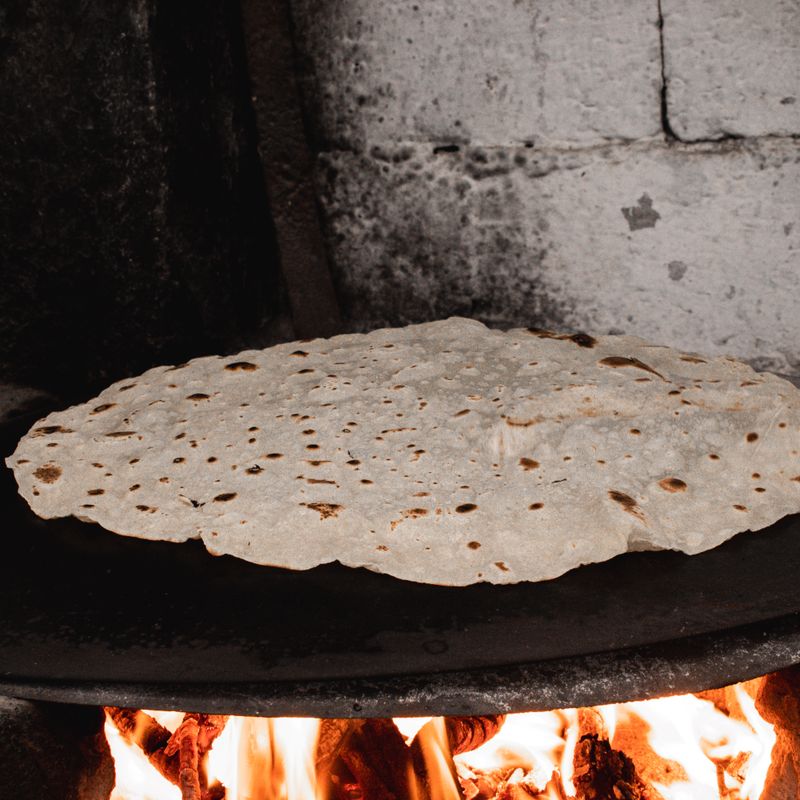
Piadina Romagnola
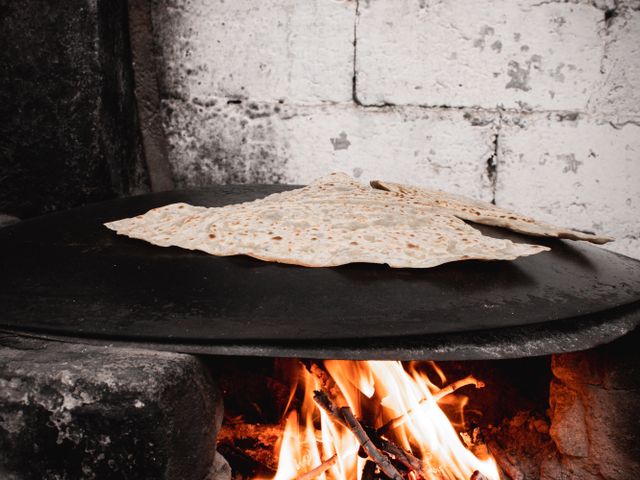
Thin, pliable, lightly blistered Italian flatbreads from Romagna, made with lard and milk and seared in a hot dry pan. Perfect folded around prosciutto, soft cheese and arugula.
- Prep
- 25 min
- Cook
- 18 min
- Wait
- 30 min
- Total
- 1 hr 13 min
- Makes
- 6 piadine (8-inch / 20 cm each)
Steps
Before you start
- Take the lard out of the fridge 30 minutes ahead so it is soft and easy to rub in.
- Warm the milk to lukewarm (about 100°F / 38°C) so the dough comes together easily.
- Plan on a 30-minute rest: the dough is much easier to roll thin once the gluten relaxes.
- Use a heavy, wide pan or cast-iron skillet; a thin pan scorches the piadine before they cook through.
Mix dry ingredients
- In a large bowl, whisk the flour, salt and baking soda for about 30 seconds until evenly combined.
+ Show details− Hide details
Ready when: No streaks of baking soda or clumps of salt visible.
Tip: Baking soda must be evenly distributed or you'll get bitter spots.
Rub in lard
- Add the lard pieces and rub them into the flour between your fingertips for 2–3 minutes until the mixture looks like coarse, sandy crumbs with no large lumps of fat.
+ Show details− Hide details
Ready when: Mixture resembles damp sand and holds slightly when squeezed.
Tip: Work quickly so the lard doesn't melt from the heat of your hands.
Add liquids
- Make a well in the center.
- Pour in the lukewarm milk and water and stir with a fork, drawing in flour from the edges until a shaggy dough forms.
- If dry flour remains, add 1–2 tablespoons more water.
+ Show details− Hide details
Ready when: Dough clumps together with no dry flour left in the bowl.
Knead smooth
- Turn the dough onto a lightly floured counter and knead for 5–6 minutes, pushing with the heel of your hand and folding, until smooth, soft and slightly elastic.
- It should feel like a firm earlobe and not stick to your hands.
+ Show details− Hide details
Ready when: Surface is smooth and springs back slowly when poked.
Tip: Sticky? Dust with a teaspoon of flour at a time; too much flour makes tough piadine.
Rest the dough
- Shape into a ball, place in the bowl, cover with a damp towel or plastic wrap, and let rest at room temperature for 30 minutes.
+ Show details− Hide details
Ready when: Dough is softer and stretches easily when gently pulled.
Portion and roll
- Divide the dough into 6 pieces of about 150 g each and roll into balls.
- Cover with a towel.
- On a lightly floured surface, roll one ball into a round about 8 inches (20 cm) wide and 1/16 inch (2 mm) thick, turning it a quarter turn after each pass.
- Trim with a plate as a guide if you like.
- Prick all over with a fork.
- Stack rolled rounds with parchment between them if desired.
+ Show details− Hide details
Ready when: Round is thin enough to see your hand faintly through it.
Tip: Keep unrolled balls covered so they don't form a dry skin.
Heat the pan
- Set a 12-inch (30 cm) cast-iron skillet over medium-high heat with no oil and heat for 3–4 minutes until a pinch of flour sizzles and browns within a few seconds.
+ Show details− Hide details
Ready when: A pinch of flour browns in about 10 seconds.
Tip: If the pan is too cool, the piadina turns dry and cracker-like instead of soft.
Sear first side
- Lay one round in the dry pan.
- Cook 1 minute until the underside has golden-brown spots and bubbles begin to puff on top.
- Pierce any large bubbles with a fork.
+ Show details− Hide details
Ready when: Underside is speckled golden-brown with small dark spots.
Tip: Lower to medium if spots turn black before 45 seconds.
Flip and finish
- Flip and cook the second side 45–60 seconds, until freckled with brown spots.
- Flip once more for 15–20 seconds if the center still looks pale or doughy.
- Transfer to a plate and cover with a clean towel.
- Repeat with the remaining rounds, stacking them under the towel.
+ Show details− Hide details
Ready when: Both sides have brown freckles; piadina is flexible, not stiff.
Tip: Stacking in a towel traps steam, keeping them soft and foldable.
Serve warm
- Serve within 15 minutes, folded in half around fillings such as prosciutto, squacquerone or mozzarella, and arugula, or tear and serve alongside cured meats and cheese.
Good to know
Tips
- Roll the dough thin (about 2 mm); thicker piadine are doughy and don't fold well.
- Never add oil to the pan; the dry heat creates the characteristic freckled spots.
- Pierce bubbles with a fork as they form so the piadina stays flat and cooks evenly.
- Keep cooked piadine stacked under a towel; steam keeps them soft.
Make ahead
The dough can be made, wrapped tightly and refrigerated up to 24 hours. Bring it to room temperature for 30 minutes before rolling. Rolled rounds can also be stacked between parchment, covered, and kept refrigerated for a few hours before cooking.
Storage & reheating
Room temperature: cooled piadine in an airtight bag up to 2 days. Fridge: up to 5 days. Freezer: up to 3 months, with parchment between each. Reheat in a dry skillet over medium heat for 20–30 seconds per side until warm and pliable (from frozen, 45 seconds per side).
Substitutions
- lard → extra-virgin olive oil, same weight (55 g / about 4 tbsp). Gives a slightly fruitier flavor and is a common modern variation; skip the rubbing step and mix the oil in with the liquids.
- whole milk → additional lukewarm water. Makes the piadine a little less tender and rich, but still good (use 240 ml total water).
- all-purpose flour → Italian 00 flour. Gives a slightly softer, more delicate texture; use the same weight.
- baking soda → 1 tsp baking powder. Provides similar lift with a more neutral taste.
More flatbreads
See all →

Find more like this
- Meal
- Lunch
- Cuisine
- Italian
- Diet
- Sugar-Free
- Method
- Stovetop
- Quick & Easy
- 5 Ingredients or LessEasy