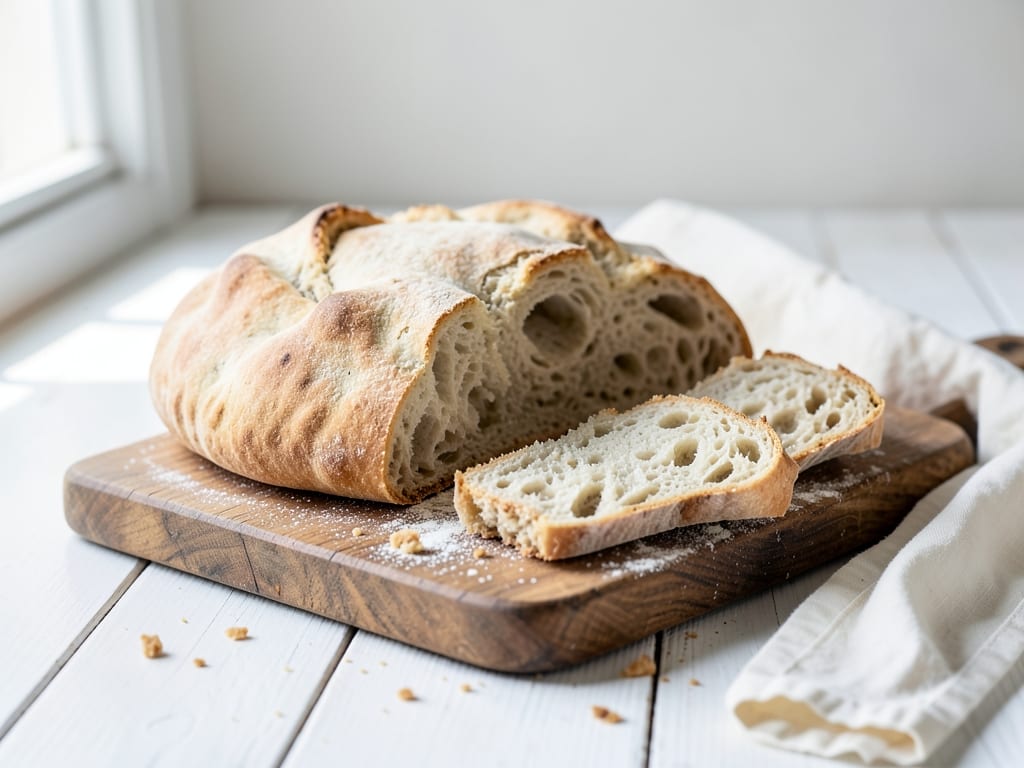
Sourdough Pita Bread
Soft, tangy pita with big puffed pockets, made with an active sourdough starter and baked on a screaming-hot stone or steel. Naturally leavened, no commercial yeast, and ready to stuff with falafel, kebabs or hummus.
- Prep
- 50 min
- Cook
- 12 min
- Wait
- 5 hr 55 min
- Total
- 6 hr 57 min
- Makes
- 8 pitas (about 6-inch / 15 cm each)
Steps
Before you start
- Feed your starter 4-8 hours ahead so it is bubbly, domed and at its peak when you mix. A starter that floats in water is ready.
- Plan about 7 hours start to finish; most of it is hands-off fermentation at a room temperature of about 75°F (24°C). A cooler kitchen needs longer.
- Position an oven rack in the lower third and put a baking stone, baking steel or an upside-down heavy baking sheet on it before preheating.
- Weigh ingredients with a kitchen scale for the most reliable dough.
Mix and rest dough
- In a large bowl, stir together the water and sourdough starter until the starter mostly dissolves and the liquid looks milky.
- Add the 400 g bread flour and mix with a wet hand or spatula until no dry flour remains and the dough looks shaggy.
- Cover with a towel and let it rest for 30 minutes.
+ Show details− Hide details
Ready when: No dry flour pockets remain; dough is shaggy and slightly sticky
Tip: Use lukewarm, not hot, water so you don't stress the starter.
Knead in salt and oil
- Sprinkle the salt and drizzle the olive oil over the dough.
- Squeeze and fold the dough with wet hands for about 2 minutes to work them in, then knead in the bowl or on an unfloured counter for 5-6 minutes, stretching and folding it over itself.
+ Show details− Hide details
Ready when: Dough is smooth, elastic and springs back slowly when poked; it is still slightly tacky
Tip: Resist adding extra flour. A slightly tacky dough makes the puffiest pockets.
Bulk ferment with folds
- Cover the bowl and leave at about 75°F (24°C).
- At 30 minutes and again at 60 minutes, wet your hand, grab one edge of the dough, stretch it up and fold it over the center; turn the bowl a quarter and repeat 4 times (one set).
- Re-cover.
- After the second set, leave undisturbed until the dough has grown by about 50% and looks airy with a few bubbles, about 4½ hours total.
+ Show details− Hide details
Ready when: Dough is puffy, about 1½ times its original size, jiggly, with bubbles at the edges and sides
Tip: Go by the dough, not the clock: in a cool kitchen it can take up to 6 hours, in a warm one as little as 3½.
Divide and shape balls
- Lightly flour the counter.
- Turn the dough out and cut into 8 equal pieces with a bench scraper, about 98 g each.
- Shape each into a tight ball by pulling the edges into the center and pinching, then flip seam side down and roll under a cupped hand to make a smooth ball.
- Place on the counter with space between them.
+ Show details− Hide details
Ready when: Each ball is smooth and taut on top, about 98 g
Tip: Weigh the pieces so the pitas bake at the same pace.
Rest and preheat ovenOven 500°F / 260°C
- Cover the balls with a clean towel and rest for 45 minutes.
- At the same time, place the stone, steel or inverted baking sheet on the lower-third rack and preheat the oven to 500°F (260°C).
- The full 45 minutes ensures the surface is thoroughly hot.
+ Show details− Hide details
Ready when: Balls look slightly puffy and spring back slowly when pressed; oven has been at temperature for at least 30 minutes
Tip: Do not skip the preheat; the burst of bottom heat is what inflates the pocket.
Roll out pitas
- Working with 2-3 balls at a time (keep the rest covered), roll each on a very lightly floured counter into a round about 6-7 inches (15-18 cm) across and ¼ inch (6 mm) thick.
- Roll from the center outward, turning often, so the thickness is perfectly even.
- Brush off excess flour and lay the rounds on a towel without stacking.
+ Show details− Hide details
Ready when: Rounds are an even ¼ inch thick, with no thin spots or tears
Tip: Thin spots let steam escape, so the pita won't puff. Don't press the edges thinner than the center.
Bake in batchesOven 500°F / 260°C
- Carefully open the oven and use a spatula or peel to place 2-3 pitas directly on the hot stone, leaving space between them.
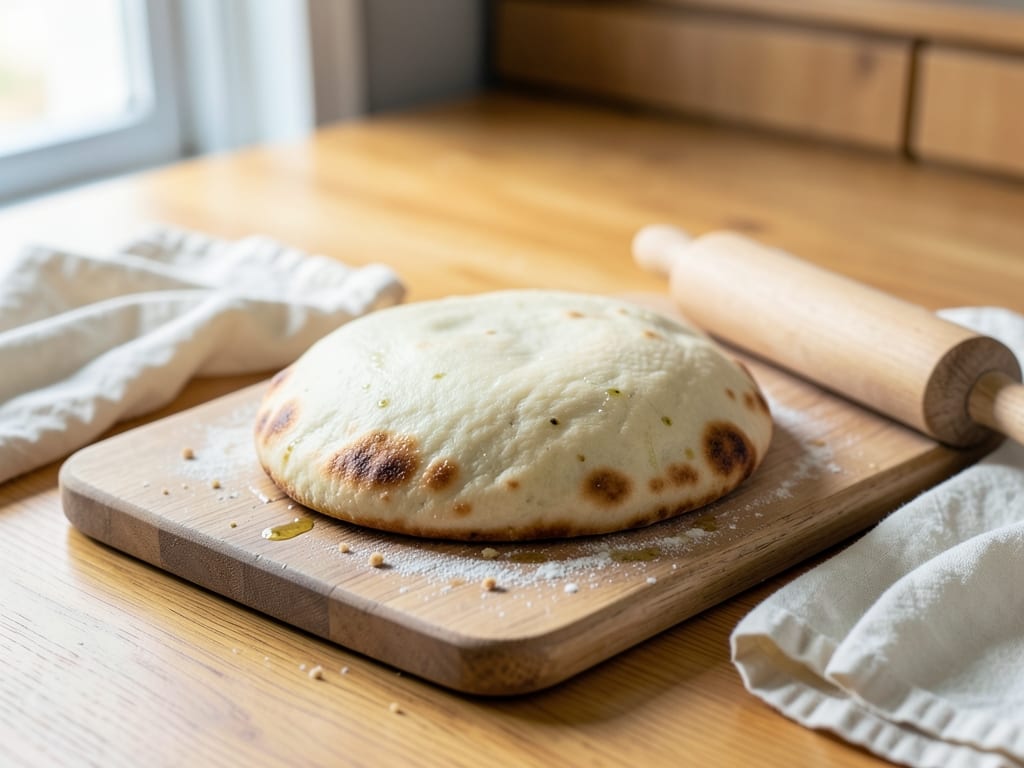
- Close the door and bake 3-4 minutes, without opening, until the pitas balloon and are pale with a few light golden-brown spots.
- Remove with the spatula and repeat with the remaining rounds, letting the oven recover heat for 1 minute between batches.
+ Show details− Hide details
Ready when: Pitas are fully puffed into balls, lightly speckled golden brown, and feel set on top
Tip: Overbaking makes them crisp like crackers. Pull them as soon as they are puffed and spotty.
Steam and cool
- Stack the hot pitas in a clean kitchen towel and wrap loosely.
- Let them steam for 10 minutes; they will deflate and soften.
- Serve warm, or cool completely before storing.
+ Show details− Hide details
Ready when: Pitas are soft, flexible and bend without cracking
Tip: Wrapped in the towel they stay soft; uncovered they dry and stiffen quickly.
Good to know
Tips
- Roll evenly and keep the thickness consistent; the pocket forms when steam is trapped between two intact layers.
- A very hot baking surface is crucial. If your pitas don't puff, raise the oven temperature or preheat longer.
- Use as little dusting flour as possible, and brush off any excess; flour on the surface can burn and keeps edges from sealing.
- If a pita doesn't puff, it is still delicious as a flatbread for dipping.
Make ahead
"After the final fold, the dough can ferment about 2 hours at room temperature, then be covered and refrigerated for 8-24 hours. Let it sit at room temperature for 1 hour, then divide, shape, rest 45 minutes with the oven preheating, and continue from step 6."
Storage & reheating
"Room temperature: cool completely, then keep in a zip-top bag or airtight container up to 2 days. Fridge: up to 5 days. Freezer: stack with parchment between pitas, wrap well and freeze up to 3 months. Reheat for 30-60 seconds per side in a dry skillet over medium heat, or wrap in foil and warm at 350°F (175°C) for 5-8 minutes; thaw frozen pitas first."
Substitutions
- bread flour → all-purpose flour. Works, but the pitas are slightly less chewy; reduce water by about 1 tablespoon (15 ml).
- bread flour → up to 100 g whole wheat flour replacing 100 g of the bread flour. Gives a nuttier flavor; add 1-2 tablespoons (15-30 ml) more water as needed.
- extra-virgin olive oil → neutral oil such as sunflower or avocado oil. Same amount; you'll lose the fruity flavor.
- fine sea salt → kosher salt (Diamond Crystal). Use about 2 teaspoons; go by the 8 g weight if you can.
More flatbread doughs
See all →
Find more like this
- Meal
- Lunch
- Cuisine
- Middle Eastern
- Method
- Oven
- Quick & Easy
- 5 Ingredients or LessFreezer Friendly