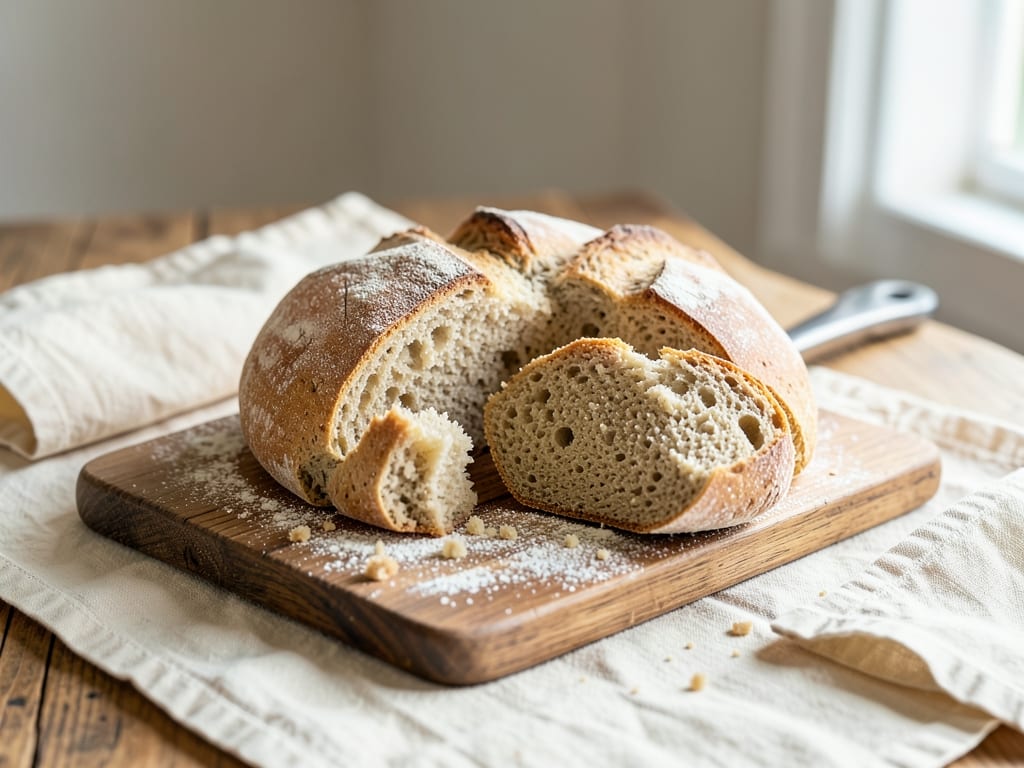
Sourdough Khobz Batbout
Soft, pillowy Moroccan pocket breads made with a sourdough starter and fine semolina, then cooked in a dry skillet until they puff. Slice them open and fill with kefta, eggs, cheese or olives.
- Prep
- 42 min
- Cook
- 32 min
- Wait
- 6 hr 25 min
- Total
- 7 hr 39 min
- Makes
- 8 batbout (about 5 inches / 12 cm each)
Steps
Before you start
- Feed your starter 4–6 hours ahead so it is bubbly, doubled and passes the float test. This recipe assumes a 100% hydration starter (equal weights flour and water).
- Plan on about 7½ hours from mixing to eating. Most of it is hands-off fermenting at a room temperature of about 75°F (24°C). A cooler kitchen will need longer.
- Use fine semolina (sometimes labeled semolina flour or extra-fine). Coarse semolina will make the crumb gritty.
- Weigh the ingredients with a kitchen scale if you can. The dough is soft and the hydration matters.
Mix the dough
- In a large bowl, whisk the lukewarm water (240 ml) and starter (100 g) until the starter mostly dissolves and the water looks milky.
- Add the bread flour (300 g), semolina (100 g), salt (8 g) and olive oil (20 ml).
- Mix with a wet hand or spatula for 2–3 minutes until no dry flour remains.
- The dough will look shaggy and sticky.
+ Show details− Hide details
Ready when: No dry flour is visible and the dough forms a rough, sticky mass.
Tip: Semolina absorbs water slowly, so the dough will feel wetter now than it does after resting.
Rest the dough
- Cover the bowl with a damp towel or plate and let the dough rest for 30 minutes.
- The flours hydrate and the dough becomes much easier to knead.
+ Show details− Hide details
Ready when: The dough looks puffier and less sticky when touched.
Knead until smooth
- Turn the dough onto an unfloured counter.
- Knead for about 8 minutes, pushing it away with the heel of your hand and folding it back.
- Use a bench scraper to lift it if it sticks.
- Return it to the bowl, seam side down.
+ Show details− Hide details
Ready when: The dough is smooth, soft and slightly tacky, and springs back slowly when poked.
Tip: Resist adding extra flour. A slightly tacky dough gives a softer, puffier bread.
Bulk ferment
- Cover the bowl and leave it at about 75°F (24°C).
- After 1 hour and again after 2 hours, wet your hand, grab the edge of the dough, stretch it up and fold it over the center.
- Turn the bowl a quarter turn and repeat 4 times each set.
- Cover again and leave until the total time reaches about 5 hours.
+ Show details− Hide details
Ready when: The dough has grown by about 50–75%, looks airy with a few bubbles at the edges and jiggles when the bowl is shaken.
Tip: In a cool kitchen this can take 6–7 hours. Judge by the dough's volume, not just the clock.
Divide and shape
- Dust the counter lightly with some of the dusting semolina (20 g total for the recipe).
- Tip the dough out and cut it into 8 pieces of about 95 g each.
- Shape each piece into a tight ball by tucking the edges underneath and rolling it against the counter with a cupped hand.
- Place the balls on a semolina-dusted towel with space between them.
+ Show details− Hide details
Ready when: Each ball is smooth on top and holds its round shape.
Tip: Handle the dough gently so you don't squeeze out the gas that makes the breads puff.
Proof the balls
- Dust the tops of the balls lightly with semolina, then cover them with a second towel.
- Leave them for 40 minutes.
+ Show details− Hide details
Ready when: The balls look puffy and a gently floured fingertip leaves a dent that fills back in slowly.
Flatten into discs
- Gently press each ball into a disc about 5 inches (12 cm) wide and ½ inch (1 cm) thick, using your palm or a light touch with a rolling pin.
- Keep the thickness even all over, because thin spots won't puff.
- Cover the discs with the towel and rest them for 15 minutes.
+ Show details− Hide details
Ready when: The discs are even in thickness and look slightly puffy.
Tip: Don't use a lot of flour on the surface. Excess burns in the dry pan and tastes bitter.
Cook the first side
- Heat a 12-inch (30 cm) skillet over medium heat for 2 minutes, with no oil.
- Brush off any extra semolina.
- Place 2 discs in the pan, leaving space between them.
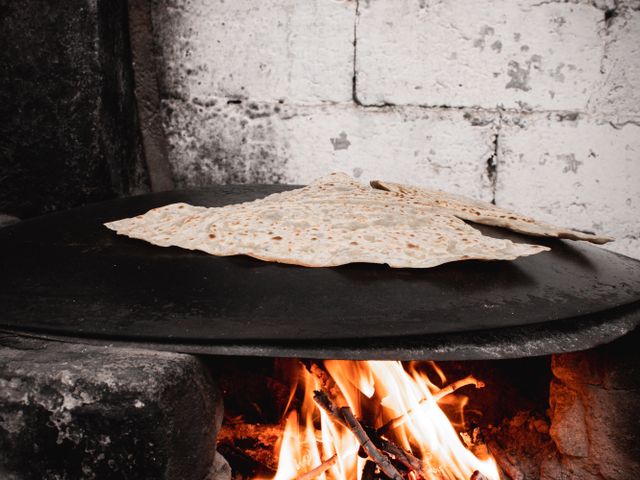
- Cook for 3–4 minutes without moving them, until the underside is pale gold with a few light brown spots.
+ Show details− Hide details
Ready when: The underside is pale gold with light brown speckles and the top surface looks slightly dry at the edges.
Tip: If the pan smokes or the bread browns in under 2 minutes, lower the heat slightly. Too-high heat sets the crust before the bread can puff.
Flip and puff
- Flip the breads and cook the second side for 3 minutes.
- Flip once more and cook for 1–2 minutes, pressing very gently on the center with a folded towel if needed.
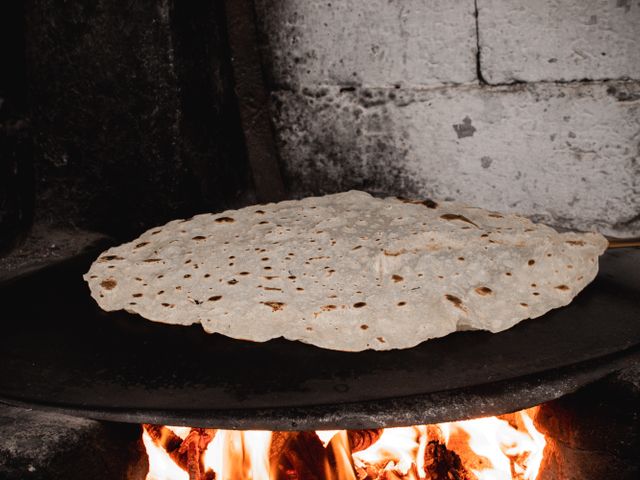
- The bread should puff into a balloon.
- Move to a towel-lined plate and repeat with the remaining discs, 2 at a time.
+ Show details− Hide details
Ready when: Both sides are golden with light brown freckles, the bread puffs, and it feels light and springy when pressed. The sides are not doughy.
Tip: If a bread doesn't puff, cook it a bit longer. It's still delicious as a flatbread.
Brush and wrap
- While the breads are still warm, lightly brush the tops with the finishing olive oil (15 ml).
- Stack them in a clean towel and wrap loosely for 5 minutes so the crusts soften.
- Serve warm, whole or split open to fill.
+ Show details− Hide details
Ready when: The crusts are soft and pliable, not crisp.
Tip: Wrapping traps steam, which keeps batbout soft rather than dry.
Good to know
Tips
- The dough should be soft but not sloppy. Wet hands work better than adding flour.
- Even thickness is the key to puffing. Keep the discs about ½ inch thick all over.
- Cook in a dry pan. Oil in the pan will brown the bread too quickly and stop it from puffing.
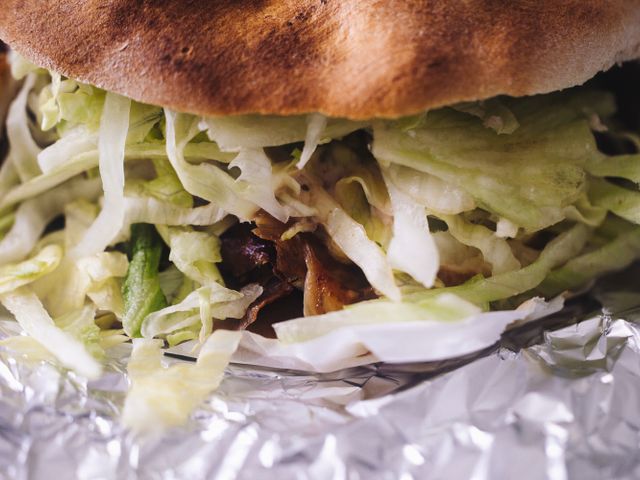
- Serve with kefta, scrambled eggs, olives or soft cheese, or use for dipping into tagines and soups.
Make ahead
After kneading in step 3, you can ferment the dough in the fridge for 12–16 hours in place of the 5-hour bulk ferment. Let it sit at room temperature for 1 hour, then divide and shape as directed. You can also cook the batbout up to a day ahead and reheat them.
Storage & reheating
Room temperature: wrap tightly in a towel inside a bag for up to 2 days. Fridge: up to 5 days in an airtight bag. Freezer: freeze for up to 3 months with parchment between the breads. Reheat for 20–30 seconds per side in a dry skillet over medium heat, or wrap in foil and warm in a 350°F (175°C) oven for 8–10 minutes.
Substitutions
- bread flour → all-purpose flour. The bread will be slightly softer and less chewy. Reduce the water by about 10–15 ml if the dough feels sticky.
- fine semolina → whole wheat flour. Gives a nuttier, denser bread and may need an extra tablespoon of water.
- extra-virgin olive oil → neutral vegetable oil. Gives a milder flavor but the same texture.
- active sourdough starter (100% hydration) → 7 g instant yeast plus 50 g extra flour and 50 ml extra water. Not sourdough, but it works if you have no starter. Bulk ferment for 1–1½ hours instead.
More flatbread doughs
See all →
Find more like this
- Meal
- Lunch
- Cuisine
- Moroccan
- Method
- Stovetop
- Quick & Easy
- Freezer Friendly