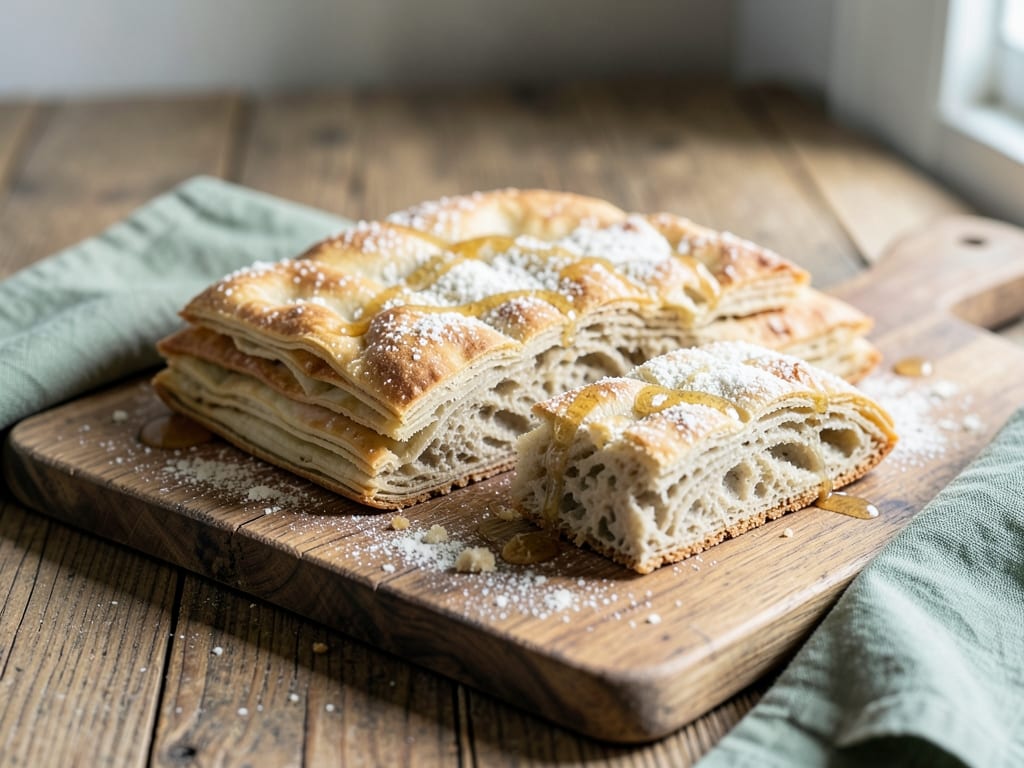
Sourdough Msemen (Moroccan Layered Flatbread)
Flaky, buttery Moroccan square flatbreads made with active sourdough starter. A long ferment gives the dough a gentle tang and stretchy, forgiving texture, while the semolina-dusted folds create dozens of crisp-chewy layers when pan-fried.
- Prep
- 1 hr 1 min
- Cook
- 32 min
- Wait
- 4 hr 45 min
- Total
- 6 hr 18 min
- Makes
- 8 square msemen (about 5 inches / 12 cm each)
Steps
Before you start
- Feed your starter 4–8 hours ahead so it is bubbly and has at least doubled; it should float in water.
- Read the timing: the dough needs a 4-hour room-temperature ferment plus 45 minutes of resting later, so plan about 6½ hours start to finish.
- Fine semolina (sold as 'fine semolina' or 'semolina flour') works best; coarse semolina will feel gritty.
- Clear a large, smooth work surface (about 24 × 24 inches / 60 × 60 cm), since you stretch each ball very thin.
Mix the dough
- In a large bowl, whisk the all-purpose flour, 100 g fine semolina, salt and sugar.
- Add the starter and lukewarm water.
- Stir with your hand or a sturdy spoon for 2–3 minutes until no dry flour remains and you have a shaggy, sticky dough.
+ Show details− Hide details
Ready when: No dry flour left; dough is shaggy and sticky.
Tip: Starter that has not peaked gives sluggish fermentation. Use it at its bubbliest.
Knead until smooth
- Turn the dough onto an unfloured surface and knead for 8–10 minutes, slapping and stretching it, until it is smooth, elastic and only slightly tacky.
- Add a few drops of water or a dusting of flour only if it is truly unmanageable.
- Return it to the bowl and cover.
+ Show details− Hide details
Ready when: A small piece stretches into a thin, slightly see-through sheet (windowpane) without tearing immediately.
Tip: Msemen dough should be softer than bread dough; resist adding much flour.
Bulk ferment
- Cover the bowl with a damp towel or plastic wrap and leave at room temperature (72–76°F / 22–24°C) for about 4 hours.
- The dough will puff, feel airy and grow by roughly 50%.
+ Show details− Hide details
Ready when: Dough has grown about 50%, is domed and jiggles, with a few bubbles visible.
Tip: In a cool kitchen, allow up to 5–6 hours. In a warm one, check at 3 hours.
Divide and oil balls
- Mix the melted butter with 60 ml (¼ cup) of the oil in a small bowl.
- Oil your work surface and hands with some of the remaining 30 ml oil.
- Divide the dough into 8 pieces of about 90 g each.
- Shape each into a smooth tight ball, coat lightly in oil, and arrange on an oiled tray.
- Cover and rest 30 minutes.
+ Show details− Hide details
Ready when: Balls look smooth and glossy and spread slightly when poked.
Tip: Keep the balls covered so they do not form a skin.
Stretch, layer and fold
- On a generously oiled surface, take one ball and flatten it with oiled fingers, then stretch from the center outward to a very thin rectangle about 10–12 inches (25–30 cm) wide, thin enough to see your fingers through it.
- Brush with the butter-oil mixture and sprinkle with a pinch of dusting semolina.
- Fold the top third down and bottom third up like a letter, brush the strip again, then fold the sides in thirds to form a square about 3½–4 inches (9–10 cm).
- Set aside on an oiled tray.
- Repeat with the remaining balls, keeping leftover fat for the pan.
+ Show details− Hide details
Ready when: Dough sheet is translucent and each folded square is neat with a layered edge.
Tip: Small holes are fine, since the folds hide them. Stretch with the pads of your fingers, not your nails.
Rest the squares
- Cover the folded squares with a towel and let them rest 15 minutes so they relax and are easy to flatten without springing back.
+ Show details− Hide details
Ready when: Squares feel soft and slack when pressed.
Heat pan and flatten
- Heat a 12-inch (30 cm) skillet over medium heat for 3 minutes until a drop of water sizzles at once.
- Do not add fat to the pan.
- Gently press and stretch the first square with oiled fingertips to about 5½–6 inches (14–15 cm), keeping its square shape.
+ Show details− Hide details
Ready when: Water droplets dance and evaporate immediately.
Tip: Flatten each square just before it goes in the pan; flatten ahead and the layers merge.
Pan-fry each msemen
- Place the flattened square in the dry pan.
- Cook 2 minutes until the underside is golden with brown spots and the top looks puffed.
- Brush the top with a little leftover butter-oil, flip and cook 2 minutes more.
- Flip once more if needed for even color.
- Flatten the next square while the first cooks, and repeat to cook all 8.
+ Show details− Hide details
Ready when: Both sides are deep golden with brown spots, the edges look crisp and the layers have separated slightly.
Tip: If it browns in under 90 seconds or smokes, lower the heat slightly; pale, doughy msemen means the pan is too cool.
Fluff and serve
- As each msemen comes off the heat, place it on a plate and clap or push the opposite edges toward the center with both hands so the layers fluff and separate.
- Stack under a towel to stay soft.
- Serve warm drizzled with honey, if using.
+ Show details− Hide details
Ready when: The layers ripple and separate visibly.
Tip: Crush while hot; they crush less well once cooled.
Good to know
Tips
- Oil generously: the oiled surface and hands are what let the dough stretch paper-thin without sticking or tearing.
- Cook in a dry pan, then brush fat on top. Fat in the pan makes the layers fry greasy rather than flaky.
- For a savory version, sprinkle chopped onion, cumin and parsley or crumbled cheese over the stretched dough before folding.
- If the dough keeps springing back while stretching, cover it and rest 10 minutes, then try again.
Make ahead
"After shaping and folding (step 5), refrigerate the folded squares on an oiled tray, tightly covered, for up to 24 hours. Bring to room temperature for 30 minutes, then flatten and cook. You can also freeze the uncooked folded squares, separated with parchment, for up to 2 months; thaw in the fridge overnight."
Storage & reheating
"Room temperature: wrapped in a towel inside a container for up to 1 day. Fridge: up to 4 days in an airtight container. Freezer: cooked msemen with parchment between them for up to 3 months. Reheat in a dry skillet over medium heat for 1–2 minutes per side (from frozen, 2–3 minutes per side) until hot and crisp at the edges."
Substitutions
- fine semolina → additional all-purpose flour (100 g). Dough will be slightly softer and less crisp, and the layers a bit less distinct. Use fine flour for dusting too.
- unsalted butter → ghee or smen. Use the same weight; ghee gives a nuttier flavor and smen a traditional funky one.
- active sourdough starter (100% hydration) → 7 g (2¼ tsp) instant yeast plus 50 g extra flour and 50 ml extra water. Skip the long ferment: let rise 1 hour instead. Flavor will be milder.
- honey → maple syrup or date syrup. Same amount; both work well for serving.
More flatbread doughs
See all →

Find more like this
- Meal
- Breakfast
- Cuisine
- Moroccan
- Diet
- VegetarianHalal
- Method
- Stovetop
- Quick & Easy
- Freezer Friendly