
Vietnamese Cinnamon and Beef Tendon Broth
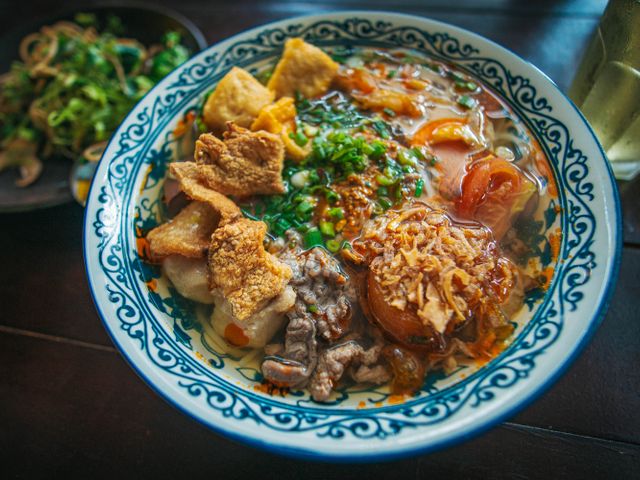
A deeply aromatic and comforting Vietnamese broth built on slow-cooked beef tendon, infused with warming cinnamon, star anise, and rock sugar. The tendon becomes gelatinous and tender, enriching the broth with collagen while the spices create a balanced sweetness and fragrant complexity. Perfect served hot as a standalone broth or as a base for noodle soups.
- Prep
- 20 min
- Cook
- 1 hr 30 min
- Wait
- 15 min
- Total
- 2 hr 5 min
- Makes
- About 8 cups (2 liters) broth with tendon
Steps
Before you start
- Trim excess fat and silver skin from beef tendon; blanch it first to remove impurities for a clearer broth
- Gather all spices before starting; they should be added together
- If not using a pressure cooker, plan for 3–4 hours of gentle simmering instead of 90 minutes total time
Blanch the tendon
- Bring 8 cups (2 L) of water to a rolling boil in a large pot.
- Add the beef tendon pieces and bring back to a boil, cooking for 3 minutes to release impurities.
- Drain in a colander and rinse the tendon pieces under cold running water, scrubbing gently with your fingers to remove any grey foam or debris.
- Set aside.
+ Show details− Hide details
Ready when: Tendon pieces are clean and foam is rinsed away
Tip: Blanching removes impurities that would cloud the broth, resulting in a clearer, more refined finished product.
Toast the spices
- Dry-toast the cinnamon sticks and star anise in a dry 6-quart (5.7 L) pressure cooker over medium heat for 2–3 minutes, stirring frequently, until fragrant.
- Do not let them burn.
- The spices should smell warm and aromatic.
+ Show details− Hide details
Ready when: Spices are fragrant and slightly darker in color
Tip: Toasting releases essential oils and deepens the flavor, but watch carefully to avoid burning, which would make them bitter.
Add broth ingredients
- Add the blanched tendon, 10 cups (2.4 L) of fresh water, rock sugar, shallot halves, ginger slices, and fish sauce to the pressure cooker.
- Stir gently to combine and dissolve the rock sugar partially.
- The broth should just cover the tendon.
+ Show details− Hide details
Ready when: Ingredients are combined and rock sugar is starting to dissolve
Tip: Stir gently to avoid breaking up the tendon pieces, which are still delicate at this point.
Pressure cook the broth
- Close and seal the pressure cooker according to the manufacturer's instructions.
- Bring to high pressure over high heat.
- Once the pressure regulator indicates high pressure, reduce the heat to medium-low to maintain pressure and cook for 90 minutes.
- The broth should simmer steadily but not furiously.
+ Show details− Hide details
Ready when: Pressure regulator shows high pressure maintained; steam escapes steadily
Tip: Do not open the pressure cooker early. The full 90 minutes is necessary for the tendon to become truly tender and the broth to develop its deep, gelatinous body.
Release pressure
- Once the cooking time is complete, carefully turn off the heat and let the pressure release naturally for 15 minutes.
- (The pot will still be under pressure during this time.) Then carefully open the pressure release valve to vent any remaining steam, holding the lid away from your face.
- Once the hissing stops, unlock and open the lid.
+ Show details− Hide details
Ready when: No steam escapes when the valve opens; pressure is fully released
Tip: Never force-cool a pressure cooker under running water, as the rapid temperature change can warp the pot. Natural release also keeps the broth clear and full-bodied.
Strain and taste
- Carefully ladle the broth through a fine-mesh strainer lined with cheesecloth into a large bowl, leaving the solids behind in the pot.
- You should have about 8 cups (2 L) of clear, amber-colored broth.
- Reserve the tender tendon pieces (discard the spent shallots, ginger, and spices, or save for garnish if desired).
- Add fish sauce to taste if needed and adjust salt to your preference—the broth should be savory and well-balanced, not overly salty.
+ Show details− Hide details
Ready when: Broth is clear and aromatic; tendon is fork-tender
Tip: Taste before serving; rock sugar should provide subtle sweetness without being cloying. If the broth tastes flat, add a pinch more fish sauce or salt.
Serve
- Ladle the hot broth into bowls.
- Divide the reserved, tender beef tendon pieces among the bowls.
- Garnish with sliced scallions (white and light green parts first, dark green parts last) and fresh cilantro if desired.
- Serve piping hot.
+ Show details− Hide details
Ready when: Broth is steaming; tendon is soft and easily pierced with a spoon
Tip: Add scallion whites during cooking or just before serving for fresher flavor; reserve dark greens for garnish to add a pop of color and mild onion notes.
Good to know
Tips
- Blanching the tendon first is the secret to a clear, refined broth. Skip this step and you'll have a cloudy, murky finished product.
- Toasting the cinnamon and star anise in a dry pan deepens their flavor dramatically—do not skip this step, but watch carefully so they don't burn.
- A pressure cooker cuts the cooking time dramatically (from 3–4 hours to 90 minutes), but if you don't have one, you can simmer gently in a Dutch oven for 3–4 hours instead. The result will be equally delicious.
- Rock sugar is traditional and gives a more refined, complex sweetness than white sugar. Look for it in Asian markets or online.
Make ahead
The broth can be prepared up to 3 days ahead. Cool completely, then store in an airtight container in the refrigerator. The broth will gel slightly from the collagen in the tendon—this is a sign of quality. Reheat gently on the stovetop over medium heat until steaming, stirring occasionally. You can also freeze the broth for up to 3 months; thaw overnight in the refrigerator before reheating.
Storage & reheating
Room temperature: up to 2 hours (strain solids and cover). Refrigerator: up to 3 days in an airtight container; the broth will gel as it cools. Freezer: up to 3 months in freezer-safe containers or ice cube trays. Reheat on the stovetop over medium heat until steaming, or in a microwave-safe bowl in 2–3 minute intervals, stirring between rounds.
Substitutions
- beef tendon, cleaned and cut into 2-inch (5 cm) chunks → beef shank or beef chuck (2 lb / 900 g), cut into 3-inch chunks. These will cook more quickly (60 minutes under pressure) and will not become as gelatinous, but will still create a rich, aromatic broth.
- rock sugar, lightly crushed → light brown sugar or white granulated sugar (2 tbsp or 25 g). Rock sugar has a more subtle, refined sweetness, but brown sugar or white sugar will work in a pinch; use slightly less to avoid over-sweetening.
- fish sauce → soy sauce (2 tbsp or 30 ml). This shifts the flavor profile slightly toward saltiness rather than umami depth, but is a functional substitute if fish sauce is unavailable.
- cinnamon sticks, about 3 inches (7.5 cm) long → ½ tsp ground cinnamon, added in the last 10 minutes of cooking. Ground cinnamon is more intense; add it near the end to avoid bitterness. The broth will be slightly less fragrant but still aromatic.
More broths
See all →



Find more like this
- Meal
- Dinner
- Cuisine
- Vietnamese
- Main ingredient
- Stew Beef
- Method
- Instant Pot