
Vietnamese Beef Marrow Broth
A slow-simmered Vietnamese beef broth built on roasted spices and charred aromatics. The bones release their rich marrow into a deeply savory, subtly fragrant liquid that serves as the soul of pho and other Vietnamese noodle soups. Charring the shallots and ginger creates complexity, while star anise, cinnamon, and coriander seeds add warmth and depth without overpowering the beefy essence.
- Prep
- 15 min
- Cook
- 3 hr
- Wait
- 15 min
- Total
- 3 hr 30 min
- Makes
- About 8 cups (1.9 L) broth
Steps
Before you start
- Pat the bones dry so they brown better
- Have a large pot (8 quarts) ready
- Toast the spices just before use so they're fragrant
- Place a fine-mesh strainer and cheesecloth nearby for straining
Toast the spices
- In a small dry skillet over medium-low heat, add the star anise, cinnamon, coriander seeds, and cloves.
- Toast for 1–2 minutes, stirring occasionally, until fragrant—do not allow them to darken or burn.
- Transfer to a plate.
+ Show details− Hide details
Ready when: Spices smell fragrant and toasted, not acrid
Tip: Avoid overtoasting; charred spices will taste bitter. If you smell anything sharp or burnt, remove immediately.
Char the aromatics
- Heat a large heavy-bottomed pot (8 quarts) over high heat for 2 minutes.
- Once very hot, place the shallot halves and ginger halves cut-side down directly on the dry pot bottom (no oil).
- Char for 3–4 minutes without moving them until blackened in spots.
- Flip the aromatics and char the other side for 2 minutes.
- The ginger skin should be singed and the shallots caramelized.
- Remove and set aside.
+ Show details− Hide details
Ready when: Shallots and ginger are blackened on both flat sides
Tip: The charring adds smoky depth. Don't skip it or move the aromatics—they need direct contact with the hot pot to develop color and flavor.
Blanch and rinse the bones
- Return the pot to high heat and add the cold water.
- Once it reaches a boil, carefully add the beef bones.
- Return to a boil, then immediately pour everything through a fine-mesh strainer.
- Rinse the bones under cold water and wipe out the pot to remove scum.
- This step removes impurities and keeps the broth clear.
+ Show details− Hide details
Ready when: Water boils vigorously and bones are opaque on the surface
Tip: Don't skip the blanch and rinse—it's crucial for a clean, clear broth. Scum left in the pot clouds the final result.
Build the broth base
- Return the cleaned bones to the pot along with the charred shallots, charred ginger, quartered onion, and toasted spices.
- Pour in 10 cups (2.4 L) of fresh cold water.
- Bring to a boil over high heat, then reduce to low and maintain a gentle simmer—you should see only small, occasional bubbles rising to the surface, never a rolling boil.
+ Show details− Hide details
Ready when: Water reaches a rolling boil
Tip: Once it boils, lower the heat immediately. A vigorous boil emulsifies fat and proteins into the broth, making it cloudy. A gentle simmer keeps it clean and clear.
Skim the impurities
- In the first 10 minutes of simmering, white foam and gray impurities will rise to the surface.
- Use a large shallow spoon or skimmer to remove them every 2–3 minutes.
- Stop skimming once the surface is mostly clear and the impurities have largely subsided.
- This step ensures clarity and cleanliness.
+ Show details− Hide details
Ready when: Surface is mostly clear with no thick foam layer
Tip: Skimming is important but don't obsess—a few minutes of occasional skimming is enough. Don't skim so aggressively that you cool the broth.
Simmer the broth
- Maintain a gentle simmer over low heat for 2.5 to 3 hours.
- The bones should remain submerged.
- During the final 30 minutes of simmering, you can stir in the fish sauce, rock sugar, and a pinch of salt if you wish (optional—you can also season to taste at the end).
- The longer the bones simmer, the richer and more gelatinous the broth will become as the marrow dissolves into the liquid.
+ Show details− Hide details
Ready when: Broth is rich, amber-colored, and slightly gelatinous when cooled; bones are tender and marrow can be easily scooped out
Tip: Check the pot occasionally to ensure the broth is at a bare simmer, not boiling. If it boils, the broth will become cloudy. The marrow bones should fall apart easily when squeezed—if they're still very firm, simmer a bit longer.
Strain and cool
- Remove the pot from heat and let it settle for 5 minutes.
- Place a fine-mesh strainer lined with cheesecloth over a large clean pot or bowl.
- Carefully pour the broth through the strainer, discarding the bones and aromatics.
- (Save any marrow from the bones if you wish—it can be spooned out and saved for serving.) Allow the broth to cool at room temperature for 15 minutes, then refrigerate if using later.
+ Show details− Hide details
Ready when: Broth is clear and free of solids; a thin layer of fat may solidify on top when chilled
Tip: Line your strainer with cheesecloth to catch any remaining fine particles. Don't press on the solids—let gravity do the work for a clearer broth.
Good to know
Tips
- Charring the shallots and ginger without oil is the secret to the broth's subtle smoky backbone—don't skip this step.
- A gentle simmer, not a boil, is non-negotiable for a clear broth. Rapid boiling emulsifies fat and proteins into the liquid.
- The broth will taste richer and more gelatinous after chilling because the collagen from the bones sets into a light gel. This is the sign of a successful broth.
- Save the rendered fat that rises to the surface when the broth is chilled. It's excellent for sautéing aromatics, frying shallots, or cooking rice.
Make ahead
Yes. The broth is best made 1–2 days ahead and chilled so you can easily lift off the solidified fat layer (which can be reserved for cooking or discarded). This also allows the flavors to mellow and deepen overnight.
Storage & reheating
Refrigerate in an airtight container for up to 4 days. The fat layer that solidifies on top acts as a seal and preserves the broth. Freeze in ice cube trays (each cube ≈ 2 tablespoons) for up to 3 months, or in larger containers for up to 6 months. To reheat, thaw overnight in the refrigerator, then gently warm on the stovetop over medium heat. If frozen in bulk, you can also reheat directly from frozen over low heat in a covered pot.
Substitutions
- rock sugar (or granulated sugar) → 1 teaspoon granulated sugar or 1 teaspoon honey. Rock sugar dissolves slowly and adds a subtle sweetness without harshness. Granulated sugar works but dissolves faster; honey adds a floral note.
- fish sauce → 1 tablespoon soy sauce or tamari. Fish sauce is traditional and adds umami depth. Soy sauce is milder but still contributes savory depth; adjust to taste.
- beef marrow bones (leg and knuckle bones) → Beef knuckle bones or beef leg bones (avoid marrow-less center-cut bones). The marrow is essential for richness. Use bones with visible marrow cavities. Oxtail (1.5–2 pounds) can replace half the bones for added depth.
- coriander seeds → 1/2 teaspoon ground coriander. Ground coriander releases flavor faster but lacks the subtle texture of whole seeds. Use half the amount if substituting with ground.
More broths
See all →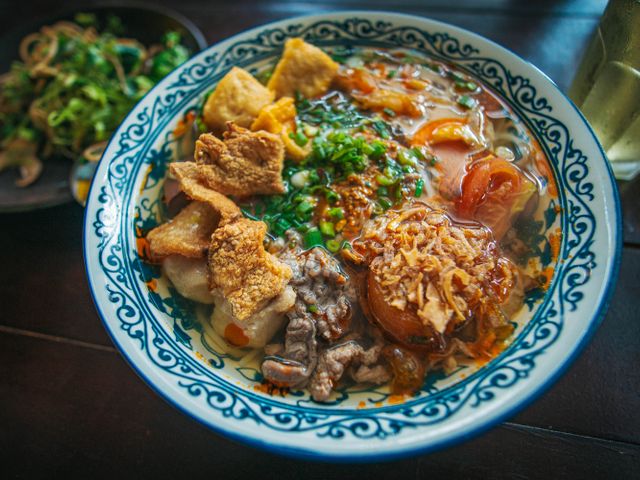



Find more like this
- Meal
- Lunch
- Cuisine
- Vietnamese
- Main ingredient
- Beef Roast
- Method
- Stovetop
- Quick & Easy
- EasyMake AheadFreezer Friendly