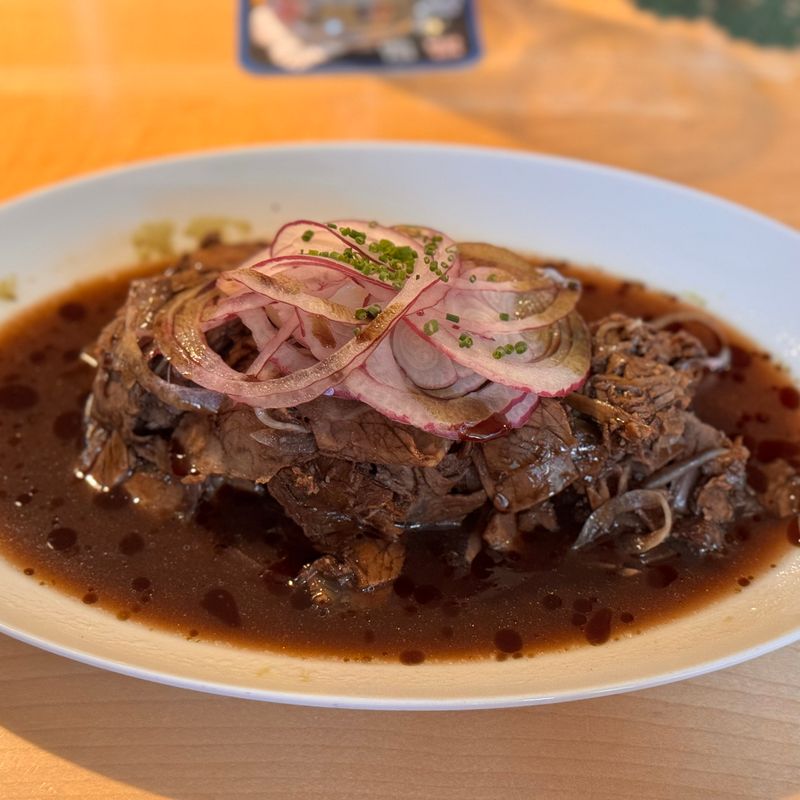
Beef Brisket and Root Vegetable Broth
A deeply flavored, homemade beef broth made by slow-simmering beef brisket with roasted root vegetables, aromatics, and herbs. The long, gentle cooking extracts gelatin and collagen, creating a silky, restorative broth that's perfect on its own or as a foundation for soups and sauces.
- Prep
- 20 min
- Cook
- 3 hr
- Wait
- 30 min
- Total
- 3 hr 50 min
- Makes
- About 2 quarts (8 cups) broth
Steps
Before you start
- Pat the brisket dry with paper towels so it browns properly
- Roughly chop vegetables—no need to peel them for broth
- Have a fine-mesh strainer or colander lined with cheesecloth ready for straining
Sear the brisket
- Heat a large heavy-bottomed pot (6–8 quart) over medium-high heat until hot.
- Place the whole beef brisket in the pot and sear for 4–5 minutes on the first side until deeply browned.
- Flip and sear the second side for another 4–5 minutes.
- The goal is a rich crust on both sides; this builds the broth's depth.
- Transfer the brisket to a plate.
+ Show details− Hide details
Ready when: Brisket has a deep brown crust on both sides
Tip: Do not skip searing—this develops the rich flavor backbone of your broth.
Prepare vegetables for roastingOven 425°F / 220°C
- While the brisket sears, spread carrots, parsnips, turnips, onion halves, and smashed garlic on a baking sheet.
- Toss lightly with a pinch of salt.
- Place in a 425°F (220°C) oven for 15–18 minutes, stirring halfway through, until the vegetables are caramelized and tender at the edges.
- This roasting step deepens the broth's sweetness and umami.
+ Show details− Hide details
Ready when: Vegetables are golden-brown and softened at the edges
Tip: Roasting before simmering adds a sweet, complex backbone to the broth. Don't skip this step.
Deglaze the pot
- With the brisket seared, the pot may have caramelized bits stuck to the bottom.
- Add 1 cup of cold water and scrape the bottom with a wooden spoon for 1–2 minutes, loosening all browned bits.
- These caramelized solids add tremendous depth to the broth.
- Leave the liquid and bits in the pot.
+ Show details− Hide details
Ready when: All brown bits are loosened and incorporated into the liquid
Tip: Deglazing captures every drop of flavor from the seared meat.
Assemble the broth pot
- Return the seared brisket to the pot on top of the deglazing liquid.
- Add the roasted vegetables and all their caramelized bits from the baking sheet.
- Pour in the remaining 11 cups of cold water until the brisket is covered by about 2 inches.
- Add the bay leaves, thyme sprigs, and black peppercorns.
+ Show details− Hide details
Tip: Cold water helps extract more gelatin and collagen from the brisket during the gentle simmer.
Bring to a boil, then reduce heat
- Bring the pot to a boil over high heat, about 8–10 minutes.
- As soon as a rolling boil begins, reduce the heat to low so the liquid simmers very gently—you should see only occasional bubbles breaking the surface.
- This gentle approach keeps the broth clear rather than murky.
+ Show details− Hide details
Ready when: Pot reaches a rolling boil
Tip: A gentle simmer, not a rolling boil, yields a clearer, more refined broth.
Skim and maintain gentle simmer
- Once simmering, skim any foam, scum, or impurities that rise to the surface for the first 5–10 minutes using a spoon or skimmer.
- This clarifies the broth.
- Then adjust the heat to maintain a bare simmer—just a few bubbles rising occasionally.
- Partially cover the pot with a lid, leaving it slightly ajar so some steam escapes.
+ Show details− Hide details
Ready when: Surface is clear and only a few small bubbles emerge occasionally
Tip: Skim impurities early for the clearest, cleanest-tasting broth.
Simmer the broth
- Maintain a gentle simmer for 3 hours total.
- The brisket should become very tender—it will shred easily with a fork when done.
- At the 2.5-hour mark, you can test doneness by piercing the meat with a fork; it should slide through with almost no resistance.
- Resist the urge to stir often; let it be.
- The long, slow cooking extracts gelatin, collagen, and all the deep savory flavors.
+ Show details− Hide details
Ready when: Brisket shreds easily with a fork; broth is rich and full-bodied
Tip: Do not boil—a gentle simmer yields a clearer, silkier broth with better extraction of gelatin.
Strain the broth
- Line a fine-mesh strainer or colander with cheesecloth and set it over a large bowl.
- Carefully pour the broth through the cheesecloth, allowing it to drip slowly.
- You can gently press the vegetables and meat to extract a bit more liquid, but do not force them through—you want a clear broth.
- Discard the solids (brisket, vegetables, herbs, peppercorns).
+ Show details− Hide details
Ready when: Broth has drained completely and is clear to golden in color
Tip: A cheesecloth filter ensures a crystal-clear, refined broth. Patience here pays off.
Cool and degrease (optional)
- Let the strained broth cool to room temperature, about 30 minutes.
- Once cool, a layer of fat will solidify on the surface.
- For a lighter broth, use a fine-mesh spoon or skimmer to lift off and discard the fat layer.
- Alternatively, refrigerate the broth overnight; the fat will harden into a thick layer that lifts off easily.
- You may leave the fat for more richness and mouthfeel—that's a matter of preference.
+ Show details− Hide details
Ready when: Fat layer is opaque and can be lifted or spooned off
Tip: Keeping the fat adds richness and body; removing it yields a lighter, more delicate broth.
Season to taste
- Return the broth to the pot and reheat over medium heat until steaming, about 5 minutes.
- Taste and season with kosher salt and freshly cracked black pepper.
- Start with about 2 teaspoons of salt and adjust to your preference.
- The broth should be savory and deep but not oversalted.
- Serve hot, or cool and store.
+ Show details− Hide details
Ready when: Broth is steaming and well-seasoned to your taste
Tip: Season at the very end after straining and cooling—the flavors will have concentrated, and salt can be adjusted precisely.
Good to know
Tips
- Roasting the root vegetables before simmering adds depth and sweetness without adding sugar or other ingredients. Don't skip this step.
- A gentle simmer—not a rolling boil—keeps the broth clear and extracts maximum gelatin without emulsifying fat into the liquid.
- If you have a meat thermometer, the brisket is done at 190–200°F (88–93°C) internal temperature, which ensures it's tender enough to shred.
- Homemade broth freezes beautifully in ice cube trays (1 ounce per cube) for easy portioning in sauces, soups, and gravies.
Make ahead
This recipe is ideal for make-ahead cooking. Prepare the broth up to 5 days in advance, cool, and refrigerate in an airtight container. The flavor actually improves slightly as it sits. You can also freeze the cooled broth for up to 3 months.
Storage & reheating
Room temperature: Cool and use within 2 hours. Refrigerator: Store in an airtight container for up to 5 days. Freezer: Freeze in airtight containers or ice cube trays for up to 3 months. To reheat: Thaw in the refrigerator overnight, then warm gently over medium heat on the stovetop, or thaw and reheat in the microwave in 2–3 minute intervals, stirring occasionally.
Substitutions
- turnips → parsnip (increase parsnip to 4 medium, 470 g) or rutabaga. Turnips add mild earthiness and sweetness, but parsnips or rutabaga can replace them if unavailable. Adjust vegetable ratios slightly to maintain the 3-lb total weight.
- parsnips → celery root or additional carrot. Parsnips contribute subtle sweetness and body. Celery root or extra carrot work well but will shift the flavor profile slightly.
- beef brisket, untrimmed (with fat cap) → beef chuck or beef bones (2 lbs knuckle bones plus 1 lb chuck). Brisket is fattier and yields a silkier broth. Chuck or bones work but produce a thinner, less rich result. Use bones primarily for a lighter, clear broth.
- fresh thyme sprigs → rosemary (2 sprigs) or oregano (2 teaspoons dried). Fresh thyme provides classic herbal notes. Rosemary is more assertive; oregano adds Mediterranean warmth. Use half the amount if dried.
More broths
See all →
Find more like this
- Meal
- Dinner
- Main ingredient
- Beef Roast
- Method
- Stovetop
- Quick & Easy
- EasyMake AheadFreezer Friendly