Crab Shell and Corn Broth
A golden, aromatic broth made by simmering crab shells and corn cobs with aromatics and Old Bay seasoning. This is an excellent way to extract flavor from crab trimmings and corn husks, yielding a broth that's rich enough to serve as a light soup or refined enough to use as a base for seafood risotto, chowder, or sauce. The corn adds subtle sweetness that balances the brininess of the crab.
- Prep
- 15 min
- Cook
- 45 min
- Total
- 1 hr
- Makes
- About 1 quart (4 cups) broth
Steps
Before you start
- Have crab shells cleaned of any internal organs or gills (keep the shells themselves)
- Corn cobs should be cut into halves or thirds to fit in your pot
- Use a stockpot large enough to hold all ingredients with water coverage
- Gather all aromatics and seasoning before starting
Combine shells and cobs
- Add crab shells, corn cobs, onion halves, and garlic cloves to a 6- to 8-quart stockpot.
- Pour cold water over everything so the solids are fully submerged by about 2 inches (5 cm).
- This slow start with cold liquid helps extract the maximum flavor from the shells.
+ Show details− Hide details
Tip: Starting with cold water instead of hot water prevents the proteins from seizing too quickly and sealing in the pot.
Bring to boil, skim scum
- Place the pot over medium-high heat (about 7 out of 10) and bring to a gentle boil, watching carefully.
- As the liquid heats, a gray or tan foam (impurities) will rise to the surface.
- Using a skimming spoon or ladle, gently skim off all the foam and discard for the first 5–7 minutes after boiling begins.
- This step creates a clear, clean-tasting broth.
+ Show details− Hide details
Ready when: Broth is at a gentle boil and foam has stopped rising noticeably
Tip: Don't let the broth boil vigorously or the shells will break apart and cloud the liquid. A gentle rolling boil is perfect.
Add seasoning
- Once most scum is removed, stir in Old Bay seasoning, bay leaf (if using), and black peppercorns.
- Reduce heat to medium-low (about 3 out of 10) so the broth simmers gently with just a few bubbles breaking the surface every second or two.
+ Show details− Hide details
Tip: Add Old Bay early so its flavors infuse throughout the simmering time. If added at the end, it tastes harsher.
Simmer the broth
- Maintain a gentle simmer, uncovered, for 35–40 minutes.
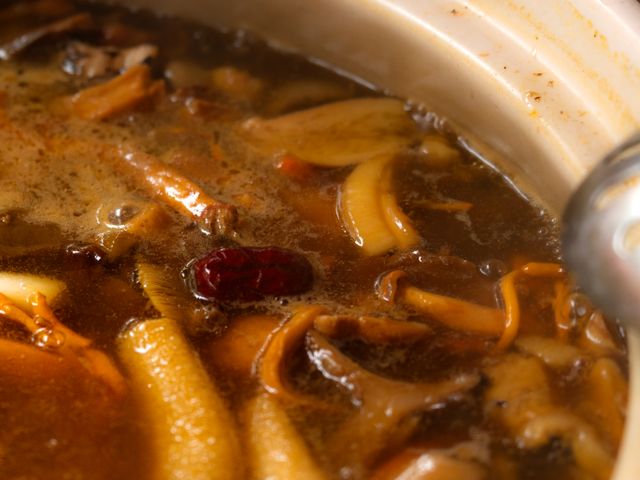
- The broth should smell rich and briny, and the liquid will deepen to a pale golden or amber color.
- The corn cobs will soften and the shells will have released their essence into the water.
- Do not stir; just let it bubble gently.
+ Show details− Hide details
Ready when: Broth is pale golden to amber and aromatic; shells are soft enough to break easily with a spoon
Tip: Resist the urge to simmer longer—over 45 minutes, the shells can begin to impart a slightly bitter or muddy taste.
Strain broth
- Remove the pot from heat and let it cool for 2–3 minutes until it's safe to handle.
- Set a fine-mesh strainer lined with cheesecloth or a dampened coffee filter over a large bowl.
- Carefully pour the broth through the strainer, allowing all liquid to drain.
- Discard the solids (shells, cobs, aromatics).
+ Show details− Hide details
Ready when: All broth has passed through the strainer and solids are discarded
Tip: Line your strainer with a damp cloth or coffee filter to catch fine particles that cloud the broth. If the broth is too cloudy, strain it again through cheesecloth.
Taste and season
- Pour the strained broth into a clean pot and bring to a bare simmer over medium heat.
- Taste the broth carefully (it will be hot).
- Add kosher salt to taste—typically 1/2 to 1 teaspoon (3–6 g)—and adjust Old Bay if desired.
- The broth should taste clearly of crab and corn with a hint of spice and brine, not overpowering.
+ Show details− Hide details
Ready when: Broth tastes balanced and flavorful
Tip: Taste as you season—Old Bay contains salt, so the broth may need only a little additional seasoning. You can always add more, but you cannot remove salt once added.
Good to know
Tips
- Save crab shells and corn cobs in the freezer as you accumulate them. When you have enough, thaw and make this broth. It's a zero-waste way to use scraps.
- If you don't have cheesecloth, use a fine-mesh strainer lined with a dampened coffee filter or a clean kitchen towel (double-layer), though this may slow the straining process.
- Crab shells from live blue crabs, Dungeness crabs, or king crabs all work. Use shells from crabs you've cooked and cleaned; do not use shells from raw crabs.
- This broth is the perfect foundation for crab bisque, corn and crab chowder, seafood risotto, or a simple broth bowl garnished with fresh crab meat and corn kernels.
Make ahead
Yes. Strain the broth, cool to room temperature, and refrigerate in an airtight container for up to 4 days. You can also freeze it for up to 3 months in ice cube trays (for small portions) or freezer containers. Thaw in the refrigerator overnight and gently reheat over medium heat before serving or using in another recipe.
Storage & reheating
Room temperature: cool completely and use within 2 hours (not recommended). Refrigerator: in an airtight container, up to 4 days. Freezer: in airtight freezer bags or containers, up to 3 months. Reheat gently over medium heat or in the microwave, stirring occasionally, until steaming. Do not boil vigorously once thawed, as this can cloud the broth.
Substitutions
- Old Bay seasoning → 1 tablespoon (5 g) each of paprika and celery salt plus 1/2 teaspoon (1 g) each of mustard powder, cayenne, and black pepper. Combine into a seasoning blend to approximate Old Bay's warm, spiced flavor profile.
- corn cobs (from fresh corn, kernels removed) → fresh corn husks (about 6–8 husks from 3 ears of corn), roughly torn, or omit entirely for a pure crab broth. Corn husks give a subtle corn flavor without the bulk of cobs; the broth will be slightly less sweet if omitted.
- bay leaf → 1/2 teaspoon (0.5 g) dried thyme or a 2-inch (5 cm) strip of dried kelp. Thyme adds earthiness; kelp reinforces the ocean flavor. Either is optional.
- crab shells (from 2–3 whole crabs or equivalent trimmed shells) → shrimp shells or lobster shells (or a mix), same weight. Other crustacean shells make excellent broth with a slightly different flavor. Shrimp will be lighter and more delicate; lobster richer and sweeter.