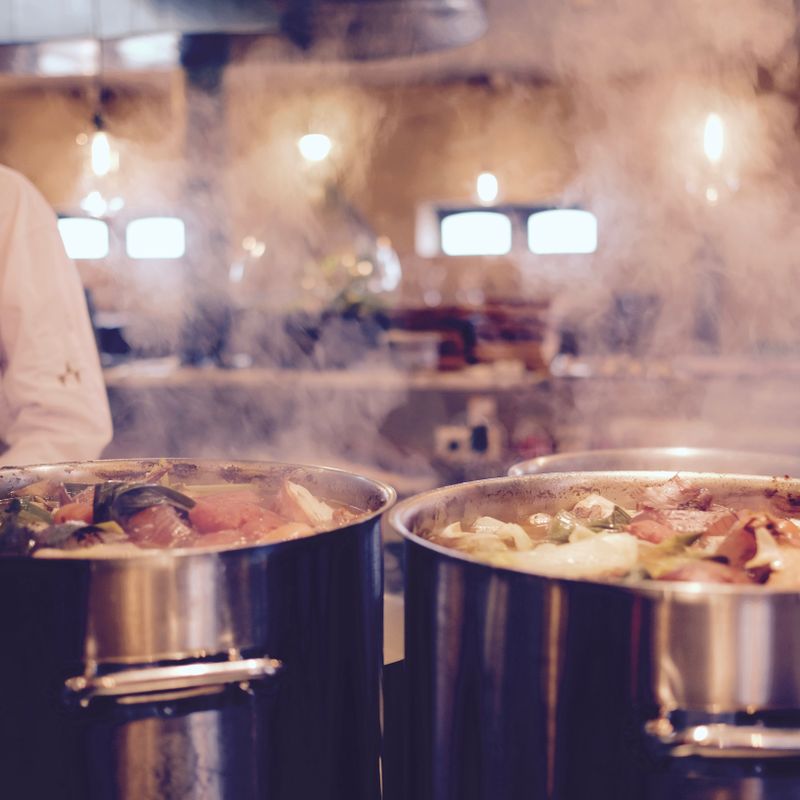
Instant Pot Turkey Stock
Turn a leftover roast turkey carcass into deeply savory, collagen-rich stock. Lightly browned vegetables, a splash of vinegar and a natural release give a clear, golden stock for soups, gravy and stuffing. It needs about 1 hour 50 minutes of mostly hands-off cooking (pressure build, 60 minutes under pressure, natural release), plus about 4½ hours of cooling and chilling, so plan for roughly 7 hours start to finish.
- Prep
- 42 min
- Cook
- 1 hr 53 min
- Wait
- 4 hr 30 min
- Total
- 7 hr 5 min
- Makes
- About 6 cups (1.4 L) stock, or six 1-cup (240 ml) servings; expect 6–7 cups before skimming the fat
Steps
Before you start
- Use the carcass from a roasted 12–14 lb (5.5–6.5 kg) turkey, which usually weighs 2½–3 lb (1.1–1.4 kg) once the meat is pulled off. Weigh it; if it is under 2½ lb, add a raw or roasted turkey wing or neck. Leave the skin, small bits of meat and pan-stuck browned bits on the bones.
- This recipe is sized for a 6-quart (5.7 L) Instant Pot. The PRESSURE COOK max line (two-thirds full, about 4 quarts or 16 cups) must never be passed, so break the carcass into small pieces before loading.
- Timeline: about 20 minutes to come to pressure, 60 minutes cooking, 25 minutes natural release, then straining, a 30-minute ice bath and at least 4 hours in the fridge. Strain and start cooling right after the release so the stock is not left in the danger zone.
- Clear fridge space for shallow containers, and set out ice and a thermometer for the cooling step.
- If the carcass has been in the fridge, use it within 3–4 days of roasting, or freeze it until you are ready.
Prep the carcass
- Break or cut the turkey carcass into 5–6 pieces with kitchen shears or by hand, snapping the rib cage and backbone so the pieces nest in the pot.
- Quarter the onions, cut the carrots and celery into 2-inch (5 cm) pieces and smash the garlic, if using.
+ Show details− Hide details
Ready when: Pieces are small enough to sit well below the max fill line.
Tip: Remove any stuffing or herb butter clinging to the carcass; it clouds and over-salts the stock.
Brown the vegetables
- Select SAUTÉ on High (More).
- Add the oil to the inner pot and heat for 1 minute.
- Add the onions (cut side down), carrots and celery.
- Cook, stirring only every 2 minutes, for 6–8 minutes.
+ Show details− Hide details
Ready when: Vegetable edges are golden brown in spots and smell sweet and toasty.
Tip: If the bottom of the pot starts to scorch, add a splash of the water and scrape it up. Stuck bits can trigger a burn warning.
Load the pot
- Press CANCEL.
- Add the turkey pieces on top of the vegetables, then the garlic, peppercorns, bay leaves, thyme and parsley stems, if using.
- Add the vinegar, then pour in 8 cups (1.9 L) cold water.
- Scrape up any browned bits on the bottom.
- The bones should be mostly covered, and the contents must sit below the PRESSURE COOK max line.
+ Show details− Hide details
Ready when: Everything sits at or below the max line (two-thirds full) and the bones are mostly submerged.
Tip: If the contents pass the max line, ladle out some water or break the bones smaller. If a bone tip pokes out, press it down; never add water to cover it. The vinegar helps draw out collagen and won't taste sour.
Pressure cook
- Lock the lid and set the valve to Sealing.
- Select PRESSURE COOK (Manual) on High and set 60 minutes.
- The pot takes about 20 minutes to build pressure before the countdown starts.
- When the 60 minutes end, press CANCEL so the pot does not sit on Keep Warm.
+ Show details− Hide details
Ready when: The float pin has risen and the display counts down from 60 minutes; at the end it beeps.
Tip: If the pot doesn't reach pressure after 30 minutes, check that the sealing ring is seated and the valve is on Sealing.
Natural release
- Leave the pot undisturbed so pressure drops on its own for 25 minutes.
- If the pin has not dropped by then, carefully turn the valve to Venting with a long spoon, keeping your hands and face away from the steam.
- Open the lid only when the pin is down.
+ Show details− Hide details
Ready when: Float valve pin has dropped and the lid turns freely.
Tip: A quick release can spray fatty liquid out of the valve and cloud the stock.
Strain the stock
- Set a fine-mesh strainer over a large heatproof bowl or pot.
- Use tongs to lift out the large bones and vegetables and discard them.
- Ladle or pour the stock through the strainer right away, without letting it sit in the pot.
- For extra-clear stock, strain a second time through a strainer lined with cheesecloth or a coffee filter.
- Don't press on the solids.
+ Show details− Hide details
Ready when: Stock is deep golden to amber with no bits of bone or vegetable. You should have about 6–7 cups (1.4–1.65 L).
Tip: Pressing the solids pushes through fine particles that make the stock cloudy.
Divide and ice-bath
- Right away, ladle the hot stock into shallow containers, filling each no more than 2–3 inches (5–7.5 cm) deep.
- Set them uncovered in a roasting pan or sink with a few inches of ice water and stir every 5–10 minutes for about 30 minutes.
- Stock must reach 70°F (21°C) within 2 hours of coming off the heat.
- Once it reads 70°F (21°C) or below on a thermometer, move on to chilling.
+ Show details− Hide details
Ready when: An instant-read thermometer reads 70°F (21°C) or lower.
Tip: Don't put a big pot of hot stock straight in the fridge; it cools too slowly and can warm other food.
Chill and skim fat
- Cover the containers and refrigerate for at least 4 hours or overnight.
- The stock must reach 40°F (4°C) within 4 hours of hitting 70°F (21°C).
- Lift off the layer of solidified fat with a spoon and discard it or save it for cooking.
+ Show details− Hide details
Ready when: A firm white fat layer sits on top, and the stock reads 40°F (4°C) or below. It may be syrupy or softly jiggly, which means it is rich in collagen.
Tip: Stock from this much bone may only set lightly. Even if it stays liquid, it is still flavorful.
Season and store
- Taste the stock.
- It should taste rich and savory.
- Leave it unsalted if you plan to reduce it or use it in gravy or soup, or stir in kosher salt, 1/4 teaspoon at a time, if you will sip it.
- Label containers with the date and store as directed below.
+ Show details− Hide details
Ready when: Stock tastes savory and balanced, not flat.
Tip: Salt the dish you cook with the stock, not the stock itself, so you keep control of the final seasoning.
Good to know
Tips
- Skip cruciferous vegetables (cabbage, broccoli), beets and bitter greens; they turn the stock sulfurous or muddy in color.
- For a richer, more gelatinous stock, add a turkey neck, wing tips or leftover pan juices in place of some water, staying under the max line. Don't add extra water for a lighter stock; the pot may overfill.
- Freeze some stock in 1/2-cup (120 ml) portions or ice cube trays for pan sauces and deglazing.
- Keep the lid's sealing ring clean. Stock can leave a lingering odor, so wash the ring and lid well or air them out afterward.
Make ahead
Make the stock up to 4 days ahead and keep it refrigerated, or freeze it for up to 6 months, so Thanksgiving gravy and soup are ready to go.
Storage & reheating
Refrigerator: up to 4 days in airtight containers. Freezer: up to 6 months in freezer-safe containers or bags, leaving 1 inch (2.5 cm) of headspace for expansion; ice cube trays or muffin tins give handy portions. Do not leave stock at room temperature after cooling. Thaw overnight in the fridge. Reheat every time in a saucepan over medium-high heat until it reaches a full rolling boil (at least 165°F / 74°C), and boil for 1 minute before using.
Substitutions
- cooked turkey carcass → 2½ lb (1.1 kg) raw turkey wings or necks. Roast at 425°F (220°C) for 30 minutes first for better color and flavor. The stock will be especially gelatinous.
- apple cider vinegar → 1 tbsp (15 ml) lemon juice or white wine vinegar. Either one helps extract collagen and won't be noticeable in the finished stock.
- celery stalks → 1 small fennel stalk or a 2-inch (5 cm) piece of celery root. Gives a similar mild, aromatic background.
- fresh thyme sprigs → 1/2 tsp dried thyme. Add it with the peppercorns; dried herbs are stronger than fresh.
More broths
See all →

Find more like this
- Meal
- Dinner
- Cuisine
- American
- Main ingredient
- Leftover Turkey
- Method
- Instant Pot
- Quick & Easy
- EasyMake AheadFreezer FriendlyBudget
- Occasion
- Thanksgiving