
Classic Awase Dashi (Kombu and Bonito Broth)
A clear, golden Japanese stock made by steeping kombu in water, gently warming it, then briefly steeping bonito flakes. Light, savory and full of umami, it is the base for miso soup, noodle broths, and simmered dishes.
- Prep
- 5 min
- Cook
- 15 min
- Wait
- 40 min
- Total
- 1 hr
- Makes
- About 4 cups (950 ml) dashi
Steps
Before you start
- Start at least 30 minutes ahead so the kombu can soak; for deeper flavor, soak it in the fridge for 8 hours or overnight and skip the 30-minute soak.
- Use filtered or soft water if your tap water is hard or heavily chlorinated; it gives a cleaner, clearer dashi.
- Do not wipe off the white powder on the kombu; it is flavorful mannitol and glutamates. Just brush off any visible grit with a dry or barely damp cloth.
- Have a fine-mesh sieve and a bowl or pot ready for straining before you add the bonito.
Prep the kombu
- Use a dry or barely damp cloth to brush any visible grit from the 15 g piece of kombu, leaving the white powder.
- With kitchen scissors, snip 2 or 3 shallow slits along the edges (not all the way through) to help release flavor.
+ Show details− Hide details
Ready when: Kombu is dusty-white on the surface with no visible dirt.
Tip: Never rinse kombu under running water; you would wash away flavor.
Soak the kombu
- Put the kombu and 4.5 cups (1065 ml) cold water in the saucepan.
- Let it soak at room temperature for 30 minutes (or cover and refrigerate 8 hours for a deeper flavor).
+ Show details− Hide details
Ready when: Kombu is soft and pliable and has slightly expanded; the water looks faintly golden.
Tip: Starting in cold water extracts umami gently without bitterness.
Warm slowly
- Set the pan over medium-low heat.
- Heat for 8 to 10 minutes, until tiny bubbles form around the edges of the pan and on the kombu and the water is steaming, about 140–175°F (60–80°C) or just below a simmer.
+ Show details− Hide details
Ready when: Small bubbles rise from the bottom of the pan and the surface just begins to shimmer, but the water is not boiling.
Tip: Boiling kombu makes the broth slimy and bitter, so keep it below a simmer.
Remove the kombu
- Just before the water would boil, lift out the kombu with tongs or chopsticks and discard it (or save it for a second dashi or tsukudani).
- Bring the water to a gentle boil over medium heat, about 2 minutes.
+ Show details− Hide details
Ready when: Kombu is removed and the water reaches a gentle boil with a few steady bubbles.
Tip: If the kombu is left in at a boil, bitterness and sliminess creep in.
Steep the bonito
- Turn off the heat.
- Add all the bonito flakes in one scatter over the surface and let them sink on their own, without stirring.
- Steep for 2 minutes only.
+ Show details− Hide details
Ready when: Most flakes have sunk to the bottom and the liquid is a clear pale gold.
Tip: Don't stir or steep longer than 2 to 3 minutes, which makes the dashi fishy and cloudy.
Strain gently
- Set the sieve (lined with a paper towel or cheesecloth for extra clarity) over the heatproof bowl.
- Pour the dashi through slowly.
- Let it drip freely for a minute or two.
+ Show details− Hide details
Ready when: Dashi in the bowl is clear and light golden with a gentle smoky-ocean aroma.
Tip: Don't press on the flakes; squeezing releases bitter, cloudy liquid.
Taste and use
- Taste a spoonful warm; it should be savory, delicate, and clean, with no bitterness.
- You should have about 4 cups (950 ml).
- Use right away for miso soup, noodle broth, or simmered dishes, or cool and store.
+ Show details− Hide details
Ready when: Flavor is balanced and savory with a clean finish.
Tip: Dashi is meant to be subtle; seasoning with salt, soy sauce, or miso comes later in the dish.
Good to know
Tips
- Keep the heat gentle: the kombu should never boil, and the bonito should steep off the heat.
- Reuse the spent kombu and bonito for a weaker 'niban dashi': simmer them in 3 cups (700 ml) water for 10 minutes and strain.
- Seasoning is done later: dashi is unsalted, so add salt, soy sauce, or miso in the final dish.
- For the clearest dashi, strain through a paper towel-lined sieve and never squeeze the flakes.
Make ahead
"Dashi can be made up to 3 days ahead and refrigerated. The kombu can be soaked in the fridge overnight (up to 12 hours) before you heat it."
Storage & reheating
"Cool completely, then refrigerate in a covered container up to 3 days. Freeze up to 1 month (ice cube trays work well for small portions). Thaw in the fridge or warm gently in a saucepan over low heat until steaming; do not boil hard."
Substitutions
- katsuobushi (dried bonito flakes) → Dried shiitake mushrooms (about 3 medium) for vegan dashi. Soak them with the kombu in the cold water; skip the bonito step. The flavor is earthier and sweeter.
- dried kombu → Omit kombu and use only bonito (katsuobushi dashi). Simmer 20 g bonito in 4 cups water for 2 minutes. The result is more fish-forward with less depth.
- cold filtered water → Spring water. Use any mild bottled spring water if your tap water is hard.
More broths
See all →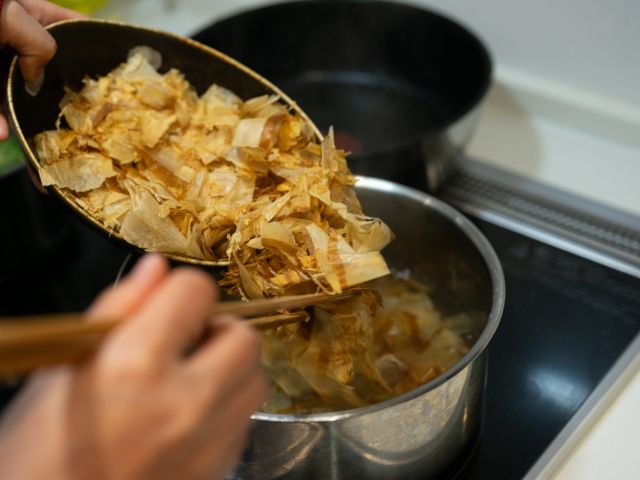


Find more like this
- Meal
- Lunch
- Cuisine
- Japanese
- Method
- Stovetop
- Quick & Easy
- 5 Ingredients or LessEasyMake Ahead