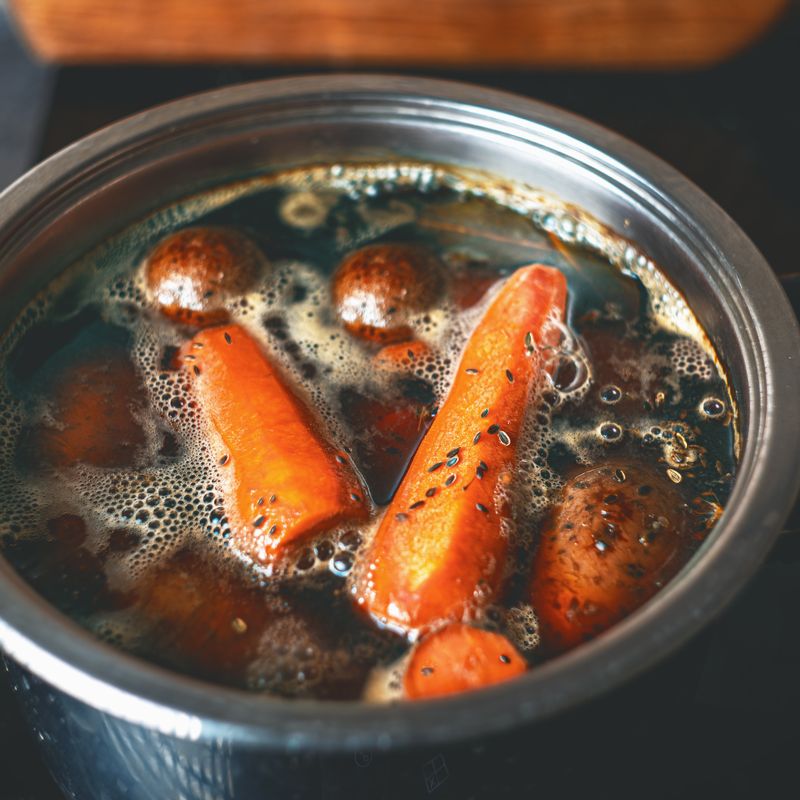
Roasted Vegetable Broth
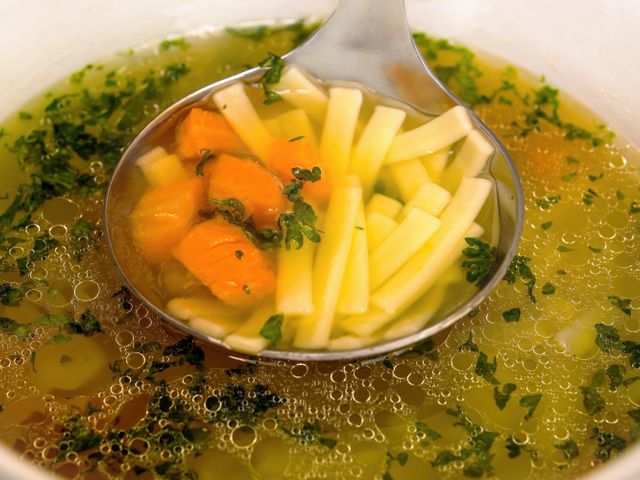
A deeply golden, French-style vegetable broth built on oven-roasted carrots, onions, parsnips and garlic, then gently simmered with thyme, bay and parsley. Savory, lightly sweet and clear enough to sip or use in soups, risottos and sauces.
- Prep
- 32 min
- Cook
- 1 hr 57 min
- Wait
- 20 min
- Total
- 2 hr 49 min
- Makes
- About 7 cups (1.7 liters) broth, 8 servings of about ¾ cup (200 ml) each
Steps
Before you start
- Position an oven rack in the center and preheat to 425°F (220°C).
- Scrub the vegetables well but do not peel them; clean skins add color. Peel the parsnips only if the skin is thick or waxy.
- Leave the onion skins on if they are clean: they give the broth a deeper amber color.
- Use a 6-quart (5.5 L) pot so the water covers the vegetables with room to spare.
Preheat and prepOven 425°F / 220°C
- Place a rack in the center of the oven and heat to 425°F (220°C).
- Scrub the carrots, parsnips and onions.
- Cut the carrots, parsnips and celery into 2-inch (5 cm) chunks, quarter the onions through the root with skins on, and cut the leek into 2-inch pieces after rinsing out any grit.
- Slice the top off the garlic head.
+ Show details− Hide details
Ready when: Vegetables are in large, similar-sized pieces so they roast evenly.
Tip: Keep pieces large; small ones burn before the big ones brown.
Toss with oil
- On an 18×13-inch rimmed baking sheet, toss the carrots, parsnips, onions, celery and leek with the olive oil and ½ teaspoon of the salt.
- Spread in a single layer, with the garlic head cut side down in the center.
- Do not crowd; use a second sheet if the vegetables overlap.
+ Show details− Hide details
Ready when: All pieces are glossy with oil and in one layer.
Tip: Crowded vegetables steam and turn pale instead of caramelizing.
Roast the vegetablesOven 425°F / 220°C
- Roast at 425°F (220°C) for 25 minutes.
- Remove the pan, stir the vegetables and flip them, then dot the tomato paste in small spoonfuls over the pan.
- Return to the oven and roast 15 to 20 minutes more.
+ Show details− Hide details
Ready when: Edges of the carrots, parsnips and onions are deep golden brown with dark spots, the garlic is soft, and the tomato paste has darkened to brick red.
Tip: Dark brown is good, but black, bitter edges will make the broth bitter, so trim any charred bits.
Transfer to the pot
- Scrape all the roasted vegetables and the garlic into a 6-quart (5.5 L) stockpot.
- Add ¼ cup (60 ml) of the water to the hot baking sheet and scrape up the browned bits with a spatula, then pour this into the pot.
+ Show details− Hide details
Ready when: The baking sheet is mostly clean, with the browned bits dissolved in the liquid.
Tip: Those browned bits hold a lot of flavor, so do not skip this.
Add aromatics and water
- Add the thyme sprigs, parsley stems, bay leaves and peppercorns.
- Pour in the remaining cold water (about 9¾ cups / 2.3 L) so the vegetables are covered by about 1 inch (2.5 cm).
+ Show details− Hide details
Ready when: Vegetables are fully submerged.
Tip: Start with cold water so flavor extracts gradually and the broth stays clearer.
Bring to a simmer
- Set the pot over high heat and bring it up to a bare simmer, about 12 minutes.
- As soon as small bubbles break the surface, reduce the heat to low.
- Skim off any foam with a spoon.
+ Show details− Hide details
Ready when: The surface shows a few gentle bubbles, not a rolling boil.
Tip: A hard boil clouds the broth and can make it taste harsh.
Simmer gently
- Simmer uncovered, with the heat low enough that only a few bubbles rise every second, for 60 minutes.
- Stir once or twice.
- Do not press on the vegetables.
+ Show details− Hide details
Ready when: The broth is deep amber, smells sweet and savory, and the volume has reduced by about one-fifth, to roughly 8 cups before straining. The carrots taste mild when sampled.
Tip: Do not simmer much longer than 75 minutes; parsnips and onions can turn the broth bitter or muddy.
Strain the broth
- Set a fine-mesh strainer over a large heatproof bowl or clean pot.
- Carefully ladle or pour the broth through.
- Let it drain for 5 minutes, gently pressing once with a spoon to release the liquid.
- Discard the solids.
+ Show details− Hide details
Ready when: The strained broth is clear amber with no bits of vegetable.
Tip: Squeeze the garlic from a few cloves into the broth if you want a mellow garlic flavor.
Season and cool
- Stir in the remaining 1 teaspoon salt, taste, and add more a pinch at a time until the flavor tastes round and bright.
- Let it cool at room temperature for about 15 minutes, then divide into shallow containers and refrigerate or freeze.
- Do not leave it out longer than 2 hours.
+ Show details− Hide details
Ready when: Broth tastes lightly salty and sweet, like a well-seasoned soup.
Tip: Cool in shallow containers to chill faster and safely.
Good to know
Tips
- Roast until deeply browned, not pale, because roasting is the main source of color and flavor in this broth.
- Avoid cruciferous vegetables such as cabbage and broccoli, and starchy potatoes, which can make the broth sulfurous or cloudy.
- Salt lightly at the end so you can season the final dish yourself; the broth concentrates if you reduce it.
- Freeze in 1-cup (250 ml) portions or in ice cube trays for easy use.
Make ahead
The broth can be made up to 4 days ahead and kept refrigerated, or frozen for 3 months. The flavor settles and improves after a night in the fridge.
Storage & reheating
Room temperature: no more than 2 hours. Fridge: up to 4 days in airtight containers. Freezer: up to 3 months in containers or freezer bags, leaving 1 inch (2.5 cm) of headspace for expansion. Reheat on the stovetop over medium heat until steaming and just starting to bubble (165°F / 74°C); thaw frozen broth overnight in the fridge first or heat from frozen over low heat.
Substitutions
- parsnips → additional carrots or 1 small celery root (celeriac). Gives a similar sweetness; the broth will be slightly less earthy.
- leek → 1 additional small onion. Leeks add a mild sweetness, but onion works well.
- fresh thyme sprigs → 1 teaspoon dried thyme. Add it with the water; fresh gives a more delicate flavor.
- tomato paste → 1 tablespoon white miso, stirred in after straining. Adds savory depth; omit the tomato paste in the oven.
More broths
See all →


Find more like this
- Meal
- Lunch
- Cuisine
- French
- Main ingredient
- Carrots
- Quick & Easy
- EasyMake AheadFreezer Friendly