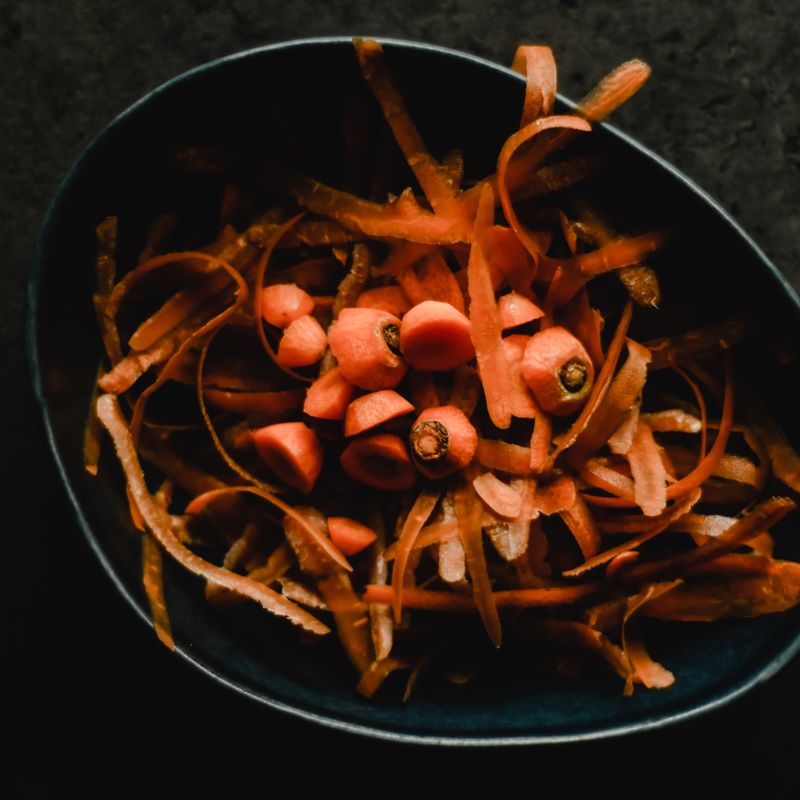
Vegetable Scrap Stock
Turn onion ends, carrot peels, celery leaves and parsley stems into a golden, savory stock with almost no cost and no waste. Lightly browning the scraps first adds depth, and a short simmer keeps the flavor clean and sweet.
- Prep
- 15 min
- Cook
- 1 hr 10 min
- Wait
- 30 min
- Total
- 1 hr 55 min
- Makes
- About 2 quarts (1.9 liters), enough for 8 cups
Steps
Before you start
- Collect scraps in a bag in the freezer over a week or two; you need about 8 packed cups (roughly 600 g). Use them straight from frozen.
- Rinse all scraps well, especially carrot peels and onion ends, to remove soil.
- Avoid bitter or strongly flavored scraps such as cabbage, broccoli, Brussels sprouts, beets (they turn the stock pink) and potato peels (cloudy).
- Do not add salt now; season the stock later when you use it in a recipe.
Heat the pot
- Set a 6-quart (5.7 L) stockpot over medium heat and add the olive oil.
- Let it warm for about 1 minute until it shimmers.
+ Show details− Hide details
Ready when: Oil shimmers and flows easily across the pot.
Brown the onions
- Add the onion ends and skins and the smashed garlic.
- Cook, stirring occasionally, for 5 to 6 minutes until the onion edges are deeply golden and the skins smell toasty.
+ Show details− Hide details
Ready when: Onion edges are deep golden brown with a toasty aroma.
Tip: Browning gives color and depth. Lower the heat if anything starts to blacken, since burnt bits taste bitter.
Add remaining scraps
- Add the carrot peels, celery leaves and parsley stems.
- Stir in the tomato paste, if using.
- Cook for 3 to 4 minutes, stirring, until the vegetables soften slightly and the paste darkens to brick red.
+ Show details− Hide details
Ready when: Celery leaves are wilted and the paste has darkened.
Add water and aromatics
- Pour in the 10 cups (2.4 L) cold water.
- Add the peppercorns and bay leaves.
- The scraps should be just covered; add a little more water if any stick up above the surface.
+ Show details− Hide details
Ready when: Scraps are fully submerged.
Tip: Starting with cold water extracts flavor more gently and gives a clearer stock.
Bring to a simmer
- Raise the heat to high and bring the pot to a boil, about 10 minutes.
- As soon as you see steady bubbles break the surface, reduce the heat to low so only a few lazy bubbles rise.
+ Show details− Hide details
Ready when: Gentle bubbles, not a rolling boil.
Tip: Boiling hard clouds the stock and can make it taste bitter.
Simmer gently
- Partially cover the pot and simmer on low for 60 minutes, stirring once or twice.
- Skim any foam if you like.
- The stock should turn amber and smell sweet and savory, and the liquid will reduce by about one-fifth.
+ Show details− Hide details
Ready when: Stock is amber, tastes rich and sweet, and the vegetables look pale and limp.
Tip: Do not simmer much beyond 90 minutes; vegetable stock can turn bitter or muddy.
Strain the stock
- Set a fine-mesh strainer over a large heatproof bowl.
- Carefully ladle or pour the stock through it.
- Press gently on the solids with the back of the spoon to release the liquid, then discard the solids or compost them.
+ Show details− Hide details
Ready when: Liquid is clear amber with no bits of vegetable.
Tip: Don't squeeze hard; that pushes sediment through and clouds the stock.
Cool and store
- Let the stock cool at room temperature for about 30 minutes, stirring occasionally, then portion into containers or jars, leaving 1 inch (2.5 cm) of headspace if freezing.
- Refrigerate once no longer steaming.
+ Show details− Hide details
Ready when: Stock is lukewarm and no longer steaming.
Tip: Don't leave stock out for more than 2 hours total.
Good to know
Tips
- Keep a labeled freezer bag for scraps and add to it as you cook; frozen scraps work without thawing.
- Mushroom stems, corn cobs and fennel trimmings add extra flavor, but keep them to about 1 cup so they don't dominate.
- Leave the onion skins on for deeper golden color.
- Taste the finished stock; if it's thin, simmer it uncovered for 10 to 15 minutes to concentrate.
Make ahead
"Make up to 4 days ahead and keep refrigerated, or freeze for up to 3 months so it's ready whenever you need it."
Storage & reheating
"Refrigerate in airtight containers for up to 5 days. Freeze for up to 3 months in containers with 1 inch (2.5 cm) headspace, or in ice cube trays for small portions. Thaw overnight in the fridge or reheat from frozen in a saucepan over medium-low heat until steaming, then season with salt as needed."
Substitutions
- celery leaves and trimmed ends → fennel fronds or leek greens. Use the same packed volume; leek greens add mild sweetness.
- parsley stems → cilantro stems or thyme sprigs. Cilantro gives a distinct flavor; use thyme sparingly (3 to 4 sprigs).
- tomato paste → 1 tablespoon (15 ml) soy sauce. Adds savory depth and color; add it with the water instead.
- onion ends and skins (yellow onion) → shallot or leek trimmings. Use equal weight; leeks should be well rinsed of grit.
More broths
See all →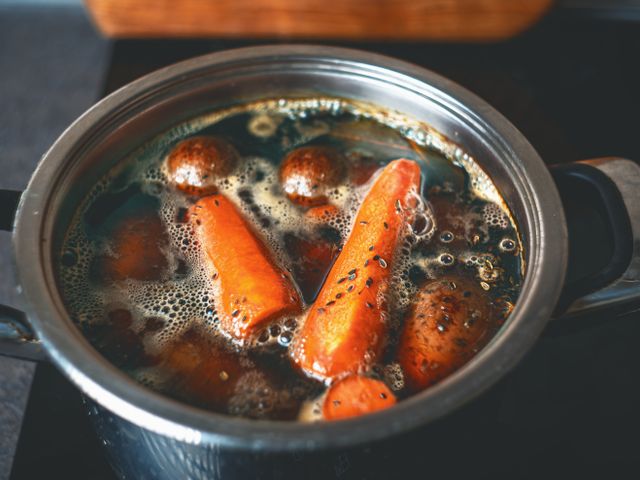
Find more like this
- Meal
- Lunch
- Main ingredient
- Carrots
- Method
- Stovetop
- Quick & Easy
- EasyOne-PotMake AheadFreezer FriendlyBudget